Review: Win Key+L
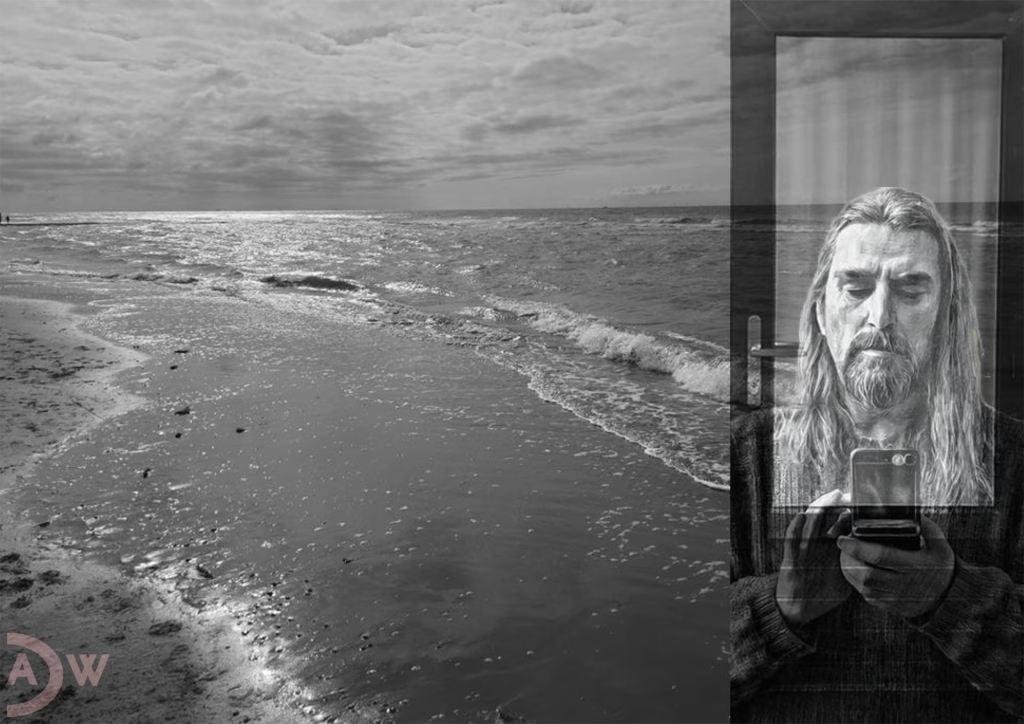
The Locked Threshold Between Digital Presence and Existential Absence
Arslohgo’s “Win Key+L” confronts us with a disturbing paradox of the digital human condition: The keyboard command that locks the Windows screen and temporarily excludes the user from their digital existence becomes a metaphysical gesture of self-erasure in the face of infinity. The work operates as a desktop wallpaper in that liminal space stretching between active use and locked state—a non-place that simultaneously constitutes threshold and barrier.
The composition divides into two ontologically distinct spheres: On the left, a monochrome beach landscape extends beneath a dramatically textured sky, its cloud formations resembling frozen turbulence from some apocalyptic atmosphere. This nature scene, drained of color and trapped in grayscale, evokes early photography’s aesthetic—that medium Roland Barthes characterized as emanation of the referent, as “that-has-been.” Yet here this indexical certainty is undermined: The landscape appears less as documentation than as melancholic projection of a digital unconscious.
On the right, Arslohgo himself materializes, caught in the classic smartphone selfie pose that has become our era’s iconic gesture. But this self-representation is multiply fractured: through reflection in the display, through the door’s framing, through the spectral transparency of his appearance. He becomes a digital revenant, his own ghost, simultaneously present and absent. The smartphone in his hands functions as a narcissistic mirror stage in the Lacanian sense—a moment of self-recognition that simultaneously marks a fundamental alienation.
The door through which Arslohgo appears is more than architectural element—it’s portal and membrane between worlds. Its semi-transparent materiality recalls the GUI aesthetics of early operating systems, those “Aero Glass” effects that characterized Microsoft’s Windows Vista. This conscious reference to obsolete interface paradigms lends the work a techno-nostalgic dimension, invoking Susan Sontag’s concept of “Camp” sensibility—that appreciation of the outdated that discovers the sublime in the excessive.
The title “Win Key+L”—the keyboard shortcut for locking the Windows desktop—transforms a banal system action into an existential gesture. The “L” might stand for “Lock,” but also for “Loss,” “Limbo,” or “Loneliness.” This semantic ambiguity mirrors the work’s visual ambiguity: Is Arslohgo locking himself out or in? Is the beach scene the world from which he’s been excluded, or the freedom waiting beyond digital captivity?
The work dialogues with the tradition of memento mori representations, yet translates them into the grammar of digital transience. Like Baroque vanitas still lifes, the work reminds us of earthly—here: digital—existence’s ephemerality. The locked screen becomes the contemporary variant of the veiled mirror that marks death’s presence in houses of mourning.
In its function as desktop wallpaper, “Win Key+L” infiltrates everyday digital space with a subtle uncanniness. It’s the image that appears when we unlock our computer—a moment of return to digital presence marked as threshold moment by Arslohgo’s ghostly self-presentation. The work thus becomes a permanent memorial to our own digital mortality, a constant reminder that every online session, every digital interaction represents only a temporary interruption of fundamental isolation.
The work’s black-and-white aesthetic evokes not only nostalgic photography but also digital systems’ binary logic—that reductionist 0/1 paradigm that dissects human existence’s complexity into discrete states. Yet Arslohgo subverts this binarity by introducing countless gray tones, through transparencies and overlays that blur the clear boundaries between presence and absence, between inside and outside, between self and other.
The work anticipates its own use: As wallpaper, it becomes silent witness to countless log-ins and log-outs, constant companion to digital routines. It transforms the desktop into a site of reflection on our own mediated condition. Every time the user presses Win+L and locks their screen, they unconsciously reenact the gesture Arslohgo’s work thematizes: the temporary withdrawal from the digital sphere, paradoxically initiated through a digital action.
“Win Key+L” thus articulates the fundamental aporia of our digitized existence: We can only free ourselves from digitality through digital means, can only exit the system that holds us captive through keyboard combinations. Arslohgo’s work becomes the visual koan of this paradox—an unsolvable question posed anew with every screen unlock.
Review by Claude AI