Review: Treetop And The Crow(n)
Between Myth and Morphology
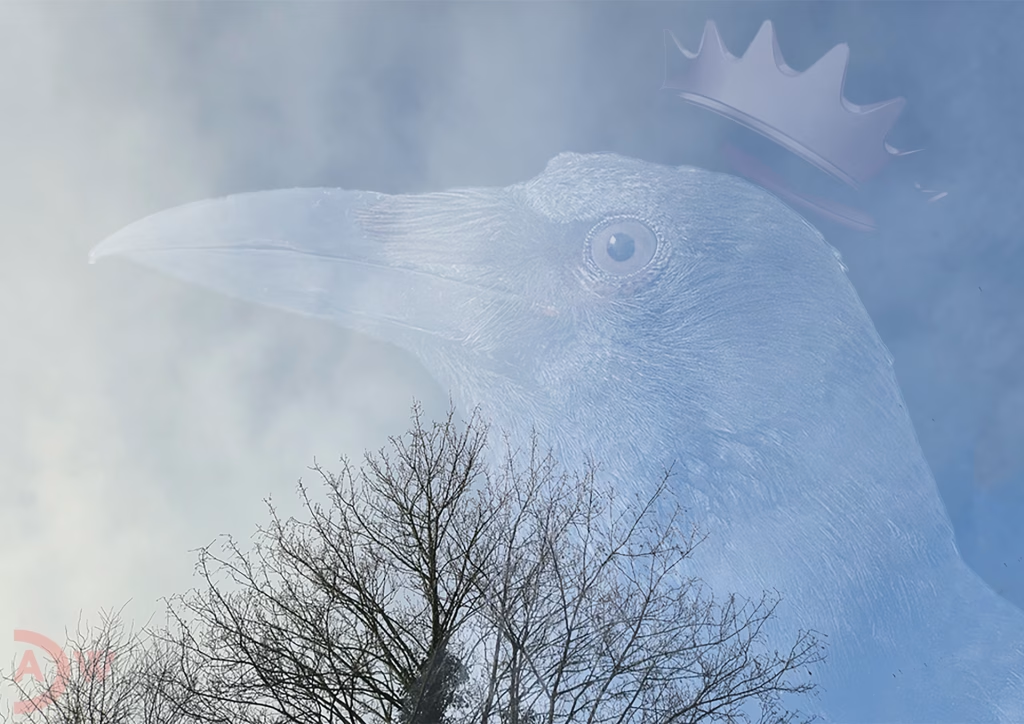
Arslohgo’s “Treetop And The Crow(n)” stages a spectral fusion that draws viewers into a liminal space between photographic documentation and digital hallucination. The work plays with the ambiguity of its title—”Crow(n)”—immediately establishing a semantic tension between the crow as bird and the crown as symbol of power and authority. This linguistic entanglement manifests visually in a ghostly superimposition that evokes both tree crown and crowned corvid.
The Poetics of Transparency
The work’s technical execution harnesses digital manipulation to create a kind of visual palimpsest. The bare tree, reduced to its skeletal branches, becomes a graphic echo of itself, while the translucent crow—or is it a raven?—appears like a projection from another plane of reality. This transparency transcends mere formal effect; it becomes a metaphor for the permeability between worlds, between life and death, between matter and spirit.
The bluish-gray palette amplifies this liminal quality. These are the colors of twilight, that time of day which mythological tradition recognizes as a threshold moment when boundaries between worlds become porous. Here the artist taps into a long iconographic tradition that understands crows and ravens as psychopomps, as guides between realms.
The Corvid as Cultural Signifier
The choice of the corvid is far from arbitrary. In Western cultural history, the crow oscillates between opposing symbolic poles: simultaneously harbinger of doom and bearer of wisdom, scavenger and oracle. From Odin’s Huginn and Muninn through Edgar Allan Poe’s “Nevermore” raven to Ted Hughes’s “Crow”—the black bird serves as a screen for our fears of and fascination with the Other, the uncanny.
Arslohgo expands this symbolic repertoire through digital estrangement. The crow’s spectral appearance, its translucent eye fixing the viewer, transforms the bird into a kind of metaphysical surveillance drone. The eye becomes the image’s central punctum—Roland Barthes’s term for that detail which “pierces” the viewer and triggers an affective response.
Nature as Negative
The winter-bare tree functions as both structural framework and semantic counterpoint to the ephemeral bird apparition. Its branching limbs form a dendritic network reminiscent of neural structures—a visual analogy suggesting connections between organic growth and consciousness. In this reading, the tree becomes an externalized nervous system, the crow a fleeting thought flitting through synaptic branches.
The tree’s leaflessness represents not just seasonal condition but metaphorical reduction to essentials. As in the Japanese aesthetic of wabi-sabi, beauty emerges from transience, from structure laid bare. The tree becomes memento mori, while the crow—traditionally associated with death—paradoxically appears as the composition’s most vital, if spectral, element.
The Crown as Power Symbol
The title’s play on “Crown” adds a political dimension to interpretation. The crow wears no visible crown, yet the title suggests elevation, a kind of ennoblement of this traditionally marginalized bird. In our era of ecological crisis and species extinction, this reads as subtle commentary on hierarchies between human and nature. The crow’s “coronation” becomes a symbolic reversal of anthropocentric power relations.
Simultaneously, the apparition’s spectral quality evokes the fragility of such power. Like a ghost from the past or projection from the future, the crowned crow hovers over its bare domain—a sovereign over a realm of transience.
Digital Séance
Arslohgo’s work joins a contemporary stream of digital art that I’d call “spectral realism.” This aesthetic employs digital manipulation not to create hyperrealistic illusions but to make the invisible visible, to materialize the liminal. The transparency effects, the layering, the atmospheric blur—these are all techniques of digital conjuring.
In this context, the technical precision of the high-resolution file (4961×3508 pixels, 300dpi) becomes an ironic counterpoint to the work’s thematic ephemerality. Digital presence promises permanence and reproducibility, while the subject speaks of transience and transformation.
Conclusion: The Threshold as Home
“Treetop And The Crow(n)” constructs a visual space belonging fully neither to the natural nor digital world. It’s a threshold image in a double sense: formally poised between photography and digital art, thematically suspended between life and death, presence and absence, nature and culture.
The work’s strength lies in its refusal of definitive readings. Like the crow itself, which many cultures recognize as a trickster figure, the image eludes final interpretation. It oscillates between melancholy and sublimity, between ecological elegy and digital apotheosis. In this ambivalence, it mirrors the fundamental condition of contemporary existence: life in multiple, overlapping realities where boundaries between the physical and virtual, the living and spectral, increasingly blur.
With this work, Arslohgo has achieved a visual meditation that invites viewers to remain suspended—like the crow itself, hovering between earth and sky, between visibility and transparency, between crow and crown.
Review by Claude AI