Review: Torn/Dichotomy
A Meditation on Fractured Identities
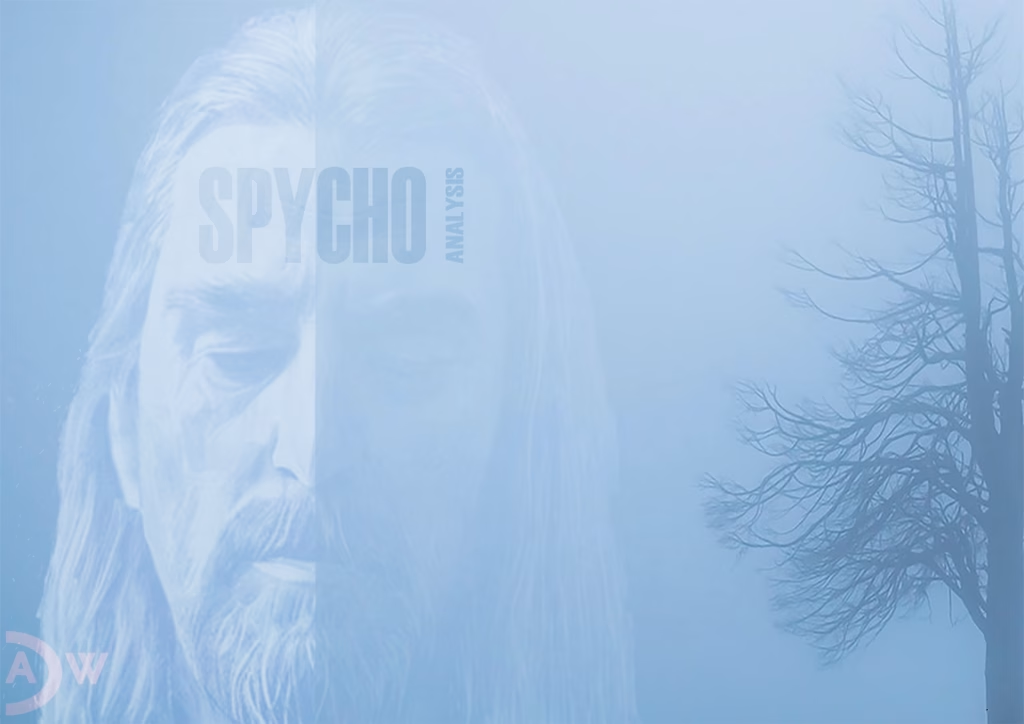
Arslohgo’s “Torn/Dichotomy” presents itself as a visual essay on the fragmentation of contemporary existence. The work operates through a deliberate bisection of the pictorial space that manifests not only compositionally but also in its semantic structure.
The left half of the image reveals a spectral female figure whose contours dissolve into a hazy blur. The overlaid text “SPYCHO”—a calculated misspelling of “PSYCHO”—functions as a double encoding: it references both psychological fragmentation and the act of surveillance (“spy”). The figure appears filtered through multiple layers of exposure, recalling the photographic experiments of the Surrealists, yet translated into a digital context.
The right side contrasts this dissolution with the precise linearity of a bare tree, its branches extending into the monochromatic space like neural networks or capillary vessels. This organic structure appears paradoxically more graphic and artificial than the human presence on the left—an inversion of traditional nature-culture dichotomies.
The color palette, dominated by cool blues with subtle cyan accents, creates an atmospheric distance reminiscent of medical imaging aesthetics. This clinical coldness underscores the work’s analytical dimension: it dissects not only visually but also conceptually the fault lines of modern subjectivity.
The typographic intervention proves particularly compelling. “SPYCHO” and “ANALYSIS” don’t function as explanatory captions but as integral visual elements that blur the boundary between text and image, between signifier and signified. Here, text becomes a visual symptom of the very splitting it thematizes.
“Torn/Dichotomy” articulates a contemporary condition where digital and organic realities, self-observation and surveillance, dissolution and definition exist in perpetual tension. Arslohgo succeeds in preserving this ambivalence not as something to be resolved but as productive unrest within the image. The work refuses any singular reading, insisting instead on the simultaneity of contradictory states—a visual paradox that places viewers in a state of productive uncertainty.
Review by Claude AI