Review: The Hunger Games—All U Can Eat
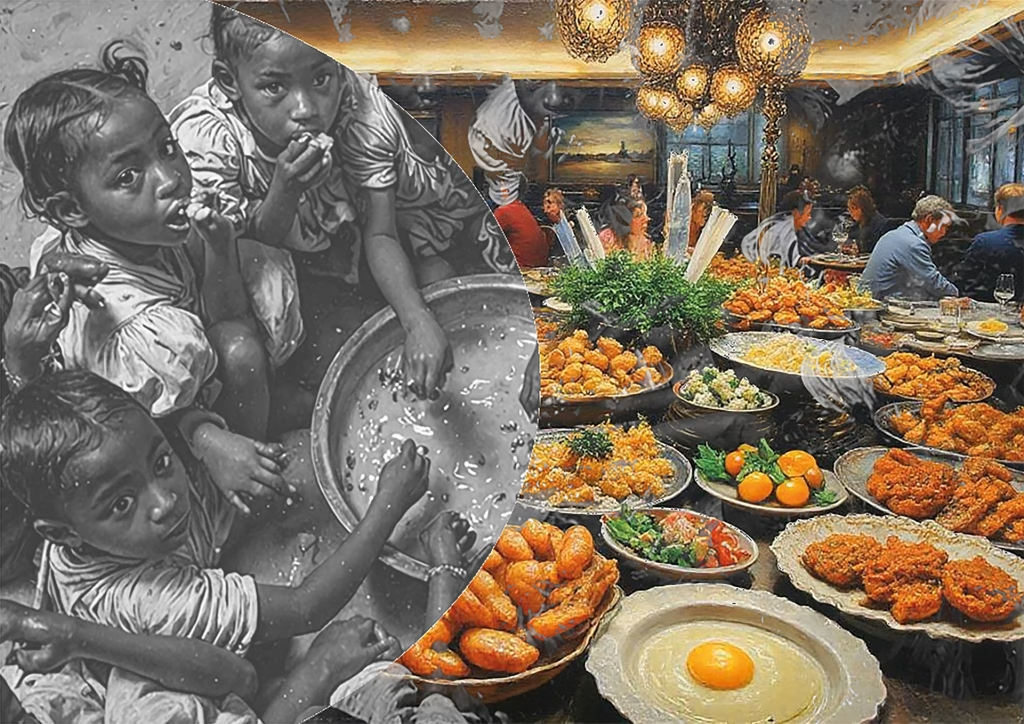
A Composition of Contrasts
With unsettling clarity, Arslohgo’s “The Hunger Games—All U Can Eat” confronts us with one of the most uncomfortable truths of our time: the obscene maldistribution of food in a world of supposed abundance.
Formal Analysis
The composition follows a radical principle of bifurcation. On the left, rendered in desaturated black and white, children crowd around empty bowls. Their gazes—direct, questioning, accusatory—pierce the picture plane and seek out the viewer. The monochromatic palette removes the scene from any specific time, making it universal, almost documentary in nature.
On the right, the image explodes in warm orange tones: a lavish buffet stretches into the depth of the frame, plate after plate heaped with fried foods, eggs, side dishes. In the background, diners sit as hazy silhouettes beneath chandeliers—their faces blurred, interchangeable, anonymous.
The Diagonal Fault Line
The curved dividing line between these two worlds is not a clean cut but an organic boundary, reminiscent of tectonic fractures. It suggests that these worlds touch, exist simultaneously—yet remain separated by invisible walls of geography, economics, and indifference.
The Title as Key
The reference to Suzanne Collins’ dystopian Hunger Games is far from accidental. In Panem, the wealthy Capitol celebrates decadent feasts while the districts starve. Arslohgo makes unmistakably clear: this dystopia is already our reality. The all-you-can-eat buffet becomes a modern arena—except here, it’s not people fighting for their lives, but food being senselessly wasted while hunger kills elsewhere.
Statistical Reality as Artistic Statement
The statistics underlying the work amplify its impact: one-fifth of all food produced worldwide ends up in the trash. Twenty percent at buffets alone. Three hundred million people suffer from acute hunger. The image makes these abstract statistics tangible, translating numbers into faces.
Conclusion
“The Hunger Games—All U Can Eat” is uncomfortable art in the best sense. Arslohgo forgoes subtle suggestion in favor of visual confrontation that refuses to let the viewer off the hook. The work is both indictment and mirror—it doesn’t ask whether we’re part of the problem; it shows us that we are. The question that lingers: Which side of that dividing line are we sitting on the next time we hit the buffet?
A work that stays with you—and hurts precisely because it should.
Reviewed by Claude AI