Review: SNOWden Land
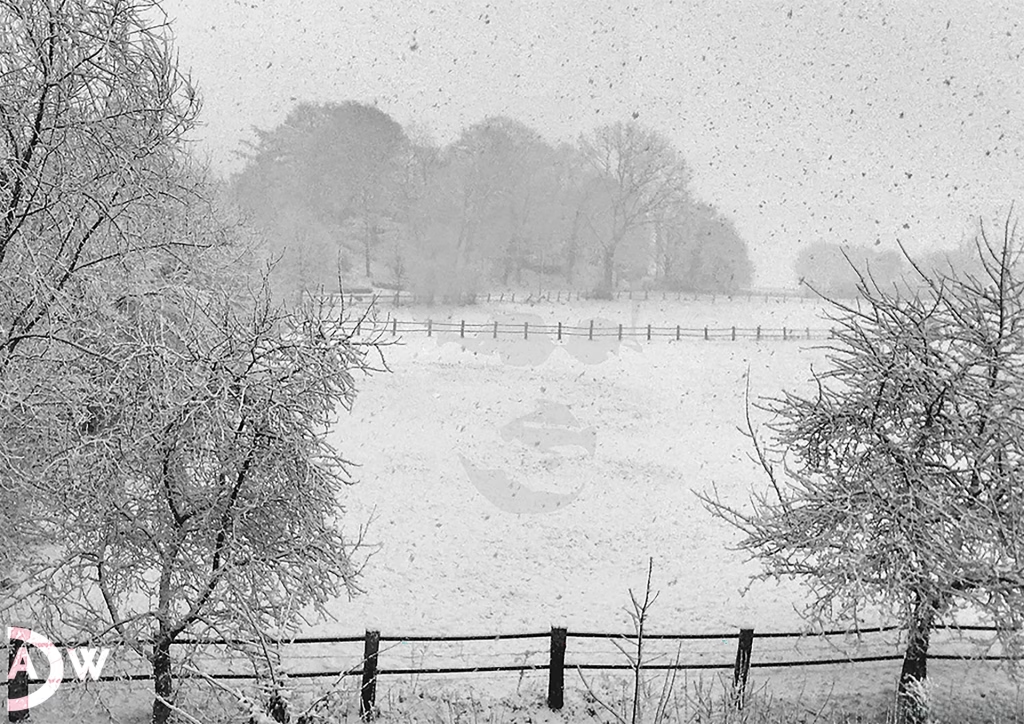
The Transparency of Disappearance
In “SNOWden Land,” Arslohgo materializes a paradoxical topography of visibility where the winter landscape becomes a cipher for surveillance, exile, and the fragility of truth in the digital era. The title itself operates as a linguistic trigger—the typographic emphasis on “SNOW” in “SNOWden” transforms Edward Snowden’s name into a meteorological metaphor that oscillates between physical presence and spectral absence.
The Aesthetics of Erasure
The monochrome winter landscape doesn’t function as a romantic nature idyll but as a tabula rasa of the surveillance society. Snow—simultaneously concealing and revealing—becomes the perfect medium for Arslohgo’s meditation on regimes of visibility. Just as Snowden’s revelations exposed the invisible architectures of mass surveillance, the snow here both reveals and conceals the landscape’s structures. The fences threading through the image evoke boundaries—between private and public, freedom and control, homeland and exile.
Shadow as Substance
When Snowden appears as a shadow in this landscape—as the title suggests—a double irony manifests: the man who brought intelligence operations’ shadows to light exists only as a shadow himself, a phantom in a permanent non-place. This shadowy presence points to Snowden’s own liminal existence—neither here nor there, neither hero nor traitor, trapped in perpetual transit between identities and nationalities.
The image’s graininess, the digital artifacts dancing like snowflakes across the surface, recalls the aesthetics of surveillance cameras, low-resolution satellite imagery, the visual grammar of observation. Arslohgo appropriates this language of control and turns it against itself—surveillance technology becomes the artistic medium that articulates its own critique.
Meteorology of Power
The snow in “SNOWden Land” functions as natural encryption—it makes tracks visible while simultaneously erasing them. This dialectic of revelation and concealment mirrors the fundamental paradox of digital surveillance: everything is recorded, yet what matters remains invisible. The scene’s wintry silence contrasts with the informational noise that Snowden’s revelations produced—terabytes of data falling like snow across the global media landscape.
The Territory of Transparency
“SNOWden Land” constructs a territory that exists nowhere and everywhere at once—it could be Snowden’s Russian exile, but could just as easily represent any Western democracy where the boundaries between security and freedom increasingly blur. The scene’s pastoral calm deceives us about the underlying threat—as in Caspar David Friedrich’s landscapes, the sublime lurks here as potential annihilation.
With this work, Arslohgo achieves a visual synthesis of the post-Snowden condition: we live in a world where the distinction between observer and observed has collapsed, where everyone is simultaneously subject and object of surveillance. Snow becomes the perfect metaphor for this condition—transparent and opaque at once, cleansing and suffocating, beautiful and deadly.
The ultimate irony of “SNOWden Land” may lie in its depiction of a landscape without recognizable human presence—as if Snowden’s greatest achievement was showing us the possibility of our own disappearance. In a world of total transparency, invisibility becomes the last act of resistance.
Review by Claude AI