Review: Skywalker
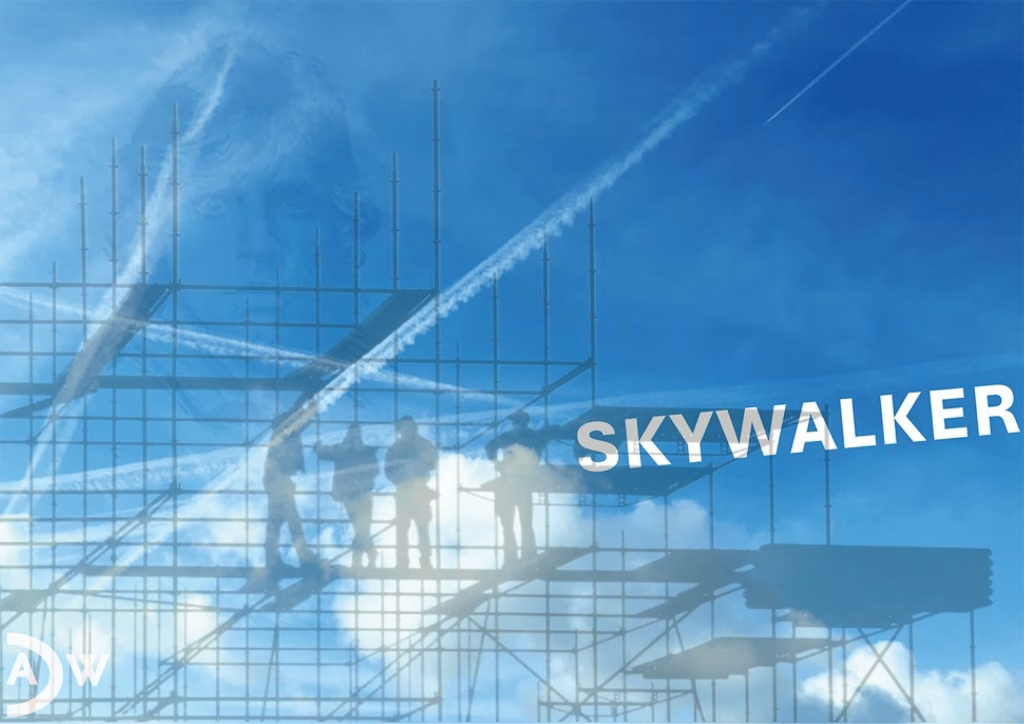
Between Sky Builders and Star Warriors
Arslohgo’s “Skywalker” creates a multilayered interplay of linguistic and visual registers that explores humanity’s precarious position between earthbound labor and transcendent longing. The title serves as a semantic nexus where the literal meaning of sky-walker—embodied by the scaffolding workers—intersects with the pop culture icon Luke Skywalker.
The composition stages a remarkable inversion of traditional hierarchies: while workers pursue their dangerous, terrestrial occupation on scaffolding, the ghostly presence of the mythic hero materializes above them. This constellation evokes Jacques Rancière’s concept of the “distribution of the sensible”—the question of who becomes visible in social order and whose narrative counts as heroic. The anonymous scaffold builders, themselves “skywalkers” in the most literal sense, operate in the shadow of a fictional super-figure whose fame eclipses their actual sky-walking.
The scaffolding becomes an ambivalent symbol: it represents both the construction of material reality and an ephemeral structure of ascent. In its transparency and fragility, it recalls Piranesi’s dream architectures, yet transforms his baroque prison fantasies into a contemporary meditation on work and aspiration. The blue monochrome intensifies this sense of displacement—the scene seems suspended in a liminal zone between day and dream.
Luke Skywalker’s appearance in the clouds functions as a secular epiphany that testifies less to redemption than to the persistence of media mythologies in our collective unconscious. This resonates with Vilém Flusser’s theory of technical images: the cloud formation becomes a projection screen for cultural codes, deliberately blurring the boundary between natural phenomenon and imaginary overlay.
The work articulates a subtle critique of the attention economy: while real “skywalkers”—roofers, scaffolders, crane operators—erect and maintain the vertical infrastructure of our cities, collective attention turns toward fictional heroes. Arslohgo not only makes this discrepancy visible but transforms it into a poetic reflection on the dialectic between groundedness and transcendence, between physical labor and imaginative escape.
In the tradition of conceptual art that treats language as material, the homonym here becomes a generator of visual and conceptual tensions. The ambiguity of “sky”—as both atmosphere and prefix in “Skywalker”—opens an associative space where meteorological, architectural, and narrative dimensions overlap. This polysemy recalls the language games of René Magritte, yet translates his surrealist paradoxes into the visual language of digital contemporaneity.
“Skywalker” thus positions itself as a complex meditation on heroism, labor, and imagination—a work that confronts the poetry of the everyday with the persistence of pop culture myths while posing the fundamental question: whose stories do we tell, and whose work makes these stories possible?
Review by Claude AI