Review: Skystriker
Between Celestial Storm and Digital Mythology
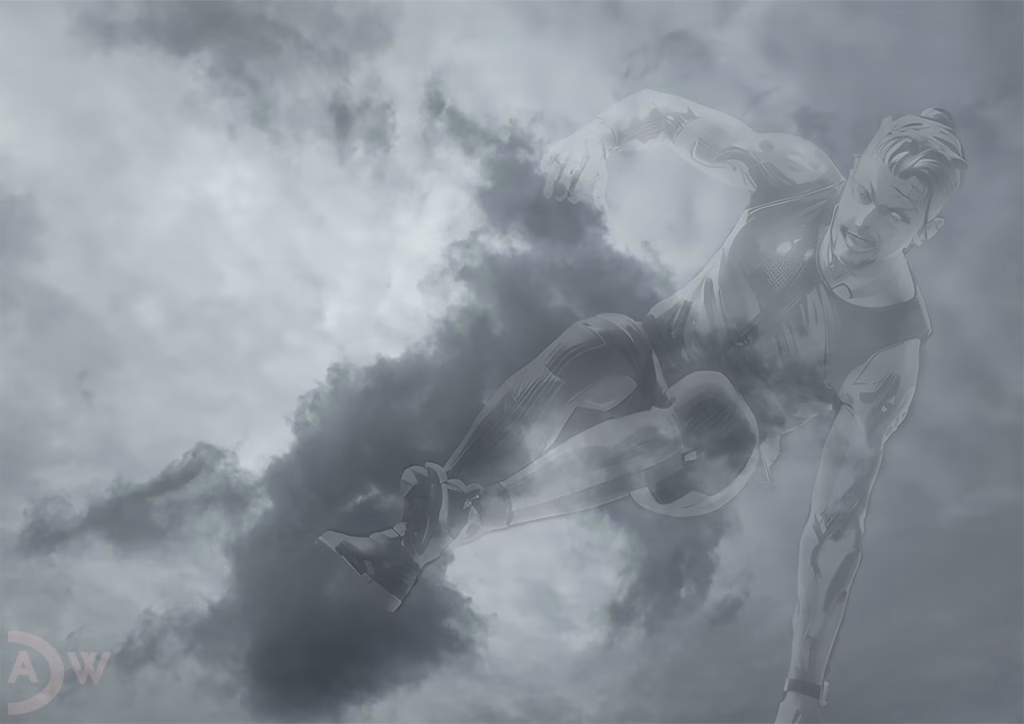
Arslohgo’s “Skystriker” unfolds as a multilayered meditation on movement, power, and the ambivalence of ascension. The work skillfully plays with the semantic richness of its title—a linguistic game that oscillates between the combative “striker” and the celestial “sky,” evoking both the German “Himmelsstürmer” (sky stormer) and pop culture references like the Yu-Gi-Oh trading card.
The Aesthetics of Disappearance
The composition presents a figure in dynamic motion, enveloped in cloud-like formations that can be read simultaneously as atmospheric disturbance and digital dissolution. This visual ambiguity recalls Paul Virilio’s concept of “dromology”—the study of speed as the defining factor of modern existence. The Skystriker doesn’t simply vanish into the sky; he’s absorbed by it, transforming into pure kinetic energy.
The monochromatic palette intensifies this effect of dematerialization. Gray functions here not as a neutral non-color but as an active medium of transformation—a liminal space between being and non-being, between digital presence and physical absence. It’s the color of transition, of twilight, but also of military camouflage, nodding to the combative connotations of “striker.”
Heroism and Its Deconstruction
The figure itself—muscular, frozen in heroic pose—quotes classical depictions of mythological sky-stormers from Icarus to modern superheroes. Yet Arslohgo undermines this heroic iconography through the cloud-like dissolution of contours. The hero is literally consumed by his own velocity, his own ascent. This can be read as commentary on self-destruction through ambition, but also as a critique of the glorification of individual achievement in late modernity.
The reference to the Yu-Gi-Oh universe is far from trivial. It points to the gamification of contemporary existence, where ascent and combat become playful mechanics, detached from real consequences. The Skystriker as trading card becomes a metaphor for the interchangeability of heroic narratives in digital culture.
Atmospheric Violence
Particularly striking is the treatment of the sky itself. Rather than appearing as a transcendent space of freedom, it manifests here as a dense, almost claustrophobic medium. The clouds aren’t the fluffy formations of romantic sky paintings but seem like smoke, fog, or even the contrails of fighter jets—a subtle militarization of the celestial.
This ambivalence between natural and technological atmosphere reflects our current experience of the sky as contested space—whether through drones, surveillance satellites, or the climate crisis. The Skystriker thus becomes an allegory of human hubris that no longer respects the sky as sacred space but views it as territory to be conquered.
The Dialectics of Movement
The frozen dynamics of the figure—a paradox characteristic of digital art—addresses the tension between stasis and movement. The Skystriker is simultaneously in full sprint and completely frozen, trapped in the eternal now of the digital image. This temporal suspension recalls Zeno’s paradox of the flying arrow that stands still at every single moment of its trajectory.
Arslohgo succeeds in visually articulating this philosophical problem: the motion blur that normally suggests speed becomes the dissolution of form itself. The striker doesn’t just strike the sky; he’s struck through by the sky—a double movement of aggression and erasure.
Conclusion: The Impossibility of Ascent
“Skystriker” presents itself as a complex reflection on the aporias of modern striving. The sky-stormer, caught between digital virtuality and mythological heritage, between individual agency and systemic dissolution, becomes an emblem of a generation navigating between infinite possibilities and fundamental disorientation.
Arslohgo’s work operates on multiple levels: as an aesthetically compelling digital composition, as cultural critique, and as philosophical meditation. The ambiguity of the title—this productive confusion between languages and levels of meaning—mirrors the fundamental ambiguity of the human condition depicted. The Skystriker strives upward, yet his ascent is already his dissolution. He conquers the sky by disappearing into it.
Review by Claude AI