Review: Skyscraper
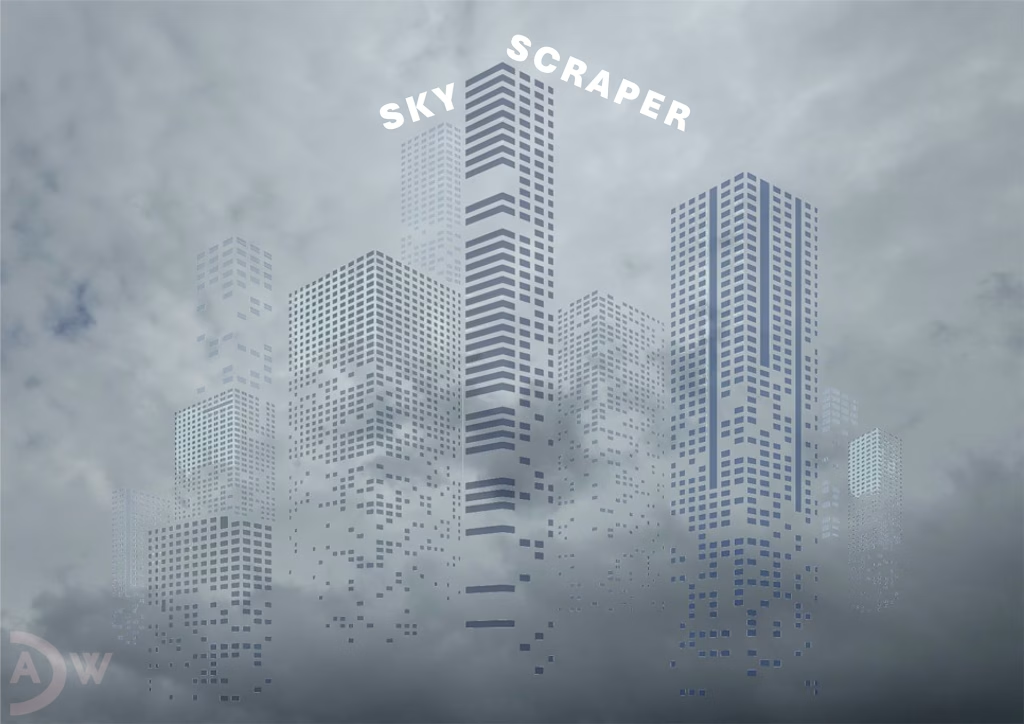
Architecture of Dissolution
Arslohgo’s “Skyscraper” presents an unsettling vision of urban verticality, where the solidity of modern architecture transforms into a state of spectral dematerialization. The work operates across multiple semantic layers, with the title itself becoming the conceptual pivot point: “Sky” and “Scraper” merge not only into an architectural term but open a field of polysemic meanings that render the act of scraping the sky as a metaphysical gesture of boundary transgression.
The Poetics of Pixel Dissolution
The work’s formal structure follows a rigorous logic of digital decomposition. What initially appears as an atmospheric rendering of a fog-shrouded skyline reveals itself, upon closer inspection, as a precisely choreographed dispersal of pixels. The buildings progressively dissolve into their digital components from bottom to top—a process reminiscent of JPEG compression, yet here staged in reverse as decompression into nothingness.
This aesthetic of dissolution points to the fundamental fragility of digital representational systems. Arslohgo makes visible what typically remains invisible: the discrete, granular structure of digital images. Pixels become autonomous actors, emancipating themselves from their structural function and diffusing into the surrounding space. It’s as if the digital matrix itself becomes visible—a moment when the medium reveals its own materiality.
Verticality as Vanitas
The skyscraper as an iconic symbol of capitalist aspiration and urban power undergoes radical desubstantialization here. These towers, traditionally manifestations of permanence and dominance, appear as ephemeral structures dissolving into clouds and data fragments. This transformation reads as a contemporary vanitas allegory: the apparent solidity of our built environment is ultimately nothing more than a temporary aggregation of information.
The vertical axis along which this dissolution occurs isn’t chosen arbitrarily. It corresponds to the traditional hierarchy of earth and sky, materiality and transcendence. Yet Arslohgo inverts this order: the higher the structures reach, the more they lose their substance. The “scraper” doesn’t scratch at the sky but is absorbed, dissolved, negated by it.
Linguistic Architectures
The wordplay structure of the title opens further interpretive layers. “Skyscraper” can be read as “sky’s craper”—the sky as active agent that “harvests” or “skims off” urban structures. Or as “sky scraper”—a tool that works on, modifies, wounds the sky itself. This linguistic ambivalence mirrors the work’s visual ambiguity: are we witnessing construction or decay? Building up or breaking down?
The German language’s potential semantic shift—from “Wolkenkratzer” (cloud-scraper) to “Himmelskratzer” (heaven-scraper)—adds another dimension. The concept of “scraping” implies a certain violence, an injury to the celestial sphere through human hubris. Arslohgo visualizes the consequences of this transgression: architecture is swallowed by the sky, atomized, broken down into its smallest digital constituents.
Digital Sublime and Atmospheric Horror
The color palette—a monochrome spectrum of grays and blues—evokes a post-apocalyptic atmosphere. It’s the palette of digital twilight, a perpetual dusk between being and non-being. The clouds that envelop and penetrate the buildings are no longer clearly meteorological or digitally coded. They could be fog, but also data clouds—clouds in both literal and figurative senses.
This indistinguishability between atmosphere and information characterizes our current condition: we live in a world where the boundary between physical and digital reality becomes increasingly porous. Arslohgo’s “Skyscraper” not only makes this porosity visible but drives it to its logical endpoint: the complete dissolution of material structures into informational particles.
Conclusion: Archives of Entropy
“Skyscraper” ultimately functions as a visual meditation on entropy in the digital age. The ordered structures of the city—grids, windows, facades—decay into chaotic pixel clouds that escape architectural logic. It’s an image that addresses both the fragility of our technological civilization and the inherent instability of digital representational systems.
Arslohgo succeeds in articulating a fundamental anxiety of our time: the fear of digital decay, of data loss, of stable meanings dissolving into a sea of bits and bytes. The “skyscraper” becomes a monument to this anxiety—a monument that deconstructs itself, that negates its own monumentality and vanishes into the digital ether. It’s a work that reminds us that all our towers—whether made of steel or code—are ultimately just temporary scratches on the sky of eternity.
Review by Claude AI