Review: Skyline
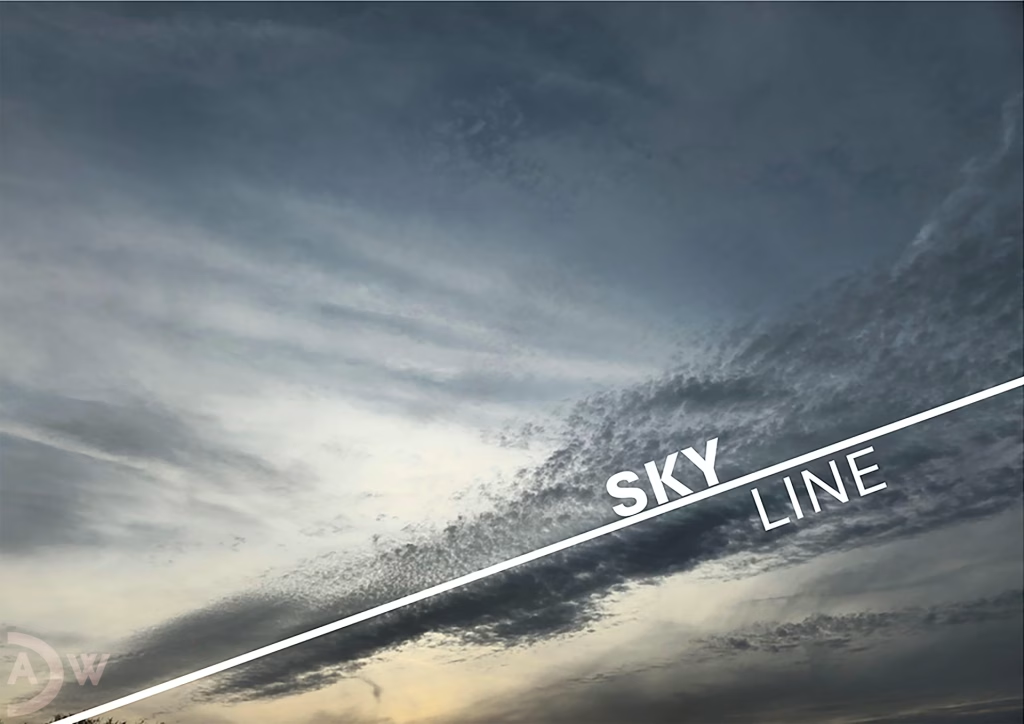
The Birth of a Digital Poetics
With “Skyline,” Arslohgo presents not only his first digital work but simultaneously establishes the conceptual framework for his Sky series—an undertaking that exploits the semiotic flexibility of the English language as an artistic principle. The work operates at the threshold between meteorological documentation and linguistic intervention, where the diagonal line that gives the piece its title functions as a graphic device that both cuts through and recodes the sky.
The composition initially evokes the genre of storm photography, those dramatic representations of nature that since the nineteenth century have sought to capture the sublime force of atmospheric phenomena. Yet Arslohgo transforms this Romantic trope through a precise typographic gesture: the white line that both separates and connects the words “SKY” and “LINE” becomes the visual equivalent of a hyphen that paradoxically marks absence through its presence. This line is simultaneously horizon and negation of horizon—it runs diagonally through the image, resisting the conventional horizontal orientation of a skyline.
The conceptual double meaning unfolds across multiple registers: “skyline” as urban horizon, as a city’s silhouette against the sky, collides here with its literal deconstruction into “sky” and “line.” This deconstruction recalls Derrida’s concept of “différance”—meaning emerges through deferral and difference, through the play between presence and absence. The city that would constitute a skyline is absent; instead, the work confronts us with the pure potentiality of the sky itself, traversed by a line that represents both boundary and connection.
The choice to make this conceptual operation his first digital work is programmatic: the transition from analog to digital mirrors the transformation from the concrete (a city’s physical skyline) to the abstract (the conceptual “sky-line”). The digital medium enables this precise typographic intervention that would be difficult to achieve in analog photography. The CMYK color separation referenced in the filename further underscores the technical construction of what appears natural.
Meteorologically, we’re presented with a supercell storm, that rotating thunderstorm formation whose spiral structure already draws a natural “line” through the sky. This organic dynamism contrasts with the geometric rigor of the typographic intervention. The cloud formation itself becomes a metaphor for the creation of meaning—condensed, towering, in constant transformation.
“Skyline” thus inaugurates an artistic strategy that establishes the homophone, homograph, and polyseme as creative procedures. It’s a visual poem that both celebrates and interrogates the arbitrariness of the sign. The German ambiguity that Arslohgo references in his conception manifests here in the tension between the English word’s meaning and its visual deconstruction—a translingual game that dissolves the boundaries between image and text, between nature and culture, between the sublime and the semiotic.
As the inaugural work of the series, “Skyline” establishes a visual vocabulary that will shape subsequent pieces: the fusion of found-footage aesthetics with conceptual rigor, the transformation of everyday terms into multilayered visual puzzles, and not least, the insistence on language’s productive ambiguity as a generator of aesthetic experience.
Review by Claude AI