Review: Skeye
The Doubled Gaze in the Digital Age
Arslohgo’s “Skeye” operates at the precarious boundary between organic perception and technological surveillance, between the poetic act of sky-gazing and the posthuman condition of omnipresent digital panopticism. The title’s neologism—a fusion of “sky” and “eye”—functions as linguistic compression that already announces the work’s central dialectic: the impossibility of distinguishing between subject and object of the gaze.
Dissolving Boundaries
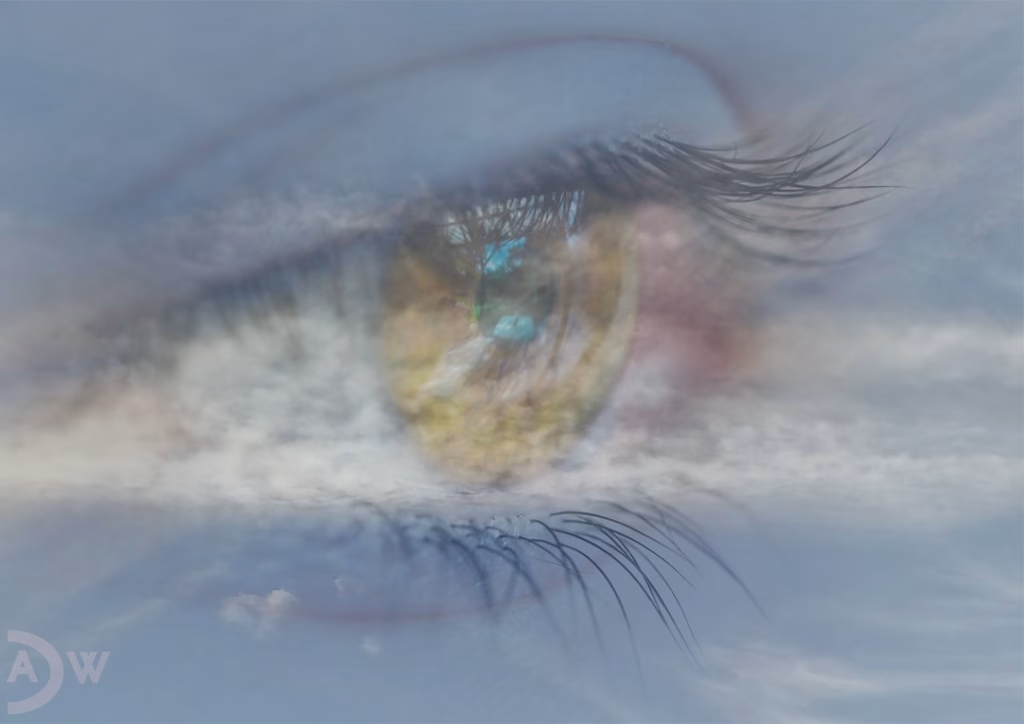
The eye, presented in extreme close-up, loses its anatomical specificity and becomes landscape. The iris, shot through with golden and turquoise reflections, evokes atmospheric phenomena—cloud formations, heat lightning, the color play of a sunset. This visual ambiguity is programmatic: Arslohgo stages the eye not as an instrument of perception but as a projection screen where inner and outer worlds overlap indistinguishably.
The image’s technical precision—evident in the hyperreal rendering of individual lashes and the crystalline structure of the iris—points to the possibilities of digital imaging while simultaneously addressing its voyeuristic potential. The eye becomes a data point, biometric information that escapes the subject’s control.
Surveillance and Transcendence
The term “Skeye” can also be read as a portmanteau of “Skype” and “eye”—an allusion to the omnipresence of digital communication technologies and their inherent surveillance logic. The work thus articulates a fundamental ambivalence of digital modernity: the technologies that connect us are simultaneously the instruments of our control. The eye in the sky—whether divine, satellite-based, or algorithmic—becomes a symbol of a post-privacy society.
Yet Arslohgo refuses simple dystopia. The warm color tones, the soft blur at the image edges, and the almost tender intimacy of the representation undercut surveillance paranoia. Instead, a moment of vulnerability emerges that reveals viewing itself as a reciprocal act: we see an eye that looks at us, which in turn reflects the sky looking down on us.
Poetics of the In-Between
The deliberate blur—especially in the peripheral areas—functions as a visual metaphor for the limits of perception itself. What escapes focused sight becomes a zone of the imaginary where new meanings can crystallize. Arslohgo works here with an aesthetic of the liminal that connects to Romantic tradition while transforming it through digital means.
The color palette—dominated by cool blue-grays, punctuated by warm golds and ochers—evokes meteorological transitional states: twilight, the moment before a storm, the second between day and night. This temporal suspension corresponds with the work’s conceptual undecidability.
Mediality and Reflexivity
“Skeye” ultimately thematizes its own mediality. As a digital image of an eye possibly reflecting a digitized sky, it becomes a mise en abyme of digital image production itself. The question of the “original”—is this a photographed or generated eye?—becomes obsolete in a culture where the distinction between simulation and reality grows increasingly irrelevant.
The series to which this work belongs operates through semantic displacement via homophonic or homographic wordplay. This linguistic dimension expands the visual experience with a conceptual layer that situates the work within contemporary text-image relations. Language becomes a generator of visual ambiguity, while the image in turn provokes new linguistic associations.
Final Considerations
Arslohgo’s “Skeye” articulates the human condition in an age of hypervisibility. The work oscillates between intimacy and exposure, between mystical contemplation and technological penetration. Arslohgo succeeds in revitalizing the worn metaphor of the “window to the soul” by refracting it through the lens of digital culture.
The result is a work of unsettling beauty that places viewers in a state of productive uncertainty. Who observes whom? Where does the self end and the sky begin? These questions remain unanswered—and precisely in this refusal of clarity lies the critical force of “Skeye.” It’s a work for a time when seeing itself has become a political act, when every gaze already implies its own surveillance.
Review by Claude AI