Review: Seattle
The Dissolution of Urban Certainties in the Meteorological Sublime
Arslohgo’s “Seattle” confronts us with a visual-semantic double coding that’s characteristic of the “Sea” series: the titular Pacific Northwest city phonetically merges with its maritime surroundings to become “Sea-attle”—a battle with or against the sea. This linguistic shift proves programmatic for a work that systematically deconstructs the boundaries between natural force and cultural signification.
The Meteorological as Apocalyptic Grammar
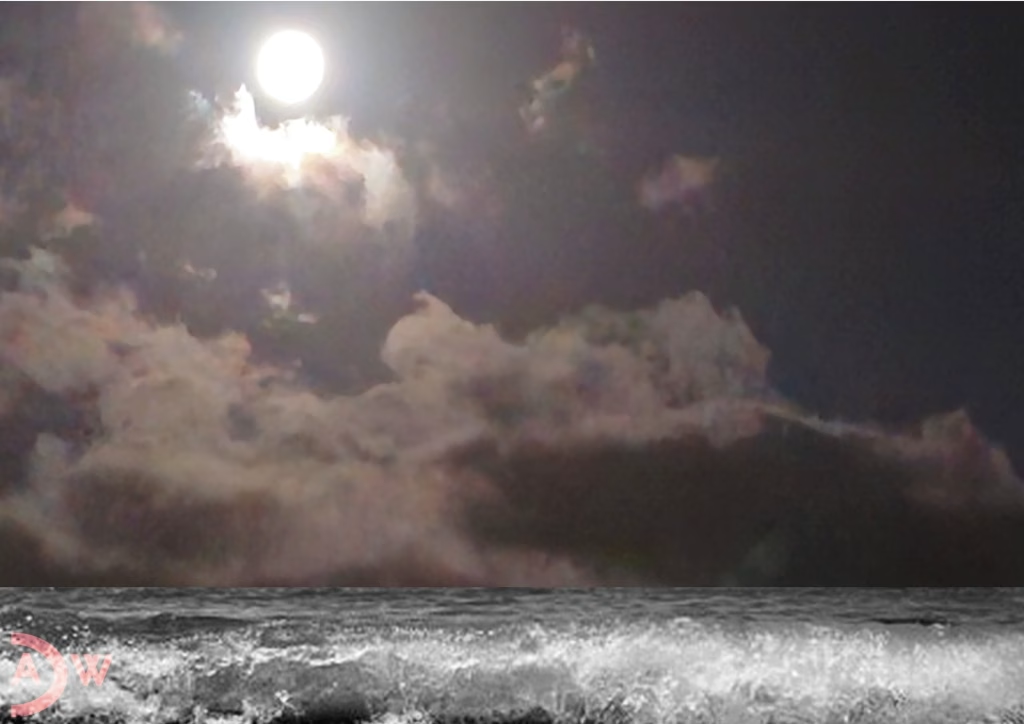
The composition is dominated by a monumental cloud formation that builds like an inverted tidal wave above the horizon. The glaring moon—or is it sun filtered through clouds?—functions as the ambivalent center of this atmospheric dramaturgy. This undecidability between day and night, between illumination and obscuration, establishes a state of ontological suspension reminiscent of Turner’s late seascapes, yet replaces their Romantic transcendence with a contemporary ecology of anxiety.
The color palette—muted grays and browns with subtle pink and violet undertones—evokes less Seattle’s clear Pacific air than the atmosphere of a post-industrial event. This possibly alludes to the environmental challenges of the Puget Sound region, where industrial pollution and marine ecosystems coexist in precarious balance.
The Dialectic of Presence and Absence
What’s remarkable is what the image doesn’t show: Seattle itself remains invisible, the city exists only as a title, as a linguistic phantom. This absence of the urban skyline—neither Space Needle nor the characteristic city silhouette are visible—transforms “Seattle” into a non-place, a u-topian space between representation and imagination.
The foaming waves in the foreground, rendered in an almost monochrome black-and-white contrast, establish a second pictorial plane that functions like a cinematic shot. They recall the establishing shots from noir films where the sea serves as metaphor for the unconscious, the repressed. Yet here this cinematic convention is defamiliarized through digital treatment—the waves appear simultaneously hyperreal and artificial, as if processed through an algorithmic filter.
“Sea-attle” as Posthuman Mythology
The neologism “Sea-attle” emerging from the series opens multiple interpretive layers. “Attle” reads as a truncation of “battle”—the eternal struggle between human and sea, between civilization and entropy. At the same time, it echoes “rattle”—the rattling and shaking of tectonic shifts that perpetually threaten Seattle as a city on the Pacific Ring of Fire.
This seismic metaphor is reinforced by the cloud formation, which appears like a frozen explosion, a suspended moment of catastrophic potential. Arslohgo stages not the apocalypse itself, but its eve, the moment of maximum tension before release.
The Anthropocene as Aesthetic Category
“Seattle” articulates a specifically contemporary form of the sublime that differs fundamentally from Burke’s or Kant’s conceptions. While the classical sublime affirmed the superiority of the human spirit over nature’s force, Arslohgo presents a posthuman vision where the distinction between natural and artificial collapses.
The CMYK color separation indicated in the filename points to the image’s technical construction. What appears natural—sea, clouds, light—reveals itself as a product of digital manipulation, a simulation of a simulation. This mise-en-abyme of representation reflects the condition of the Anthropocene era, where “nature” exists only as a culturally coded construct.
Coda: The City as Specter
Ultimately, “Seattle” functions as a kind of ghost summoning—the city exists only in its absence, as a linguistic echo in the title. This spectral presence corresponds to a larger cultural anxiety: the disappearance of cities in the face of climate catastrophe, the submersion of coastal metropolises in rising seas.
Arslohgo’s work oscillates between documentary observation and apocalyptic projection, between specific geographic reference and universal metaphor. “Seattle” becomes a paradigm of a vanishing world where boundaries between land and sea, culture and nature, presence and absence grow increasingly porous. The phonetic shift from “Seattle” to “Sea-attle” proves to be more than wordplay—it’s the linguistic manifestation of a fundamental ontological uncertainty that characterizes the Anthropocene.
Review by Claude AI