Review: Seashell
The Apocalypse of the Petro-Modern Era
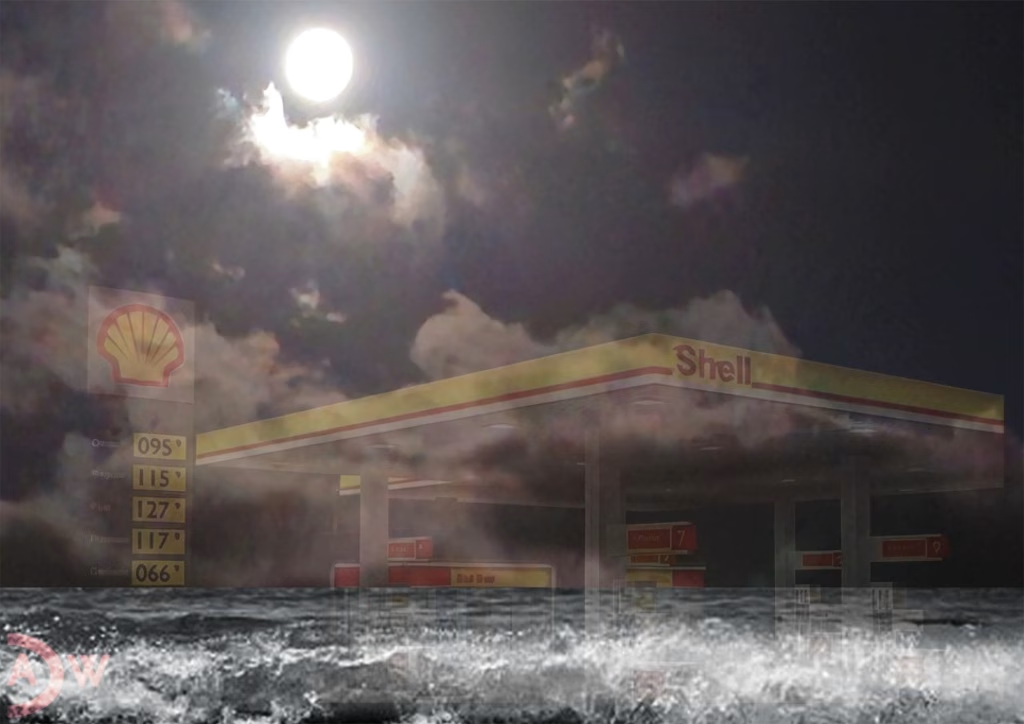
Arslohgo’s “Seashell” from the “Sea” series deploys a visually and semantically multilayered strategy that transforms the promise of fossil fuels as civilization’s foundation into an apocalyptic scenario. The titular seashell materializes here as a Shell gas station, which appears simultaneously to be sinking into and rising from the sea, while above it a blazing full moon evokes an almost sacred atmosphere.
Wordplay as Conceptual Architecture
The artist activates a multiple play on words: “Seashell” deconstructs into “Sea” and “Shell,” where the latter denotes both the mollusk and the oil corporation. This homophonic overlay—which wouldn’t translate in German as “See-Schale” loses the ambiguity—becomes the work’s conceptual framework. The Shell station, that ubiquitous symbol of petro-modernity, undergoes a return to its logo’s origin: the scallop shell (Pecten maximus), which has represented the company since 1904, originally referencing trade relationships with the Far East.
Between the Sublime and Catastrophe
The composition orchestrates a tension between Romantic sublimity and ecological disaster. The moon, in its supernatural luminescence reminiscent of Caspar David Friedrich’s nature mysticism, illuminates a scene oscillating between dream and nightmare. The dramatic cloud formation evokes both divine epiphany and toxic emanation—an ambiguity reflecting fossil energy’s dual nature as modernity’s blessing and curse.
The gas station itself becomes a liminal space: its transparent architecture suggests permeability and dissolution, while the still-legible price displays (095, 115, 127, 117, 066) appear as archaeological fragments of a sinking economy. These columns of numbers, once indicators of daily market fluctuations, become cryptic signs of a drowning civilization.
The Anthropocene as Tidal Zone
The foaming surf in the foreground establishes the sea as an active, reclaiming force. Arslohgo stages not merely the flooding of a gas station, but the collision of two temporal regimes: the geological time of oceans meets the accelerated time of the Capitalocene. The waves gnawing at the station’s foundations visualize nature’s revenge on the very infrastructure that enabled its exploitation.
This superimposition of gas station and seabed inevitably recalls J.G. Ballard’s “The Drowned World” (1962), where sunken cities become psychogeographic landscapes of the unconscious. In Arslohgo’s work, the Shell station becomes a modern Atlantis variant, a relic of human hubris reclaimed by the origin of all life—the sea.
Iconography of Energy Transition
The choice of a Shell station is anything but arbitrary. Shell stands paradigmatically for oil companies’ entanglement in climate change denial and greenwashing. The shell in the logo, originally a symbol of pilgrimage and spiritual transformation, becomes here an ironic cipher for the failed transformation of energy systems.
Arslohgo’s work reads as a visual archaeology of the future: What remains of the fossil modern when sea levels rise? The ghostly presence of the illuminated gas station—still functional yet already doomed—becomes a metaphor for our current interregnum, where the old order is dying but the new cannot yet be born.
Conclusion
“Seashell” functions as a multilayered memento mori of petro-modernity. Through semantic condensation in the title and the sublime staging of ecological apocalypse, Arslohgo creates a work that serves both as memorial to past mistakes and projection screen for future catastrophes. The return of Shell to shell, gas station to seashell, cultural space to natural space, articulates itself as poetic justice, where corporate logos find their way back to their mythic origins—swallowed by the very sea they helped exploit.
Review by Claude AI