Review: Searle
Speech Acts in the Flow of Meaning
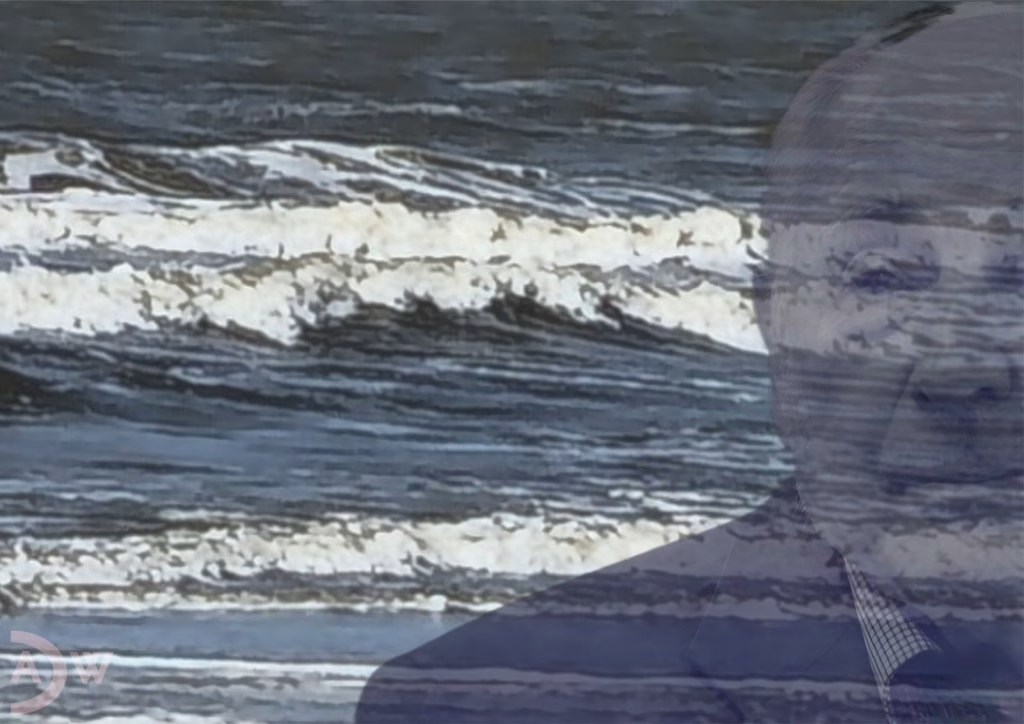
Arslohgo’s “Searle” operates across multiple semantic levels simultaneously, transforming what appears to be a simple seascape into a multilayered meditation on language, meaning, and performative utterances. The work belongs to the artist’s “Sea” series, where clever wordplay and visual overlays explore the instability of linguistic signs.
The Wave as Speech Act
John Searle’s placement before the churning ocean surface is anything but accidental. The philosopher who revolutionized our understanding of language—showing how it doesn’t just describe but acts—becomes a visual speech act himself. His translucent, ghostly presence, identifiable by his characteristic tie, merges with the waves to form a statement about the ephemeral yet powerful nature of linguistic utterances.
The waves themselves, repetitive yet constantly varying, visualize Searle’s concept of the iterability of speech acts. Each wave resembles an utterance: formally similar, contextually different, unpredictable in effect. The white foam marks the moment of the perlocutionary act—that point where language intervenes in the world and alters reality.
The Acronym as Corporate Speech
The extension from “Sea” to “Searle” doesn’t just reference the philosopher; through the RLE component, it opens another layer of meaning. RLE as an acronym for a technology company in the mobility sector introduces a capitalist dimension that brings Searle’s theory into contemporary context. Here we see Arslohgo’s critical stance: speech acts are no longer merely philosophical concepts but corporate tools—from wind to the wind industry, from natural to technologized forces.
The Transparency of the Subject
The spectral quality of the Searle figure—translucent as a watermark—addresses the crisis of the speaking subject in the digital age. Who speaks when an algorithm generates text? What intentionality underlies an AI utterance? Searle’s insistence on intentionality as the foundation of speech acts is visually questioned through a figure that’s barely more than a projection.
The overlay of philosopher and sea creates a visual metaphor for Searle’s “Background”—those implicit assumptions and contexts underlying every linguistic utterance. The ocean becomes the infinite background against which meaning occurs, but also dissipates.
Homophonic Shifts
Arslohgo’s play with homophonic and homographic shifts—”See/Sea,” “Searle/See+RLE”—reflects the fundamental arbitrariness of the linguistic sign. The German ambiguity of “See” (ocean/lake) amplifies this ambiguity, pointing to the impossibility of unequivocal communication. Every speech act carries within it the potential for misunderstanding.
Conclusion: The Drift of Meaning
“Searle” is more than a clever pun or philosophical illustration. It’s a visual investigation into the conditions of meaning in an era where natural and artificial intelligence, philosophical theory and technological practice, linguistic precision and semantic drift are inextricably interwoven. Arslohgo succeeds not just in citing Searle’s speech act theory but in performatively expanding it—the image itself becomes a speech act that opens new spaces of meaning while revealing their instability.
The waves keep breaking, Searle gazes at the ocean of his own theory, and somewhere in between, RLE operates, developing technologies, consulting for the wind industry. The sea remains what it always was: a space of projection where meaning forms and dissolves again, wave by wave, act by act.
Review by Claude AI