Review: Seacow Or Siren
The Seduction of Linguistic Metamorphosis
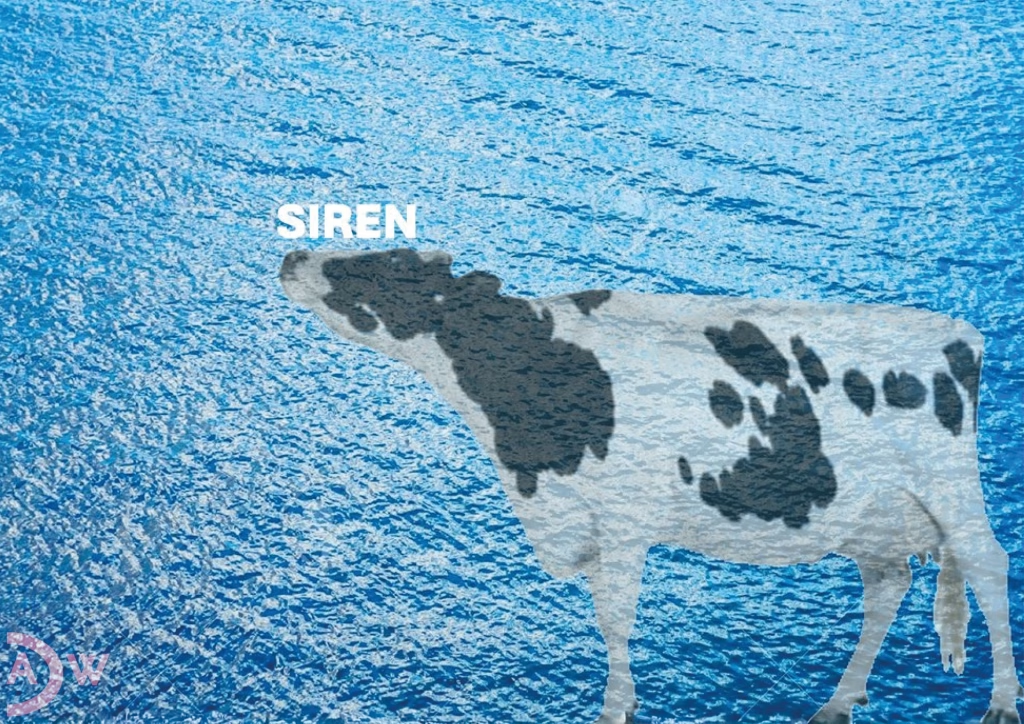
Arslohgo’s “Seacow—Siren” unfolds as a multilayered puzzle between visual presence and linguistic transformation. The work operates at the threshold between the visible and the sayable, between the literal presence of a spotted cow in azure ocean waters and the mythological echoes the title evokes.
The Dialectics of the Hybrid
The central figure—a Holstein cow with its characteristic black-and-white markings—floats weightlessly in the crystalline blue of the sea. This visual collision of terrestrial and aquatic spheres initially generates a surreal tension, which gains deeper significance through the linguistic dimension. In English, “sea cow” refers to the manatee or dugong, those gentle marine mammals sailors once mistook for mermaids—the mythical sirens.
Arslohgo stages a double transformation here: the dairy cow becomes a “sea cow,” which in turn mutates into a siren. This metamorphosis occurs not just visually but primarily on the linguistic level, where the homophony between the German “See” (sea) and the English “sea” creates a semantic short circuit. The German “Seekuh” and the English “sea cow” converge at a point of meaning-shift that positions the work in a liminal space between languages.
Demystifying the Myth
The white typography “SIREN” hovers above the cow like a label that simultaneously names and estranges. Where classical mythology depicts the siren as a seductive, dangerous creature—half woman, half bird or fish—Arslohgo presents a prosaic dairy cow. This ironic substitution exposes the mechanism of mythological projection: the siren as a phantasm of male seafaring imagination is replaced by the banal reality of a cow, which nonetheless develops its own uncanny poetry in the oceanic context.
The work recalls Magritte’s “This is not a pipe,” addressing the arbitrariness of signs. The cow is not a siren, yet through the act of naming and contextualization, it becomes one. This semiotic operation points to the constructed nature of mythological narratives and their dependence on linguistic conventions.
The Aquatic as Dream Space
The treatment of water—a shimmering, almost crystalline blue with subtle light reflections—evokes a dreamlike quality reminiscent of David Hockney’s pool paintings. But while Hockney stages the water’s surface as a membrane between reality and abstraction, Arslohgo uses the aquatic element as a medium of transformation. The water becomes an alchemical bath where meanings fluctuate and reconfigure themselves.
The cow itself appears strangely weightless, as if it has shed its terrestrial gravity. This suspension of physical laws reinforces the image’s oneiric character and suggests a state between floating and swimming, between being and non-being—a visual equivalent to the title’s semantic ambivalence.
Postcolonial Readings
In an expanded interpretation, “Seacow—Siren” can also be read as commentary on colonial encounter. The European cow in tropical waters becomes a metaphor for cultural displacement and hybridization. The transformation of the sea cow (the indigenous marine mammal) into a European dairy cow (symbol of agricultural colonization) and its re-mythologization as a siren reveals the violence of cultural overwriting.
The Series as Semantic System
As part of a series that plays with language and meaning, “Seacow—Siren” fits into a larger system of semiotic experiments. Arslohgo develops a poetics of homophony and polysemy that elevates the instability of linguistic meaning to an artistic principle. Multilingualism becomes not an obstacle but a generator of aesthetic possibilities.
The work ultimately articulates a fundamental insight into the nature of representation: meaning emerges not through mimetic depiction but through the collision and reconfiguration of signs. The cow becomes a siren not through morphological transformation but through an act of linguistic alchemy that makes the familiar strange and domesticates the foreign. In this sense, “Seacow—Siren” is a meditation on language’s power to constitute reality—and on art as a space where this power can be explored both playfully and critically.
Review by Claude AI