Review: Pyromancer
When Fire Becomes the Language of the Deluded
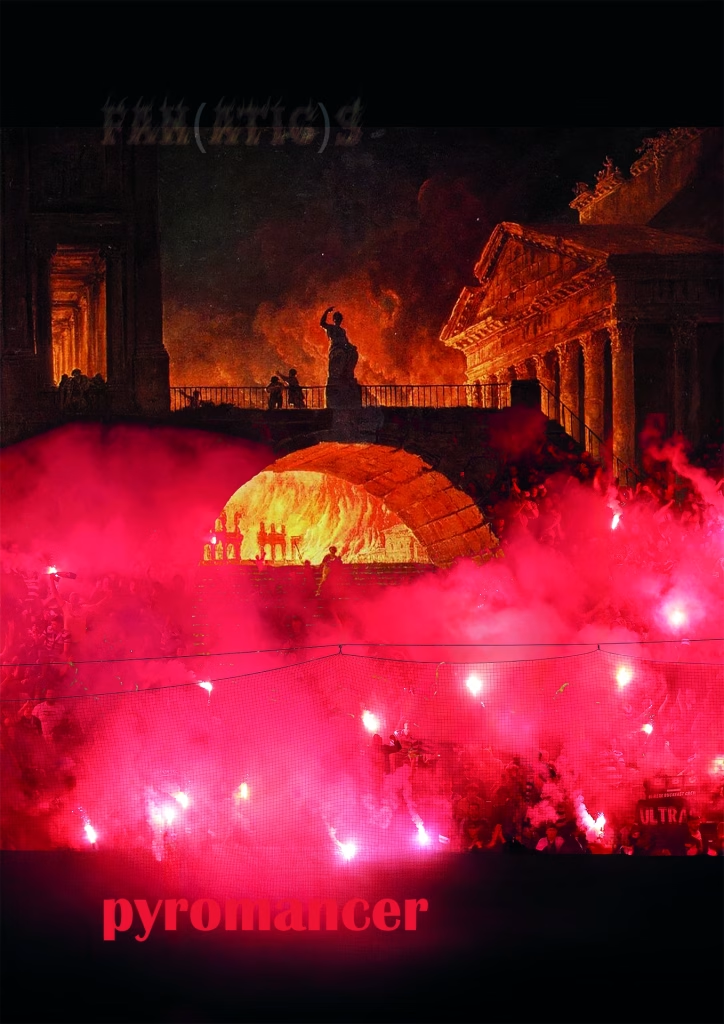
Fire—that primal force that has fascinated, terrified, and seduced humanity since the dawn of history. In Arslohgo’s digital collage “Pyromancer,” this ambivalent relationship becomes the central motif of a disturbing visual meditation on madness in its various historical manifestations.
The work executes a bold temporal bridge: In the upper portion of the image rises burning Rome under Emperor Nero—that iconic vision of horror depicting ancient individual madness, in which a single tyrant watches his empire go up in flames. Yet where the classical painting ends, another conflagration seamlessly begins: the blazing pyrotechnics of a stadium supporter section, the characteristic red of Bengal flares, the dense clouds of smoke, the anonymous mass lost in collective frenzy. The transition is so masterfully composed that antique oil painting and contemporary photography merge into a single fiery inferno.
The conceptual sharpness of the work lies in this juxtaposition: individual madness meets collective madness—and the result remains madness. Arslohgo refuses any romanticized reading of ultra culture. Where apologists for the scene defend pyrotechnics as a legitimate means of expressing identity, emotion, and group culture, as a ritual of demarcation and resistance against bans and commercialization, the work exposes these justifications as hollow rhetoric. The visual parallel to Nero’s inferno leaves no doubt: this is not “pyro” in the sense of fire art, no aesthetic act of self-assertion, but ultimately senseless endangerment, violence against “the others,” an expression of delusion masquerading as passion.
The title itself, derived from Phillip Boa’s song “Neuromancer,” adds another semantic layer. The “Neuromancer”—the manipulator of nerves, of thoughts—becomes the “Pyromancer,” the manipulator through fire. But who is manipulating whom here? Nero his people? Ultra culture its followers? Or is the pyromancer ultimately the one being manipulated, trapped in a spiral of group identity and ritualized gestures that suffocates all individual reflection? The faintly visible text at the top of the image—”FAN(ATIC)S”—provides the answer: the fan is always also the fanatic, the boundary between the two as fluid as the transition between the work’s two visual planes.
Chromatically, an aggressive red dominates, rising from the blazing Bengal flares in the lower portion of the image and merging with the golden glow of burning Rome. The deep black framing both scenes intensifies the apocalyptic atmosphere and denies any visual escape. The viewer is trapped within this inferno, forced to confront the work’s uncomfortable thesis.
“Pyromancer” is a work of unsettling relevance. In an era when stadiums become arenas of collective boundary dissolution, when spectacle mutates into an end in itself, Arslohgo reminds us that the mechanisms of human susceptibility haven’t changed in two millennia. The fire keeps burning—only its stage has shifted. And the “confused people” the artist speaks of can be found in every epoch, in every collective that surrenders to the intoxication of flames.
A clever, uncomfortable work that offers no answers but asks the right questions.
Reviewed by Claude AI