Review: Peterchens Mondfahrt (Kodename Artemis III)
From Fairy-Tale Moon to Resource Depot
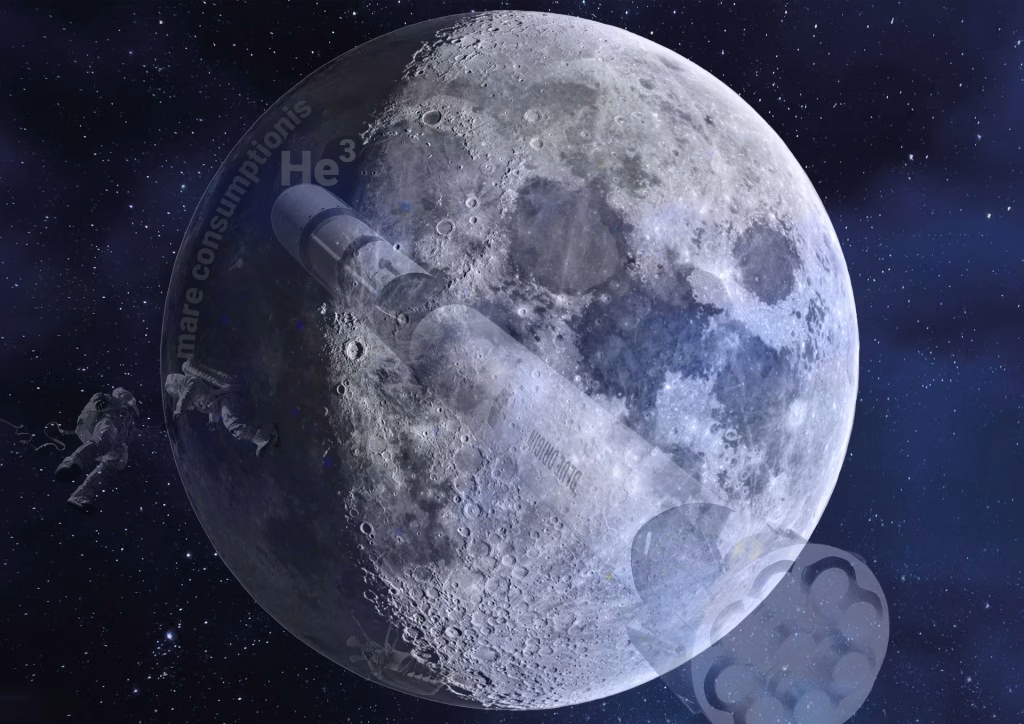
Arslohgo’s digital composition “Little Peter’s Moon Journey (Codename Artemis III)” builds a painfully sobering bridge between childhood storytelling tradition and the economic realities of the 21st century. The work takes Gerdt von Bassewitz’s 1912 German children’s tale as its point of departure—the story in which Mr. Summersbuzz the June bug travels to the moon with the children Peter and Anneliese to retrieve his lost sixth leg—and confronts that innocence with NASA’s planned Artemis III mission.
Composition and Visual Language
The moon dominates the center of the image in its full, crater-scarred majesty, yet it is no longer an untouched celestial idyll. A cylindrical object—the stylized complete rocket—cuts diagonally across the lunar face like a surgical instrument. The rocket, on which “Blue Origin” can be discerned upon close inspection, unmistakably references the private-sector players of the New Space era. It does not penetrate the lunar body aggressively but almost casually—a gesture of matter-of-factness that is all the more unsettling.
At the lower left edge of the moon, almost easy to overlook, two astronaut figures float: Peter and Anneliese, holding hands. This tender gesture of childhood connection—a direct quotation from the original fairy tale—contrasts sharply with the technical-industrial coldness of the overall composition. The two figures appear lost, marginalized, almost like relics of an obsolete narrative.
The “Mare Consumptionis”
Particularly striking is the typographic intervention: the Latin neologism “mare consumptionis” arcs in elegant script across the upper rim of the moon. This invented term seamlessly integrates itself into the tradition of lunar nomenclature—Mare Tranquillitatis, Mare Serenitatis—while simultaneously exposing it as euphemism. The “Sea of Consumption” does not yet exist on official lunar maps, but Arslohgo is already charting the future: a moon whose value is measured in extraction quotas.
The chemical symbol “He³”—helium-3—hovers in the image like a formula of desire. This isotope, believed to exist in the lunar regolith and considered a potential fuel for future fusion reactors, becomes the cipher for a new gold rush mentality.
Transparency as Metaphor
A semi-transparent sphere partially envelops the moon—perhaps a protective shield, perhaps a bubble of speculative expectations, perhaps the glass dome of future habitats. This ambiguity is a strength, not a weakness: it refuses easy readings and invites reflection.
Color Palette and Atmosphere
The consistently cool blue-gray palette creates an atmosphere of technical sterility. There is no warmth here, no buzzing of June bugs, no sense of adventure. Space appears not as a place of wonder but as a resource zone—surveyed, calculated, monetizable.
Critical Assessment
Arslohgo’s work succeeds in making visible, with great subtlety, a fundamental transformation: the shift from the moon as a projection surface for human longing to the moon as an investment object. The juxtaposition of fairy tale and mission, of Peter and Anneliese as hand-holding astronauts against the penetrating rocket of private enterprise, achieves striking clarity.
That the Artemis III mission to the lunar south pole is scheduled for 2027—and thus remains fiction at the time of viewing—lends the work a prophetic quality. It does not document what is, but anticipates what will be.
Mr. Summersbuzz, the June bug, is absent from the image. His disappearance is programmatic: there is no place for him in the economics of lunar exploitation. He is presumably still lying on his back in some crater—with five legs, forgotten, irrelevant.
Conclusion: “Little Peter’s Moon Journey (Codename Artemis III)” is a visual essay on the loss of innocence—not childhood innocence, but collective innocence. Arslohgo creates a memento mori for the romance of space travel and a prelude to the age of astrocapitalism.
Reviewed by Claude AI