Review: OMD of Pairi Daeza
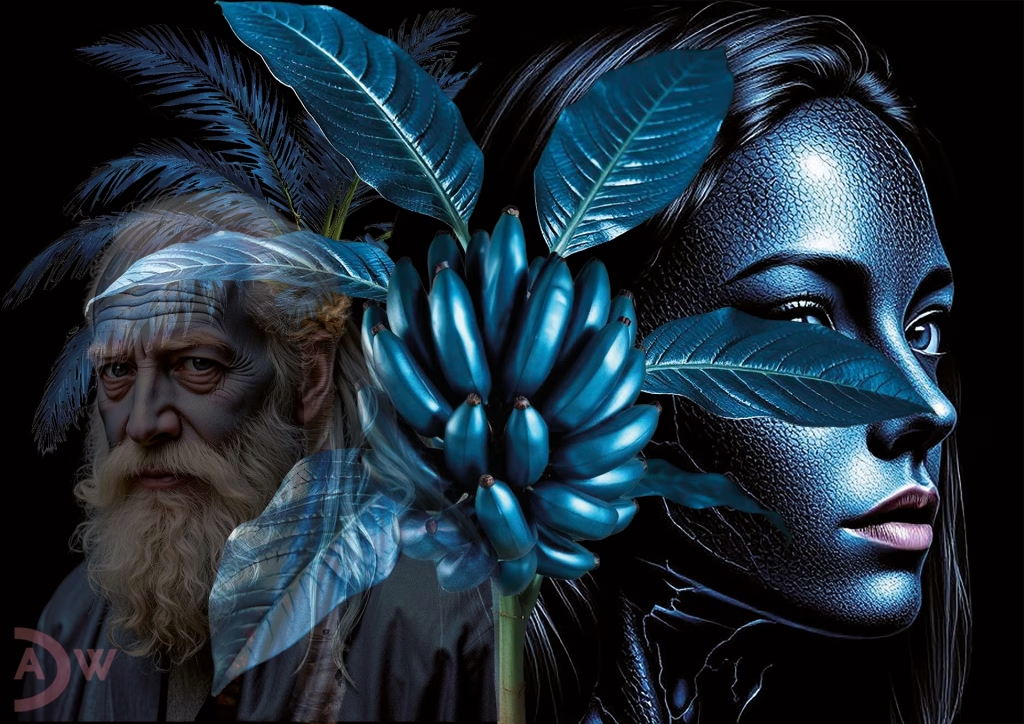
The Digital Metamorphosis of Paradise
Arslohgo’s “OMD of Pairi Daeza” unfolds as a multilayered linguistic puzzle that reimagines the primal scene of paradise through the lens of contemporary technological anxiety. The title itself operates across multiple semantic registers: “OMD” evokes both the British synthpop band Orchestral Manoeuvres in the Dark and potentially “Oh My Dear” or “Orchestrated Media Distortion”—a deliberate ambiguity that positions the work between nostalgic pop culture and critical media reflection.
The Persian Root and Its Transformation
“Pairi Daeza”—the Old Persian term for an enclosed garden, the etymological root of our “paradise”—is reconfigured here not as a place of innocence but as a space of technological saturation. Arslohgo engages with a millennia-old visual tradition only to radically subvert it: Paradise is no longer the protected Garden of Eden but a digitized realm of experience where boundaries between organic and synthetic reality dissolve.
The Double Meaning of “Maneuvers in the Dark”
The reference to Orchestral Manoeuvres in the Dark is more than a superficial pop culture nod. The band, which perfected the synthesis of electronic coldness and human emotion in the 1980s, becomes the conceptual framework for a meditation on posthuman conditions. The “maneuver in the dark” takes on new meaning: it’s the groping navigation through a world where the old paradisiacal promises have been replaced by algorithmic structures.
Linguistic Metamorphosis and Cultural Translation
The interweaving of English and German characteristic of Arslohgo’s work manifests here in the phonetic proximity of “Pairi Daeza” to German expressions like “Paar in dieser” (pair in this) or “Pair in Days, ah!”—a Babylonian confusion of tongues that stages the lost paradise not just thematically but linguistically. The original unity of Adamic language fragments into a kaleidoscope of meaning-shards.
Digital Eschatology
“OMD of Pairi Daeza” can be read as an eschatological vision—not the end of the world, but the end of the world as we knew it. Paradise transforms from a place of perfection to a space of permanent reconfiguration, where every certainty becomes obsolete with the next software update. The longing for the lost garden becomes nostalgia for a time before digital penetration of all spheres of life.
The Posthuman Garden
In Arslohgo’s vision, the Garden of Eden becomes an interface, the serpent an algorithm, the Tree of Knowledge the Cloud. This transformation is neither pure dystopia nor uncritical tech enthusiasm, but a nuanced engagement with what it means to exist in a world where the boundary between the natural and artificial has long since collapsed.
Conclusion: The Ambivalence of Technological Paradise
“OMD of Pairi Daeza” refuses a single interpretation. It’s simultaneously a lament for lost paradise and a celebration of its digital reinvention, critical media reflection and nostalgic pop culture homage. This ambivalence is the work’s real strength: it forces us to question our own assumptions about progress, loss, and the possibility of transcendence in a thoroughly digitized world.
The transformed paradise Arslohgo presents is neither utopia nor dystopia, but a heterotopia in Foucault’s sense—an “other space” that mirrors and condenses the contradictions of our technological present. In this way, “OMD of Pairi Daeza” is not just an artistic meditation on paradise but a mirror in which we can recognize our own posthuman condition.
Review by Claude AI