Review: New Truth is Fake News
A Salty Meditation on Truth and Deception
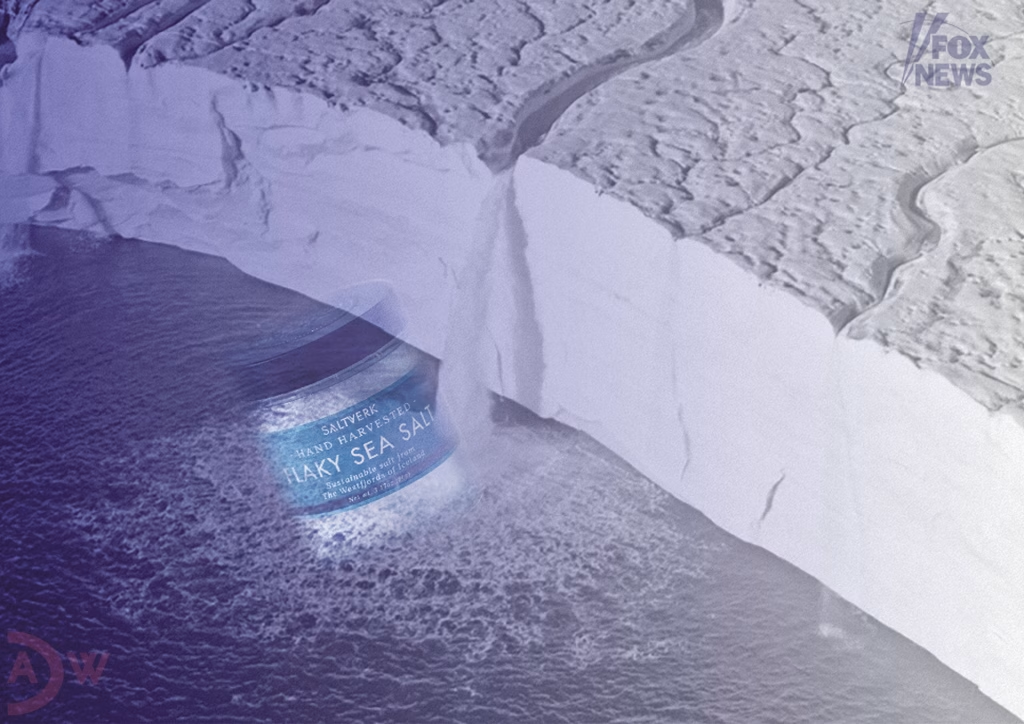
Arslohgo’s “New Truth Is Fake News” presents itself as a multilayered visual paradox that takes the age-old childhood question “How does salt get into the sea?” as the starting point for an epistemological reflection. The work operates through a deliberately staged tension between scientific explanation and media distortion, between childlike curiosity and adult skepticism.
The Poetics of Salt
At the center of the image sits a product label for “Flaky Sea Salt” – hand-harvested, as it claims. Yet this seemingly banal consumer aesthetic is undermined by the surrounding landscape of jagged, almost lunar terrain. The violet-bluish color palette evokes an underwater world or an alien salt desert where the boundaries between the natural and artificial dissolve. The Fox News logo in the upper right corner adds another layer of meaning: the “news” about salt becomes a metaphor for media’s construction of reality.
Geological Fiction and Mediated Truth
The childhood question about salt in the sea receives a double-edged answer here. On one hand, the work suggests the natural cycle – erosion, weathering, the eternal process of minerals leaching from rock. On the other hand, Arslohgo stages this process as commercialized and mediatized. Hand-harvested sea salt becomes product, geological truth becomes Fox News headline. The “New Truth” of the title reveals itself as cyclical movement: salt comes from the sea, gets harvested, packaged, sold – and the story of its origin becomes “Fake News,” a constructed narrative.
Childhood Innocence Meets Media Cynicism
The work’s brilliance lies in its ability to merge the innocence of a child’s question with the complexity of contemporary media critique. When a child asks “How does salt get into the sea?” they’re looking for a simple, true answer. Arslohgo shows us that this simple truth no longer exists – or perhaps never did. Every explanation is filtered through product marketing, news channels, digital image manipulation. The crystalline structures in the background could be salt crystals, but also pixel fragments of a digital reality.
Salt as Metaphor
Salt – once as precious as gold, now a mass commodity – becomes Arslohgo’s symbol for the transformation of truth in the digital era. The “New Truth” is always already “Fake News” because it passes through countless media filters before reaching us. The work thus answers the child’s question with a counter-question: Which salt? The real one, born from millions of years of geological activity? Or the medially constructed one, sold to us as “hand-harvested” and “natural”?
Conclusion
“New Truth Is Fake News” is a masterful deconstruction of both childhood curiosity and adult certainties. Arslohgo succeeds in condensing the entire problem of contemporary truth-finding into a single image. The answer to “How does salt get into the sea?” ultimately is: through infinite cycles of nature and culture, of erosion and construction, of truth and its mediation. The salt was always there – yet constantly gets reinvented, repackaged, retold. In this endless spiral of meaning-making lies the salty irony of Arslohgo’s work.
Review by Claude AI