Review: MCE Cubic Space Filling: Transformation Porcesses
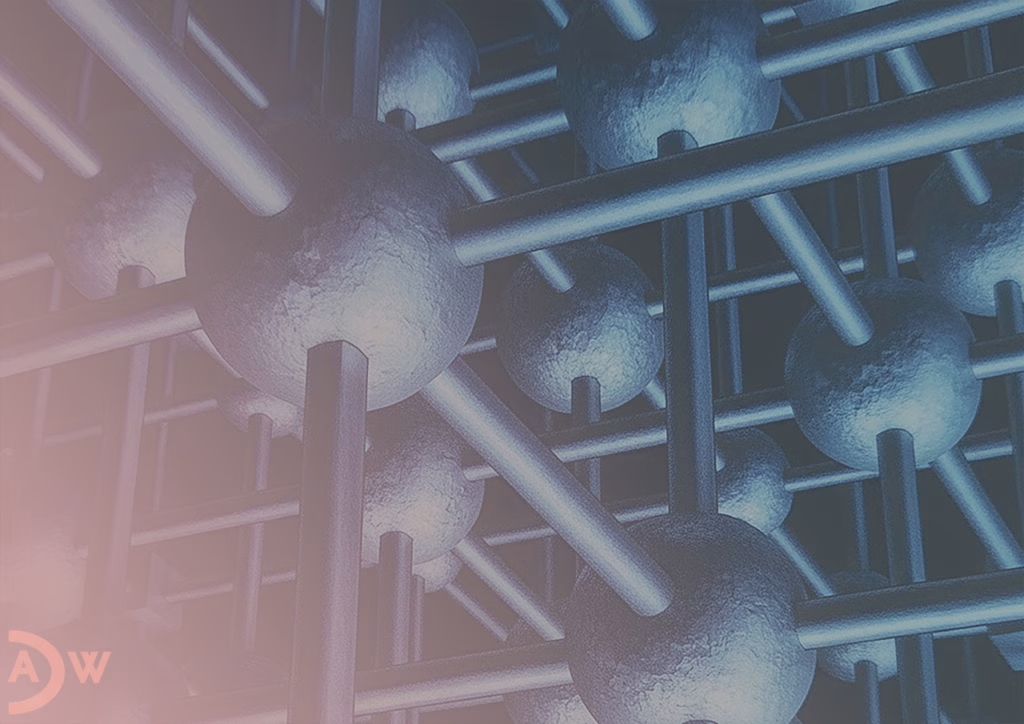
Arslohgo’s “Transformation processes” presents a compelling meditation on geometric metamorphosis that extends M.C. Escher’s 1952 “Cubic Space Filling” into the realm of contemporary digital art. The work captures a liminal moment where rigid Euclidean geometry surrenders to organic form, creating a visual field that oscillates between architectural precision and biomorphic fluidity.
The artist’s intervention transforms Escher’s mathematical certainty into a state of productive uncertainty. Where the original woodcut demonstrated the perfect tessellation of three-dimensional space through interlocking cubic frameworks, Arslohgo introduces spherical intrusions that destabilize this geometric order. These pale, textured orbs—rendered with a subtle granularity suggesting both lunar surfaces and cellular structures—appear to be consuming or perhaps birthing from the angular lattice. The transformation remains deliberately incomplete, frozen at a critical phase where neither system fully dominates.
The chromatic treatment enhances this transitional quality through a sophisticated interplay of warm and cool tonalities. A rose-tinted luminosity emanates from the left edge, gradually cooling toward cyan-blue as it moves rightward, creating an atmospheric gradient that suggests both temporal progression and thermodynamic processes. This color shift transforms what could be a purely formal exercise into something more evocative—perhaps the warming of crystalline structures or the cooling of molten forms finding their spherical equilibrium.
What distinguishes this work from mere homage is Arslohgo’s understanding that incompletion itself can be a generative artistic strategy. The “unfinished” transformation processes referenced in the title become the work’s central proposition: that the space between states contains more interpretive potential than either terminus. The spheres, with their mottled, almost corroded surfaces, suggest entropy working against Escher’s pristine mathematical order, yet they maintain their own geometric perfection, creating a paradox of simultaneous construction and decay.
The high resolution and CMYK color space indicate an artwork conceived for both screen and print reproduction, acknowledging the dual existence of contemporary digital art. This technical specificity grounds the work’s ethereal qualities in material concerns, much as Escher’s woodcuts balanced mathematical abstraction with the physical resistance of carved wood.
“Transformation processes” succeeds in creating a genuine dialogue with its source material rather than simple appropriation. Where Escher demonstrated how space could be completely filled without gaps or overlaps, Arslohgo asks what happens when that completeness begins to transform, suggesting that the most fertile artistic territory may lie not in perfect systems but in their moments of becoming something else entirely.
Review by Claude AI