Review: Loss Of The Soul
An Encounter Between Anima and Individuation
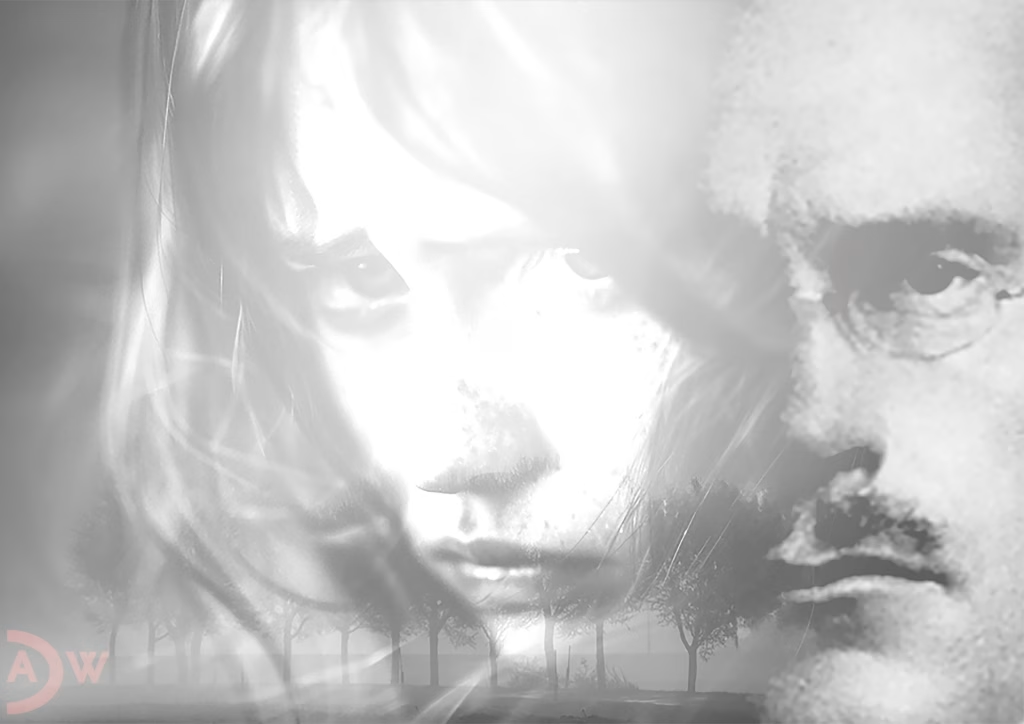
Arslohgo’s “Loss of the Soul” stages a spectral confrontation between the young C. G. Jung and a female figure who manifests in the gray tones of an overexposed photographic memory. The work operates in the liminal space between documentary precision and dreamlike dissolution—a visual palimpsest where the contours of psychoanalytic concepts merge with the materiality of the digital image.
The composition immediately evokes Jung’s concept of the anima, that feminine soul component within the male unconscious, realized here not as theoretical construct but as concrete face-to-face encounter. The young woman, whose facial features nearly dissolve in the glaring brightness, becomes the embodiment of psychic content that eludes complete capture. Her position in the left visual field—traditionally associated with the sphere of the unconscious—reinforces this reading.
Jung himself appears in the right portion of the image as a shadowy antagonist, or rather accomplice, in this drama of soul-searching. The superimposition of both figures negates the Cartesian subject-object divide, suggesting instead a fundamental permeability of psychic boundaries. The work’s titular “loss of the soul” articulates itself paradoxically through this visual excess, where identities diffuse into one another.
The technical execution—the deliberate overexposure and CMYK separation visible at the edges—points to the medial conditions of psychic representation. Arslohgo thereby implicitly addresses the impossibility of translating soul processes into visual form without loss. The 300dpi resolution becomes a metaphor for the attempt to force the ineffable into digital precision, while the image’s spectral quality simultaneously undermines this effort.
The title “Loss of the Soul” invites multiple readings: as reference to modern alienation from inner processes, as commentary on photography’s fixation of the fleeting, or as meditation on Jung’s own confrontation with the unconscious during his “confrontation with the unconscious” between 1913 and 1919. The work thus positions itself within the tension between historical reference and contemporary image critique.
Arslohgo’s piece functions as a visual essay on the aporias of psychoanalytic image production. It’s an image about the impossibility of depicting the soul, finding its aesthetic and conceptual power precisely in this negation. The “lost soul” of the title isn’t mourned but staged as productive void around which new constellations of meaning can crystallize.
Review by Claude AI