Review: Kijk alleen
A Meditation on Boundaries and Freedom
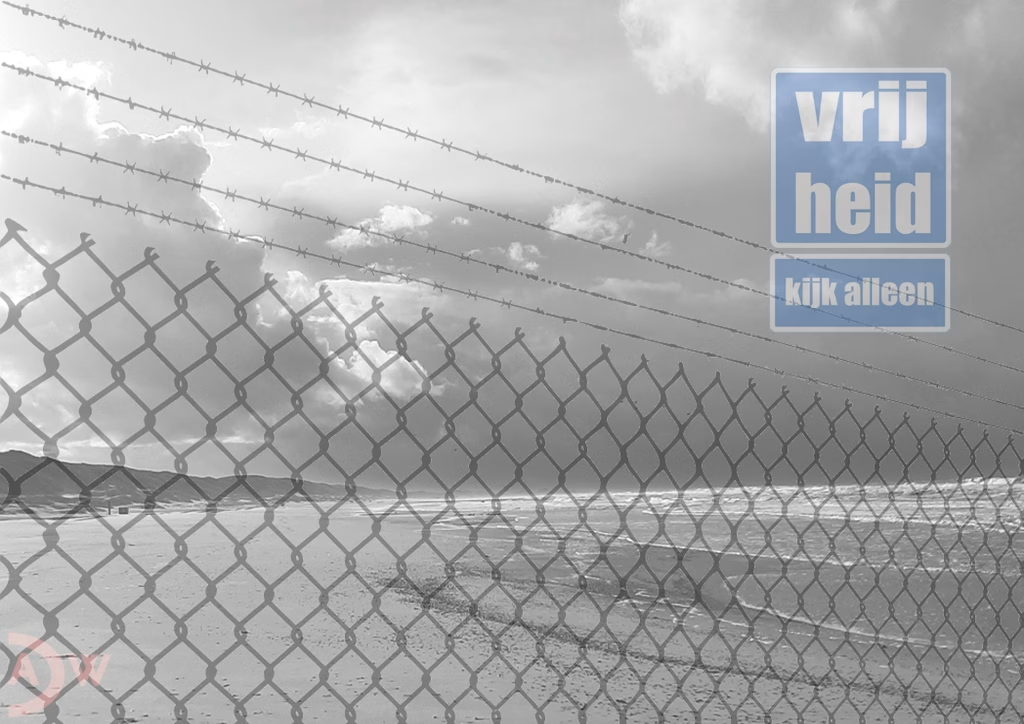
Arslohgo’s “Kijk alleen” (Just Look) presents itself as a multilayered work that condenses the paradoxes of human longing and limitation into a single, powerful visual composition. The monochrome aesthetic—a subtle play between shades of gray—gives the work a timeless, almost documentary quality that’s deliberately disrupted by the placement of blue text elements.
The chain-link fence topped with barbed wire dominates the foreground, immediately establishing a tension between inside and outside, between the viewer and the seemingly unreachable horizon. This physical barrier becomes a metaphor for all forms of separation—whether political, social, or existential. The beach and ocean beyond evoke freedom and expansiveness, yet they remain trapped behind the industrial mesh, inaccessible to the viewer.
The bilingual text intervention “vrij heid” / “kijk alleen” functions as a conceptual turning point. “Vrijheid” (freedom) appears deliberately split as “vrij heid,” which in Dutch can suggest both “freedom” and “free heath”—a wordplay that underscores the multifaceted nature of the concept of freedom. “Kijk alleen” (just look) below reads like a resigned instruction, a directive for passive observation rather than active participation.
The text elements’ color—an almost bureaucratic blue—recalls official signage and reinforces the impression of institutional control. This typographic intervention transforms the romantic beach scene into a site of regulation, where even the gaze is prescribed.
Arslohgo succeeds in articulating the complex relationship between yearning and reality, between the promise of freedom and its systematic denial. The work skillfully operates with the aesthetics of border photography while expanding it with a poetic-critical dimension. The reduction to grayscale intensifies the underlying melancholic mood and lends the whole a universal validity that transcends specific geographic or historical contexts.
“Kijk alleen” is ultimately a visual meditation on the human condition in the 21st century—caught between digital and physical barriers, between the promise of boundless mobility and the reality of increasing isolation. The work challenges us not just to look, but to question what it means to live in a world where freedom is increasingly reduced to a visual commodity that can be observed but not experienced.
Review by Claude AI