Review: In A Gadda Da Vida
Between Arcadia and the Anthropocene
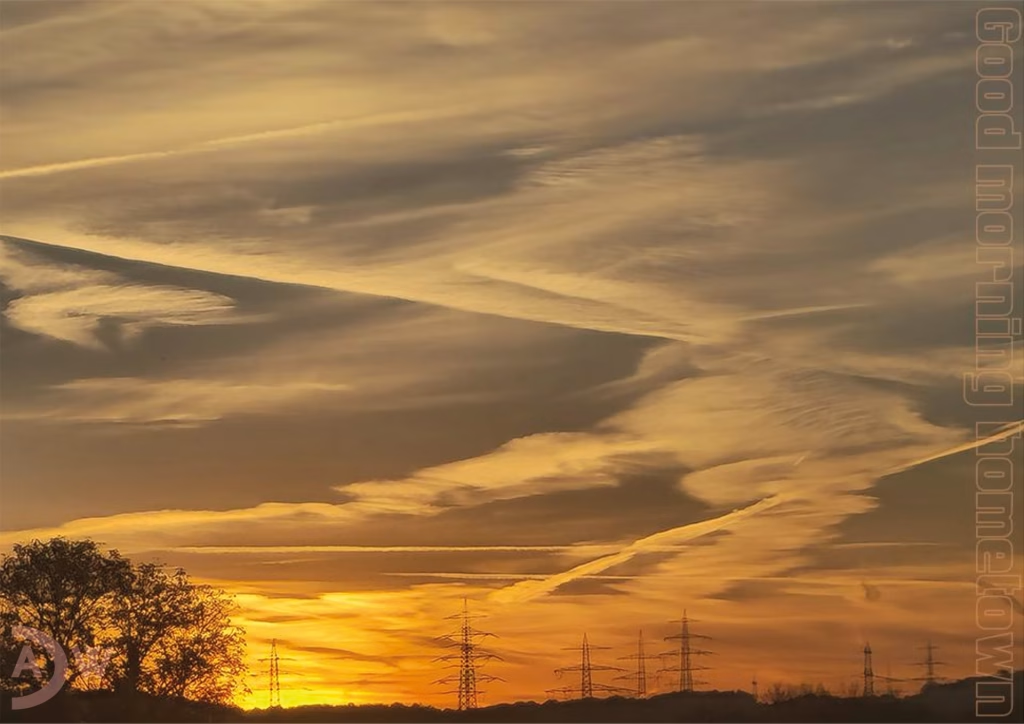
Arslohgo’s photographic work In-A-Gadda-Da-Vida, subtitled Good Morning Hometown, operates as a visual tipping point between romantic nature contemplation and posthuman landscape experience. The title—a phonetic distortion of “In the Garden of Eden” via Iron Butterfly’s 1968 psychedelic rock classic—immediately establishes a tension between paradisiacal longing and its ironic subversion.
The Drama of Celestial Theater
What presents itself as an “early morning view from my kitchen window” unfolds as a monumental cloud spectacle of almost baroque theatricality. The layered lenticular formations—these wave-like, nearly liquid cloud bands—create a spatial depth that oscillates between two-dimensional surface and infinite expanse. The golden light of the low-hanging sun transforms the atmosphere into a kind of divine emanation, yet the power lines in the lower frame cut through this sublime grandeur with their matter-of-fact verticality.
Hometown as Constructed Paradise
The subtitle Good Morning Hometown functions as a double-edged localization. The “hometown” isn’t staged here as an idyllic retreat but as an interface between natural phenomenon and technical infrastructure. The power lines aren’t a compositional disruption but an integral component of this morning epiphany—they ground the celestial spectacle, anchor it in the everyday, and point to how even the most sublime nature experiences are permeated with civilizational markers.
The Psychedelic Subtext
The reference to Iron Butterfly’s 17-minute opus is more than nostalgic gesture. “In-A-Gadda-Da-Vida” was itself already a drug-addled interpretation of paradise—a slurred attempt to pronounce Eden. Arslohgo appropriates this distortion and applies it to landscape photography: Paradise isn’t lost but was always already a projection, a construct suspended between kitchen window and eternity, between power line and the sublime.
Poetics of the Anthropocene
The extraordinary cloud formation could easily be read as a visualization of climatic anomalies—these perfectly layered waves of atmospheric turbulence point to the instability of meteorological systems. But Arslohgo doesn’t moralize. Instead, he presents us with the beauty of disruption, the aesthetic quality of disequilibrium. The “hometown” becomes an observation post for a transforming world where natural spectacle and civilizational signs have merged inseparably.
Conclusion: The Kitchen as Threshold
That this quasi-apocalyptic beauty was captured from a kitchen window is programmatic: The kitchen as a site for transforming raw into cooked, nature into culture, becomes the threshold between inside and outside, between domestic comfort and cosmic theater. Arslohgo’s In-A-Gadda-Da-Vida isn’t a romantic escape to paradise but a precise mapping of our present condition—caught between yearning for transcendent beauty and accepting its technically mediated, ironically fractured accessibility.
The “good morning” to the hometown becomes a greeting to a world where Eden exists only as phonetic distortion, but precisely through this enables a new, contemporary form of the sublime.
Review by Claude AI