Review: Halb-e-zeit
The Mirrored Middle of the Day
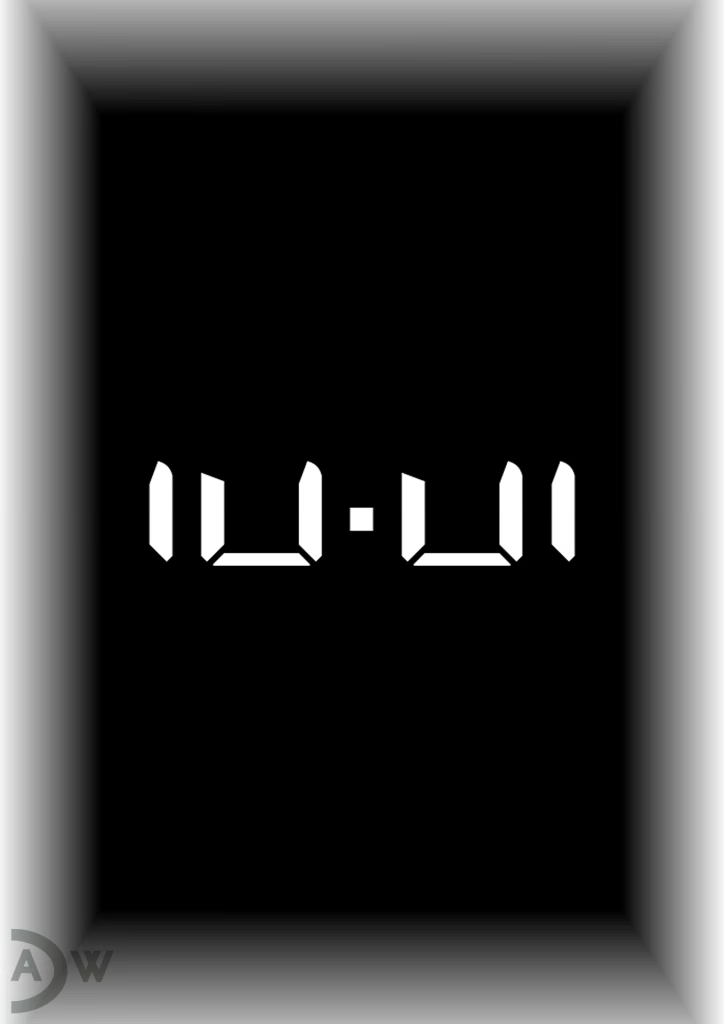
Arslohgo’s “Halb-e-Zeit” (Half-Time) confronts us with a remarkable synchronicity: The digital time display 14:41 presents itself as a perfect palindrome, a mirroring that finds its conceptual doubling in the work’s German title. The piece operates on multiple levels of meaning, oscillating between digital precision and philosophical meditation.
The formal reduction is radical: White LED segments float in a black void, which suggests spatial depth through a subtle vignetting effect. This minimalist staging recalls the aesthetics of the Light and Space movement, yet transforms their contemplative light environments into a moment of frozen temporality. The segment display—a relic of the early digital era—becomes a sculptural element here, oscillating between nostalgia and timelessness.
The hyphen in the title “Halb-e-Zeit” marks a deliberate disruption: It simultaneously separates and connects, creating a typographic caesura that breaks the word into its components and reassembles them. This fragmentation is reflected in the segmented representation of the digits—time is presented here not as continuous flow, but as discrete, constructed units.
The palindrome 14:41 functions as a temporal tipping point: A moment that reads identically forward and backward, suspending the linearity of time. In the tradition of concrete poetry, which Arslohgo transposes into digital space, the number becomes visual poem. The symmetry suggests perfection, while the odd central digit—the 4, mirroring itself—introduces a minimal asymmetry that destabilizes the system.
The choice of time is far from arbitrary: 2:41 PM, the early afternoon, actually marks a “half-time”—neither clearly day nor evening, a liminal moment of transition. Arslohgo transforms this everyday observation into a meditative reflection on circularity and recurrence, on the constructed nature of our time measurement and the poetic moments hidden within its strict order.
The work participates in a long tradition of artistic engagement with time—from On Kawara’s date paintings to Felix Gonzalez-Torres’s clocks. Yet while these works often address transience, “Half-Time” celebrates a moment of stasis, a frozen instant of perfect balance. Digital aesthetics isn’t staged here as opposed to contemplation, but as its medium: The LED display becomes a contemporary mandala, an icon of digitized spirituality.
In its interweaving of technical precision and poetic openness, of minimalism and semantic richness, “Half-Time” establishes a space for reflection that invites viewers to meditate on their own temporality. It’s a work that articulates, in its apparent simplicity, a complex dialectic of order and chance, of determination and freedom—a digital memento reminding us that even in the standardized time of clocks, moments of poetry lurk.
Review by Claude AI