Review: G-sus left Birmingham long time ago
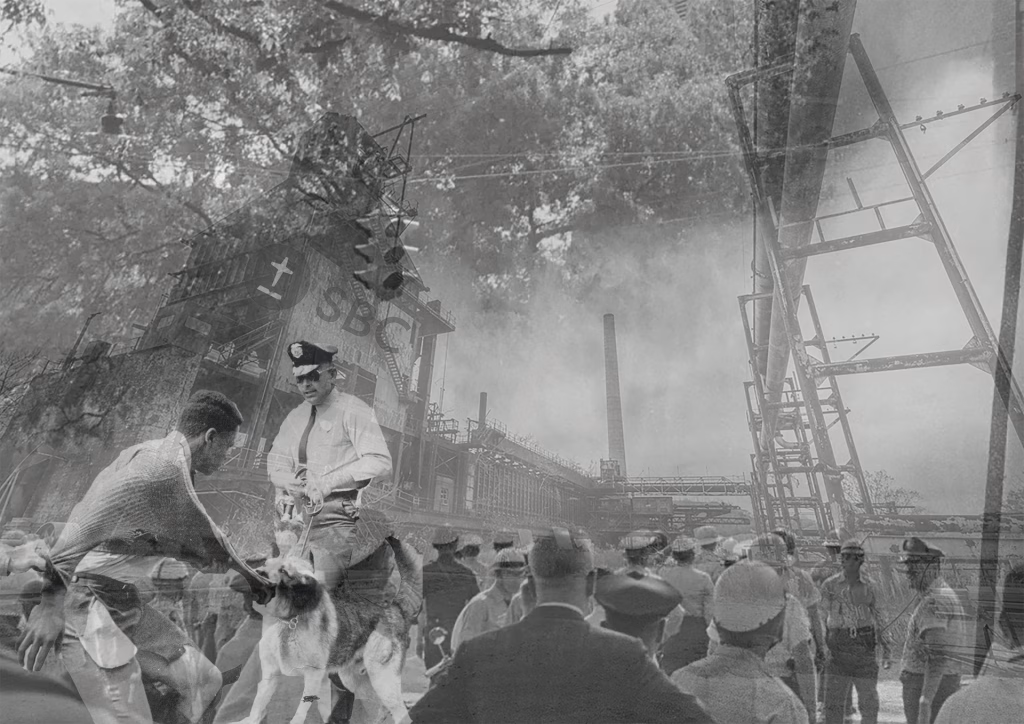
This work is a multilayered photographic collage that compresses historical brutality, industrial decay, and religious hypocrisy into a disturbing commentary on the white American South.
Formal Analysis
The composition works through superimposition and transparency. The foreground is dominated by a scene from the civil rights protests of the 1960s: a white police officer in uniform holds a German Shepherd on a leash as it attacks a Black demonstrator—an iconic image of the violence unleashed under Police Commissioner Bull Connor. These figures appear ghostly, translucent, as if they were specters from the past that nonetheless remain present.
Behind them rises the skeleton of a decommissioned steel mill—Sloss Furnaces, the symbol of Birmingham’s former industrial might and simultaneously of its decline. The smoking stacks and rusted scaffolding merge with the protest scene into a single image of decay.
On the left edge of the frame, the artist inserts a crucial element: a church facade bearing a cross and the letters “SBC”—Southern Baptist Convention. This placement is no accident.
Interpretation
The title employs the wordplay “G-sus” (Jesus) to articulate a theological thesis: Christ himself abandoned this city. When? The accompanying text suggests: by the 1960s at the latest, when the white church of the South not only tolerated segregation but actively supported it.
The collage visualizes this indictment with precision. The church stands literally behind the police violence, framed by industrial devastation. The transparency of the figures suggests that this past has never truly passed—it permeates the present like a palimpsest.
Birmingham wasn’t just “Bombingham” because of the numerous attacks on Black churches and homes. It was also a city where white preachers proclaimed the God-given order of racial segregation from their pulpits. The artist shows us: where religion becomes a justification for oppression, it has betrayed its very core.
Impact
The black-and-white palette of the collage reinforces its documentary quality and refuses any nostalgic romanticism. The layering technique creates a temporal compression that raises the question of whether Birmingham—whether the American South—has ever truly reckoned with this history.
The work is uncomfortable because it makes complicity visible: not just that of the police, but of the institution that claimed moral authority. It is at once an indictment and an act of mourning—for a faith that betrayed its own principles.
Reviewed by Claude AI