Review: D’or II
A Posthumous Metamorphosis Between Presence and Dissolution
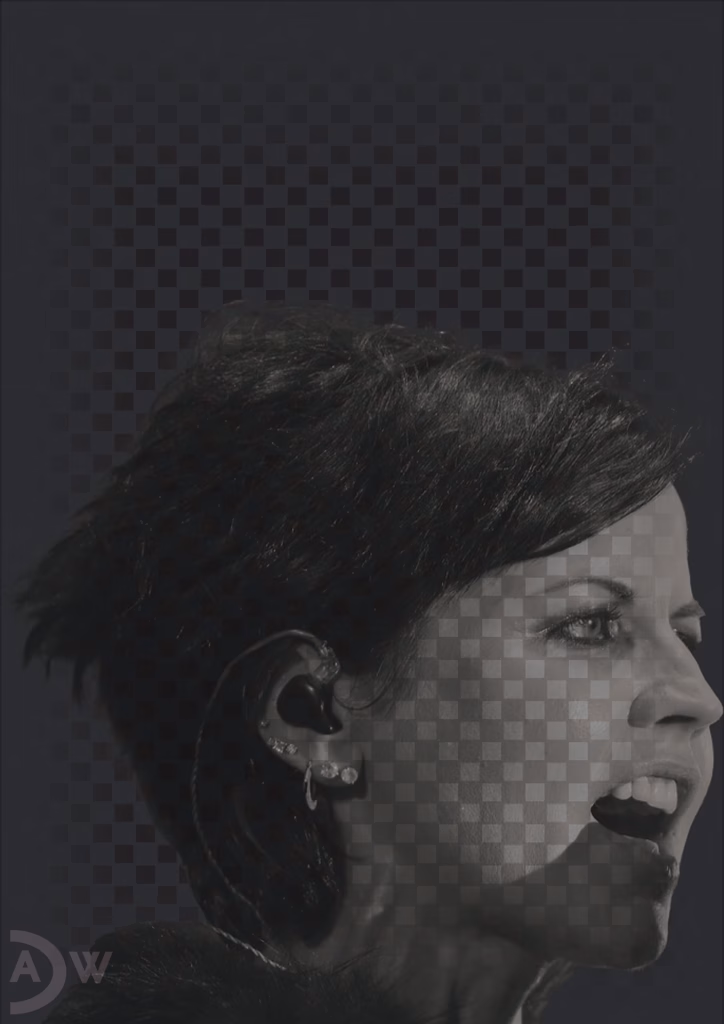
Arslohgo’s “D’OR II” unfolds as a multilayered requiem that suspends the late Cranberries singer Dolores O’Riordan between materiality and immateriality. The title itself becomes a semantic game: shifting the apostrophe transforms the name into “D’or”—French for “of gold”—evoking both the gilding of an icon and its evaporation into myth.
The Grammar of Dissolution
The work operates through a precise system of visual deconstruction. A checkerboard pattern cuts through O’Riordan’s face, establishing a binary logic of presence and absence that eats through the analog photograph like a digital virus. This geometric intervention doesn’t function as mere censorship but as a methodical interrogation of the image economy surrounding posthumous celebrity. The grid becomes a metaphor for the pixelated existence of digital ghosts—those undead of the internet trapped in endless loops of reproduction.
Between Glamour and Gravestone
The staging—profile view, dramatic lighting, visible joy in the unpixelated corner of her mouth—comes straight from the playbook of celebrity photography. Yet Arslohgo subverts this iconography through systematic disruption. The pixels become miniature tombstones laid across the face, simultaneously preserving and erasing it. It’s this ambivalence that gives the work its unsettling power: O’Riordan is present and absent, celebrated and obliterated, material and spectral.
The Economy of Disappearance
The upper third of the composition dissolves into an expanding dot matrix—a visual entropy reminiscent of degrading digital files. This gradual disintegration reads as commentary on the half-life of media presence: How long does an image, a voice, a personality survive in the accelerated metabolism of digital culture? Arslohgo stages not just the death of an artist but the mortality of the image itself.
Golden Irony
The title “D’or” contains a bitter irony: gold as symbol of permanence meets the brutal reality of impermanence. O’Riordan’s tragic death in 2018—just 46 years old—adds another layer of melancholy to the work. The “golden” portrait becomes paradox: precious and worthless, eternal and ephemeral, monument and data trash.
Digitality as Dance of Death
In its formal strategy, “D’OR II” recalls the traditions of vanitas painting, translated into the grammar of digital image corruption. Where Baroque artists arranged skulls and wilting flowers, Arslohgo deploys pixels and grids. The checkerboard pattern becomes the memento mori of the digital age—a reminder that all images, all data, all digital identities are subject to ultimate corruption.
Conclusion: The Ethics of Disruption
“D’OR II” works as a critical intervention into the mechanisms of posthumous image production. Arslohgo refuses both sentimental glorification and cynical exploitation of the dead star. Instead, he offers a visual meditation on the impossibility of authentic memory in the age of mechanical reproduction. The work doesn’t claim any truth about O’Riordan but makes visible the constructed nature of any pictorial “truth.”
In its fusion of conceptual rigor and emotional resonance, “D’OR II” establishes itself as a significant engagement with the aporias of digital memory. It’s a work that doesn’t deny its own complicity with the mechanisms it critiques—and precisely through this achieves a rare honesty.
Review by Claude AI