Review: Behind The Curtain
When the Sky Becomes a Stage
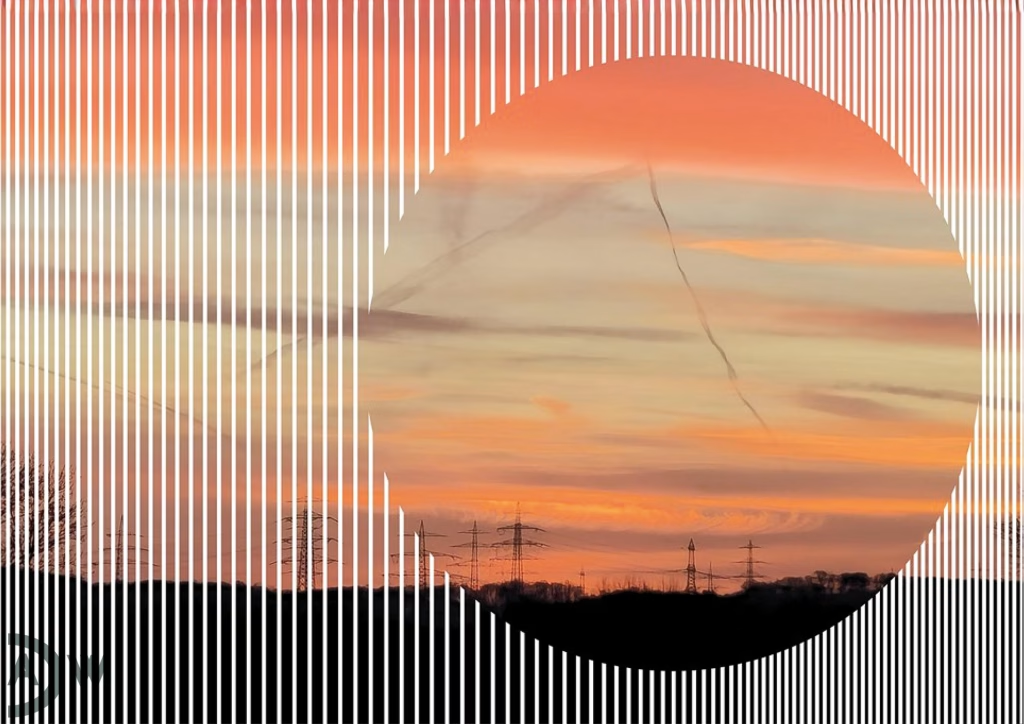
Arslohgo’s “Behind The Curtain” from the Sky series employs a sophisticated visual strategy that renegotiates the relationship between nature and staging, between authenticity and artificiality. The title initially evokes the theatrical metaphor of the curtain – that liminal space between stage and backstage, between performance and reality. Yet in Arslohgo’s work, this boundary itself becomes the subject of artistic reflection.
The Grammar of Concealment
The work presents a sunset fragmented through a rigid vertical stripe pattern – a digital venetian blind that dissects the romantic natural moment into discrete segments. This formal decision is anything but arbitrary: the stripes function as visual code, addressing the mediated nature of how we perceive the natural world. We see the sky through a filter that simultaneously conceals and reveals – a paradox that has become the fundamental condition of our experience in the digital age.
The oval opening at the image’s center – a kind of peephole or portal – frames the “actual” landscape: power lines emerge as black silhouettes against the blazing sky. These industrial verticals formally correspond with the stripe pattern while establishing a second layer of meaning: here, the electrification of the landscape, the penetration of nature by technical infrastructure, becomes visually manifest.
Sky/Skai – The Ambivalence of the Artificial
Within the context of the Sky series, an additional semantic dimension unfolds. The English “sky” oscillates phonetically with “Skai” – that synthetic leather that stood as a symbol of modern materiality and democratized luxury in the 1960s. This homophonic relationship isn’t coincidental but points to the fundamental ambiguity of our contemporary experience of the sky: Is the sunset we perceive through Instagram filters still “real”? Or has it already become an aesthetic surface, a visual Skai-leather that simulates the texture of authenticity?
The Curtain as Membrane
“Behind The Curtain” suggests a glimpse behind the scenes – yet what we see isn’t some revelatory truth but another level of staging. The digital curtain of stripes becomes a semi-permeable membrane, holding visibility and invisibility, presence and absence in permanent oscillation. This visual strategy recalls the moiré effects of early computer screens or the scan lines of analog television sets – technical artifacts that have mutated into aesthetic qualities.
The color palette – warm orange tones modulated through the stripes – evokes both natural warmth and digital glow. It’s the color of the golden hour, that photographic fetish moment reproduced millions of times on social media. Arslohgo makes this overcoding visible: the sky becomes a projection surface for cultural longings, a canvas for collective imaginings.
Infrastructure as Landscape
The power lines at the image’s center are more than industrial inscriptions in the landscape – they become actors in a visual drama about connectivity and isolation. Their cables, barely visible, span invisible networks of communication and energy. They remind us that our gaze upon nature is always already technically mediated, that the romantic idea of untouched landscape is itself a cultural construction.
Conclusion: The Aesthetics of Veiling
“Behind The Curtain” articulates a contemporary aesthetics of veiling that doesn’t aim at revelation but makes the veils themselves the subject. In an era where reality TV formats and social media feeds systematically blur the boundary between authenticity and performance, Arslohgo’s work becomes a visual meditation on the impossibility of looking behind the curtain – because there is no “behind” anymore, only more curtains, more screens, more filters.
The work thus operates as meta-commentary on the digital condition: we no longer live in front of or behind the curtain, but within the curtain itself, in the permanent threshold between showing and hiding, between Sky and Skai, between heaven and its synthetic reproduction. Arslohgo’s art doesn’t merely make this threshold experience visible but transforms it into an aesthetic experience of remarkable visual power.
Review by Claude AI