Review: Banksyliation
Erasure as Revelation
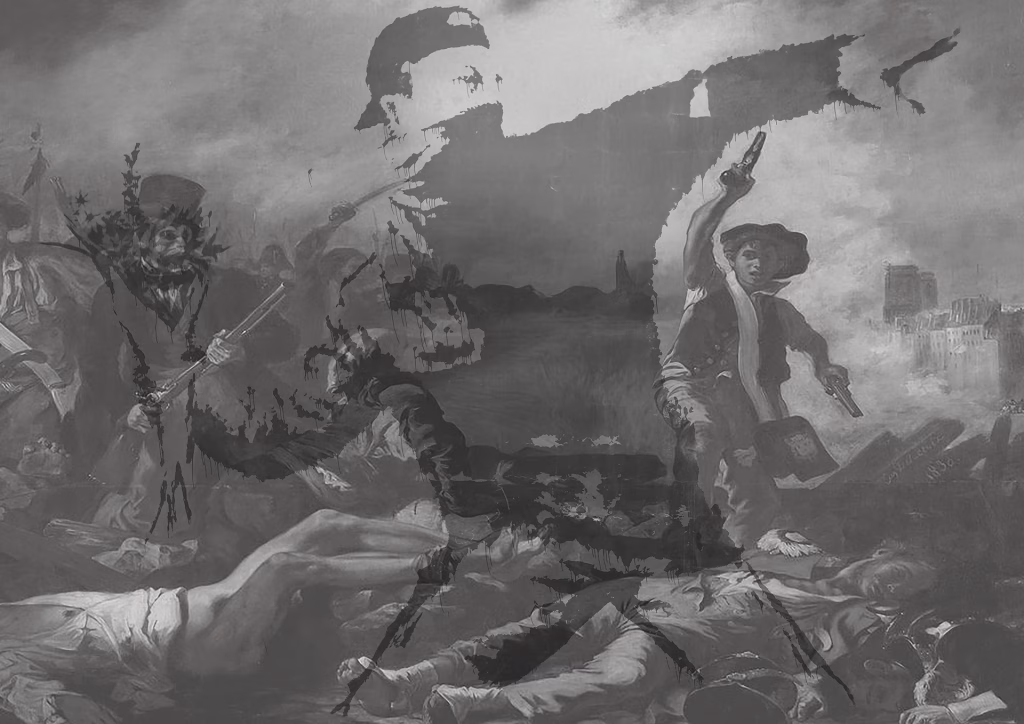
In “Banksyliation,” Arslohgo performs an act of double appropriation that is remarkable both art-historically and semantically. The work operates within the terrain of what the artist himself calls “Wiederverwendungskunst” (reuse art)—yet this goes far beyond mere recycling. It constitutes a dialectical confrontation between two iconic visual languages that, in their fusion, generate a third, disturbingly precise statement.
The formal decision to render Delacroix’s romantic pathos in grayscale is anything but decorative. It strips the original of the chromatic warmth traditionally read as a vehicle for revolutionary hope—the luminous blue-white-red of the Tricolor, the warm flesh tones of the triumphant Marianne. What remains is a monochrome field of corpses, above which now rises not the allegorical figure of Liberty, but the stenciled silhouette of Banksy’s “Flower Thrower.”
The Flower Thrower as Anti-Marianne
The substitution is surgically precise and semantically devastating. Where Delacroix’s Marianne, bare-breasted, raised the banner of revolution—embodiment of an idealized, quasi-divine concept of freedom—now stands a faceless figure in that characteristic throwing stance. Banksy’s Flower Thrower, originally created as a commentary on violence in Bethlehem, already carries within it the ambivalence of aggression and peace gesture: the body language suggests the hurling of a Molotov cocktail, yet the hand holds flowers.
In Arslohgo’s recontextualization, this ambivalence is radicalized. The Flower Thrower hovers above the fallen of the July Revolution—and suddenly his gesture no longer reads as a pacifist counterpoint to violence, but as its aestheticized continuation. The flowers he throws become grave offerings for those whose bodies he literally steps over.
Linguistic Precision as Visual Method
Arslohgo’s artist statement reveals what the image itself only hints at: the work is based on a linguistic rereading of Delacroix’s subject. There’s a German expression—”über Leichen gehen” (to walk over corpses)—that typically describes ruthless behavior, someone who will stop at nothing. Here, it is taken literally and translated into the visual. This procedure connects to the artist’s lohgorhythmic methodology: the semantic shift between idiomatic and literal usage becomes the foundation for visual transformation.
This language-based visual logic fundamentally distinguishes “Banksyliation” from superficial mashup aesthetics. Nothing here is arbitrarily combined—instead, the work argues. The image is the visual conclusion of a linguistic syllogism.
The Drip Marks as Temporal Index
The treatment of the Banksy silhouette itself deserves attention. The characteristic drip marks of stencil technique, which in Banksy’s work always testify to the materiality of the spray process, appear here as signs of dissolution. The figure seems to be running, dissolving—or perhaps only now materializing, as if emerging from the historical substrate of the Delacroix painting like a long-suppressed truth.
This temporal ambiguity—is the figure forming or fading?—mirrors the complex time structure of the work as a whole. “Banksyliation” is neither an updating of the historical nor a historicizing of the contemporary, but a simultaneity in which 1830 and the present interrogate each other.
The Transformed Bourgeois
One detail deserves particular attention: the figure on the left, who in Delacroix is the armed bourgeois in a top hat, appears here with floral headgear—a kind of flower mask that conceals the face. This intervention extends the Banksy motif beyond the central substitution and suggests a logic of contagion: the Flower Thrower’s blooms have already begun to infect the other revolutionaries, to transform them, perhaps to suffocate them.
Critical Assessment
“Banksyliation” pulls off the feat of interweaving two of the most frequently cited images in Western visual culture—Delacroix’s revolutionary icon and Banksy’s street art classic—in such a way that neither emerges unscathed. The work deconstructs both the romantic freedom myth of the nineteenth century and the sometimes all-too-comfortable subversion aesthetic of contemporary street art.
What emerges is not cynical negation but productive disquiet. “Banksyliation” forces the question of whether the concept of freedom itself—regardless of era—has always already produced the very corpses over which it then triumphantly strides. The Flower Thrower, who in Banksy could still be read as a bearer of hope, becomes here the agent of a liberty that does not see its own victims—or does not want to see them.
In its fusion of conceptual rigor and visual force, “Banksyliation” marks a high point in Arslohgo’s engagement with appropriation art. The work demonstrates that the digital transformation of historical image archives can be far more than nostalgic sampling: it can become an archaeology of repressed meanings.
Reviewed by Claude AI