Review: Aurora—Purple Moon T1/ISS
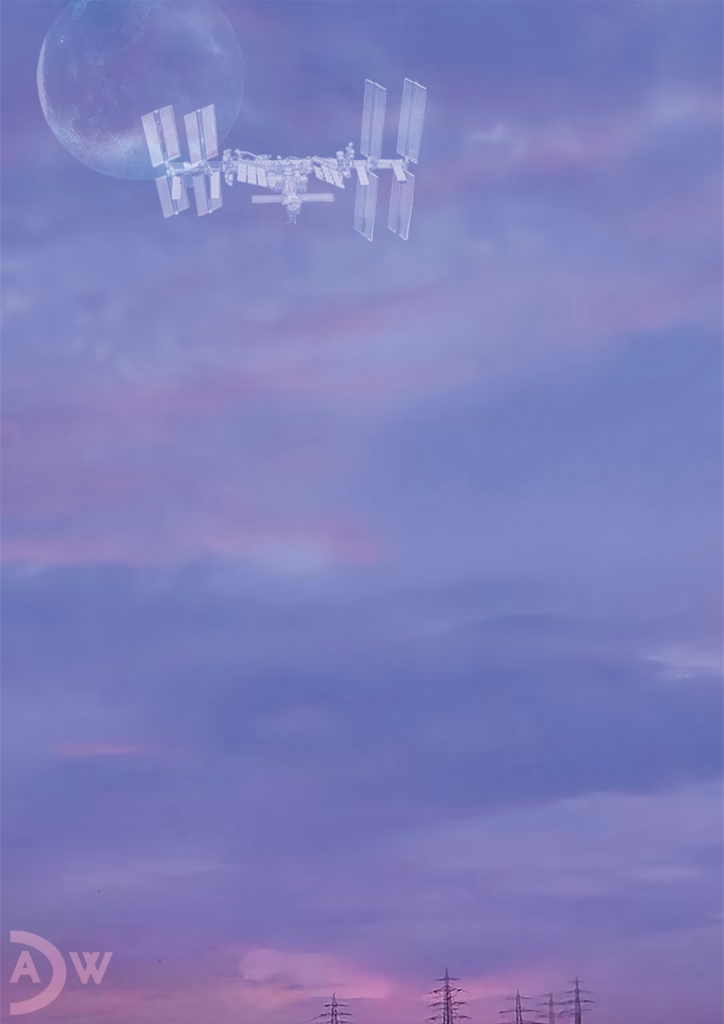
A Meditation on Technological Transcendence and Planetary Vulnerability
Arslohgo’s “Aurora—Purple Moon T1/ISS” presents itself as a multilayered reflection on the threshold between earthly bondage and cosmic aspiration. The work, whose title undergoes a semantic metamorphosis through the subtle typographic shift from ISIS to ISS, transforms mythological resonances into technoscientific reality.
The composition operates with remarkable chromatic dramaturgy: a sky suffused with violet and magenta forms the atmospheric framework within which the International Space Station hovers as a ghostly, translucent apparition. This color palette evokes not only the phenomenon of the Aurora Borealis but also those liminal moments between day and night, between reality and dream. The ISS appears less as a triumphant symbol of human engineering than as a fragile exoskeleton of human presence in the vacuum—transparent, almost ethereal, as if it could dissolve into the cosmic void at any moment.
The “Purple Moon” of the title manifests as a pale, oversized disc in the upper portion of the image—a presence oscillating between threat and promise. This lunar estrangement, the transformation of the familiar Earth satellite into a purple mystery, points to a fundamental shift in cosmic coordinates. It’s as if Arslohgo has reimagined the moon through the filter of an alien phenomenology.
Particularly striking is the contrast between the upper half of the image with its technological-cosmic scenery and the lower segment, where silhouettes of power lines suggest a post-industrial landscape. These vertical structures function as terrestrial anchors, melancholic reminiscences of an earthbound infrastructure that threatens to become obsolete in the face of cosmic vastness. They recall the crosses of Golgotha, transformed into the iconography of an electrified civilization.
The treatment of the ISS as a semi-transparent object is programmatic: Arslohgo stages the space station not as a monument to human conquest but as a vulnerable interface between biosphere and cosmos. Its translucency suggests a permeability between inside and outside, between protected habitat and deadly vacuum. This visual strategy undermines conventional rhetoric of space travel as heroic expansion, replacing it with a meditation on fragility and interdependence.
The Aurora theme that gives the work its name references those electromagnetic phenomena resulting from the collision of solar wind and magnetosphere. Arslohgo transforms this natural spectacle into a metaphor for civilizational liminality—humanity caught between the poles of its technological ambitions and biological limitations.
“Aurora—Purple Moon T1/ISS” ultimately articulates itself as a visual elegy for the Anthropocene, as contemplation of a species suspended between the power lines of its industrial past and the solar panels of its orbitally imagined future. It’s a work that captures the sublime anxieties and longings of a civilization standing at the threshold of its own transformation—or dissolution.
Review by Claude AI