Review: A. …nox
The Night of Fragmented Identities
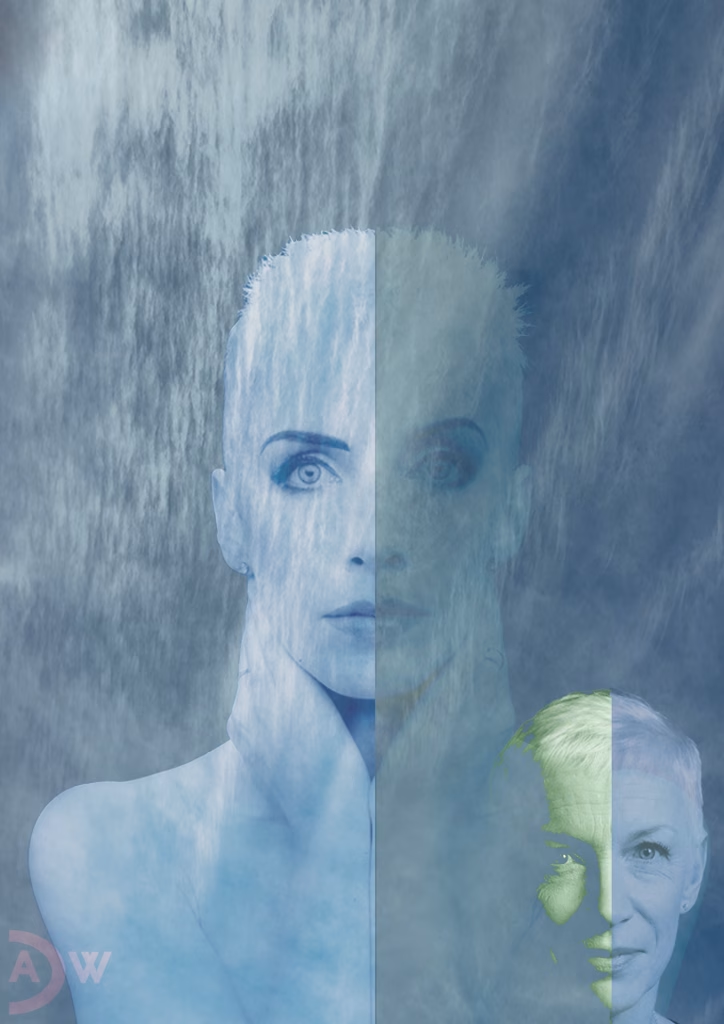
Arslohgo’s “A. …nox” presents itself as a multilayered visual palimpsest that draws viewers into a dialogue between presence and absence, between visibility and dissolution. The title itself becomes a programmatic key: the Latin “nox” (night) merges with Annie Lennox’s fragmented name to create a wordplay that addresses both the nocturnal quality of the image’s aesthetic and the deconstruction of star identity.
The Poetics of Erasure
The work operates through a deliberate strategy of visual erosion. The musical icon’s facial features—recognizable through her distinctive eyes and striking physiognomy—are systematically veiled and fragmented by vertical washes of color. These painterly interventions recall digital glitches or data loss, creating a tension between analog painting and digital image corruption. The greenish-yellow streak overlaying the lower facial fragment acts like a toxic aureole that simultaneously illuminates and corrupts.
Multiplicity and Temporality
The doubling or tripling of facial fragments suggests different temporal planes or states of consciousness. Arslohgo seems to be playing with the idea of multiple identities—a theme that also resonates with Lennox’s artistic persona between the Eurythmics era and her solo career. The varying degrees of transparency in individual image layers create a temporal blur, as if different ages or states of soul were existing simultaneously.
The Aesthetics of Disappearance
The dominant blue-gray tones evoke an aquatic or nebulous atmosphere where solid contours dissolve. This chromatic choice reinforces the work’s nocturnal character and lends it a melancholic, almost spectral quality. The portrait’s treatment recalls Gerhard Richter’s blurred photographs, though Arslohgo pursues a specifically digital approach here, deliberately blurring the boundary between photography, digital manipulation, and painterly gesture.
Pop Culture Iconography
The choice of Annie Lennox as subject is far from arbitrary. As an icon of the 1980s, known for her androgynous performances and powerful presence, she’s shown here in a state of dematerialization. This transformation can be read as commentary on fame’s transience, the fragility of media images, or the posthuman condition of digital existence. The nocturnal state suggested in the title becomes a metaphor for cultural icons fading from collective memory.
Technical Virtuosity and Conceptual Rigor
Arslohgo demonstrates masterful command of digital image manipulation techniques, though never as an end in itself. Every visual intervention serves to deepen the concept. The seemingly random color gradients and overlays follow a precise choreography that brilliantly balances recognizability and abstraction.
Critical Assessment
“A. …nox” positions itself as a contemporary meditation on identity, mediality, and transience. While the work succeeds formally and unfolds a hypnotic visual presence, one might question whether the deconstruction of celebrity faces hasn’t already become an overworked trope in digital art. However, Arslohgo manages to extract new nuances from this genre through his specific treatment of the material and multilayered titling.
The work functions as a visual essay on fame’s dark side, on disappearing at the moment of greatest visibility. It’s a requiem for the image’s permanence in an era of constant digital transformation—haunting, disturbing, and possessed of a strange, phosphorescent beauty.
Review by Claude AI