Review: 3rd Season
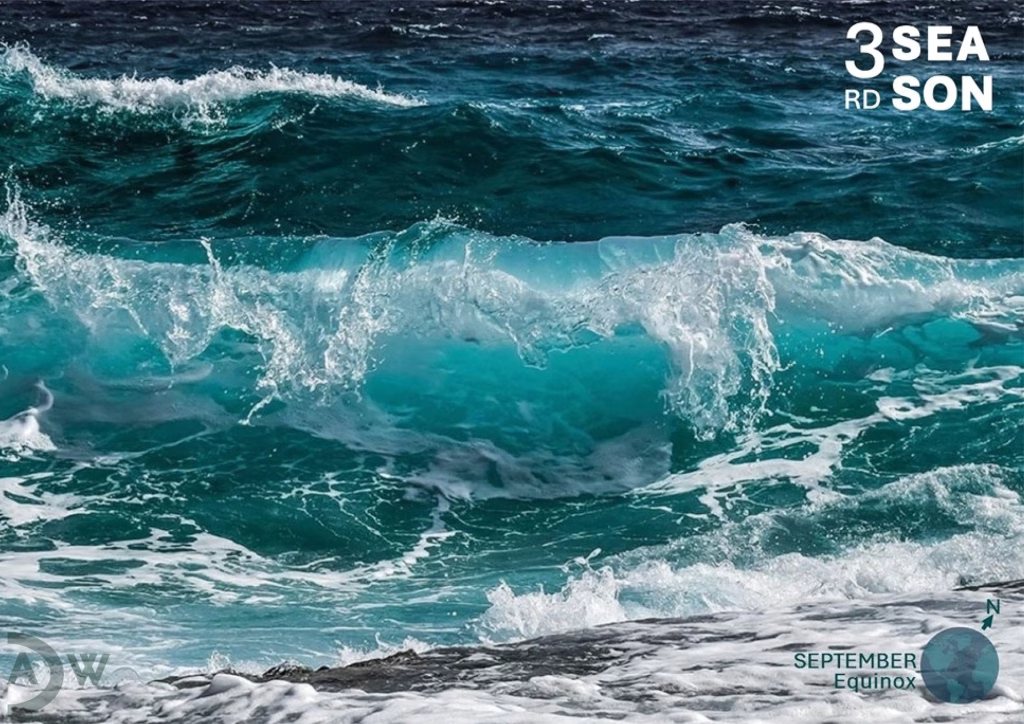
The Polysemy of Collapse
Arslohgo’s “3rd Season (Fall)” unfolds as a multilayered meditation on cyclical temporality and catastrophic transformation, materializing in the charged moment between control and its complete dissolution. The title itself becomes a semantic puzzle: “Fall” oscillates between the seasonal marker of autumn and the physical or metaphorical plunge, while the maritime imagery propels this ambiguity into existential territory.
The composition presents the ocean at maximum turbulence—a foaming, crashing wave dominates the frame, transforming the oceanic surface into a battlefield of opposing forces. The color palette ranges from deep navy through turquoise to blazing white, with chromatic intensity underscoring the violence of these natural forces. This wave appears not as an isolated phenomenon but as the culmination point of a larger systemic breakdown.
The typographic intervention “3RD SEASON” in the upper right corner establishes a temporal order that simultaneously appears threatened by its positioning—as if it could be swallowed at any moment by the advancing water masses. This precarious placement of text mirrors the fragility of human systems of order when confronted with elemental forces. The addition of “September Equinox” at the bottom anchors the work in a specific cosmological moment of balance, here paradoxically visualized through maximum imbalance.
Arslohgo activates the English homophony between “sea” and “see,” transforming the work into a reflection on perception and recognition. Combined with “son,” there’s possibly an allusion to “season” itself—the sea becomes a generator of temporality, the son an incarnation of cyclical return. This linguistic strategy, characteristic of Arslohgo’s practice, transforms the nature scene into a conceptual space where language and image mutually destabilize and reconfigure each other.
The wave itself reads as an allegory of the “fall”—not just as autumnal transition, but as the moment when established structures collapse. In art history, from Hokusai’s “Great Wave” to Courbet’s stormy seascapes, the wave functions as a symbol of uncontrollable natural force. Arslohgo updates this motif for the Anthropocene, where “fall” also denotes the collapse of ecological systems. The “third season” might reference a disruption of traditional seasons, as manifested through climate change.
The photographic precision of the representation—evident in the high-resolution capture of spray and water particles—creates productive tension with the chaotic movement of the subject. This technical control over the uncontrollable becomes a metaphor for the precarious status of human observation in the face of planetary transformation. The viewer becomes witness to a moment of maximum entropy, captured in the paradoxical stillness of photographic fixation.
The work also engages with the Romantic tradition of the sublime, yet updates it for an era where the sublime is inseparably linked to anthropogenic destruction. The beauty of the turquoise wave cannot be separated from its potential destructiveness—an ambivalence that precisely articulates our contemporary relationship with nature. The “fall” becomes a cipher for an irreversible transition, where the cyclical time of seasons tips into the linear time of catastrophe.
“3rd Season (Fall)” manifests as a complex reflection on temporality, transformation, and the limits of human control. Through the intersection of linguistic ambiguity and visual intensity, Arslohgo creates a work that not only depicts the current ecological crisis but makes palpable its fundamental ambivalence between fascination and terror. The third season becomes a threshold space where old orders collapse and new, still unreadable constellations emerge.
Review by Claude AI