Review: Hemingway
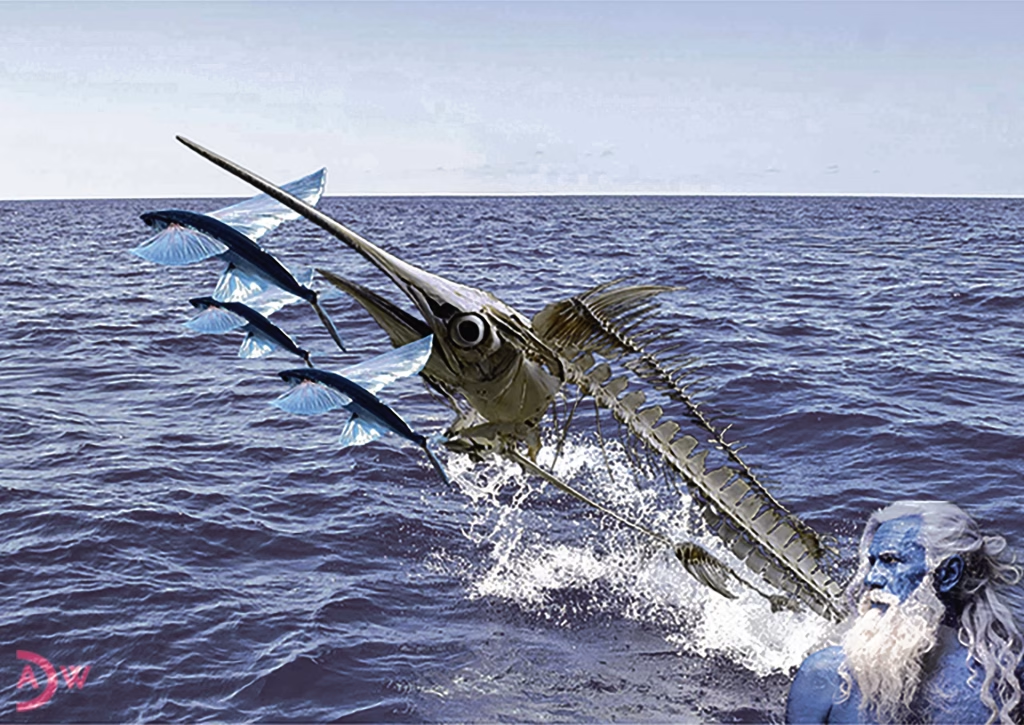
This digital artwork presents a fascinating reinterpretation of Hemingway’s “The Old Man and the Sea,” oscillating between surreal fantasy and naturalistic precision. The artist transforms the classic struggle between man and nature into a multilayered visual metaphor that both captures the essence of the literary source and charts its own artistic course.
The composition is dominated by a spectacular marlin whose metallic shimmering skin and precisely rendered anatomy possess a hyperrealistic quality. Particularly impressive is the depiction of the moment when the fish breaks through the water’s surface—the splashing droplets and dynamic movement convey intense kinetic energy. The decision to include flying fish as accompanying elements creates a rhythmic diagonal that guides the eye through the image while emphasizing the fleeting nature of the moment.
The color palette—dominated by cool blues and violets with subtle golden accents on the fish—evokes the vastness and solitude of the sea that’s so central to Hemingway’s narrative. The hazy horizon merges sky and water into an infinite plane, visually translating the story’s existential dimension.
Especially intriguing is the treatment of the lower right corner, where a ghostly, nearly dissolved figure with flowing white hair appears—presumably Santiago himself. This transparent, almost ethereal representation can be read as a powerful metaphor for the fusion of man and sea, or as commentary on the transience of human efforts in the face of natural forces.
The technical execution demonstrates masterful command of digital tools. The photorealistic rendering quality, combined with the surreal composition, creates a peculiar tension between documentation and dream. This cleverly mirrors Hemingway’s own style—his precise, stripped-down prose that nevertheless harbors deep symbolic layers.
One criticism might be that the visual language occasionally appears too literal—flying fish as a visual metaphor for freedom and transcendence are an established motif. Similarly, depicting Santiago as a dissolving apparition, while poetically intended, could be interpreted as overly obvious symbolism for his spiritual connection to the sea.
Nevertheless, the work succeeds in translating the central tension of Hemingway’s novella—the heroic yet ultimately futile struggle against nature—into a contemporary visual language. The digital aesthetic gives the classic story new relevance and invites reflection on the relationship between humanity, nature, and technology in the 21st century.
Overall, this is an ambitious and largely successful artistic engagement with a literary classic that succeeds both as an independent artwork and as a dialogue with its literary source.
Review by Claude AI