Review: The Dark Side Of The Moon
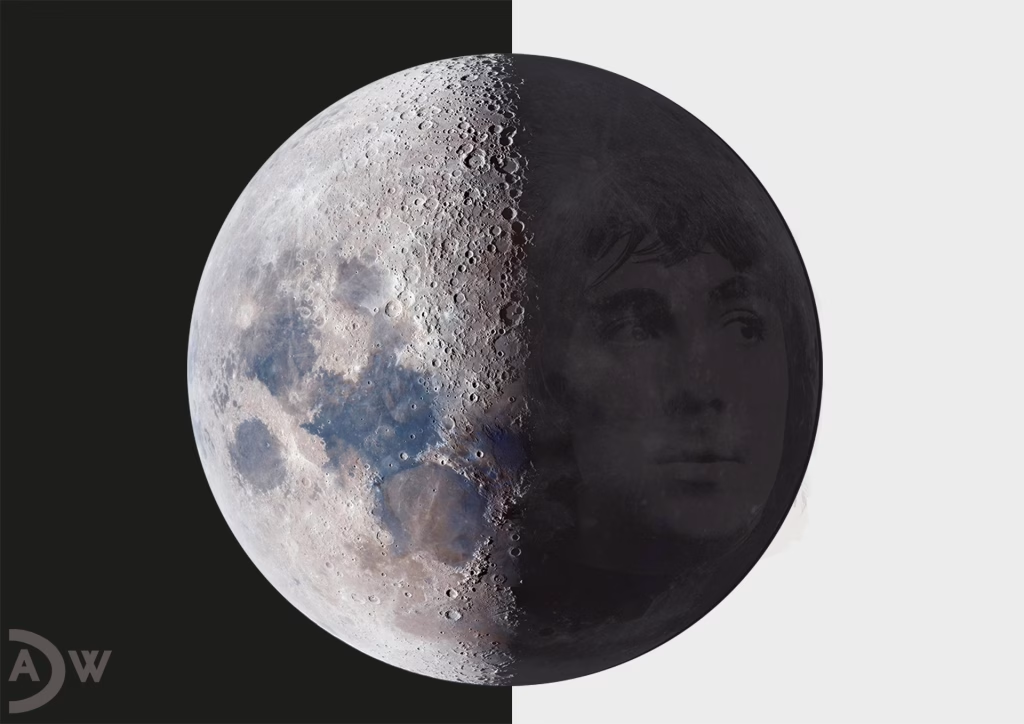
A fascinating reinterpretation of a cultural monument—Arslohgo’s “The Dark Side Of The Moon” combines two iconic moments in rock history with impressive conceptual elegance. The work transforms Pink Floyd’s legendary album artwork into a multilayered visual meditation on light and shadow, both literal and metaphorical.
The composition captivates through its geometric clarity: the moon, perfectly centered and split by the image’s vertical axis, becomes a dual symbol. The left half shows the familiar, crater-covered lunar surface in naturalistic detail—brightly illuminated, scientifically precise, almost documentary-like. The right half, however, sinks into darkness from which Keith Moon’s face, the legendary drummer of The Who, eerily emerges.
This juxtaposition is anything but accidental. Keith Moon, who died in 1978—just five years after Pink Floyd’s album was released—embodied rock’n’roll’s destructive energy like few other musicians. His notorious excesses, manic stage presence, and tragic end at just 32 make him the perfect personification of the “dark side”—not of the moon, but of fame, creativity, and human existence itself.
Arslohgo plays with multiple layers of meaning here: the surname “Moon” is taken literally and simultaneously transcended. The fusion of Keith Moon’s portrait with the celestial body’s shadow side creates a poetic condensation that goes beyond mere wordplay. It’s a reflection on the duality of artistic existence—the blazing spotlight and the consuming darkness behind it.
The technical execution underscores this dichotomy: the precise separation between the black and white halves of the background is mirrored in the treatment of the moon. While the bright side appears almost clinical in its photographic sharpness, Moon’s face loses itself in the darkness, becoming one with it—a visual metaphor for his disappearance into his own legend.
What’s particularly remarkable is how Arslohgos brings two rival bands from rock history—Pink Floyd and The Who—into dialogue. Both groups defined the 1970s, yet while Pink Floyd created a conceptual masterpiece about madness and alienation with “The Dark Side of the Moon,” Keith Moon embodied these themes in his own tragic biography.
The CMYK color profile and high resolution (300dpi) suggest a print-optimized work—a deliberate nod to the era of physical album covers, when record sleeves were still artworks you could hold in your hands. In times of digital ephemera, Arslohgo reminds us of the materiality and permanence of visual rock history.
“The Dark Side Of The Moon” works as both homage and memento mori. It’s a work about fame’s transience, about the thin line between genius and self-destruction, and about how we preserve our fallen heroes in collective memory—frozen in eternal darkness, forever part of a larger, cosmic narrative.
Review by Claude AI