Review: Skisle
Between Dissolution and Persistence
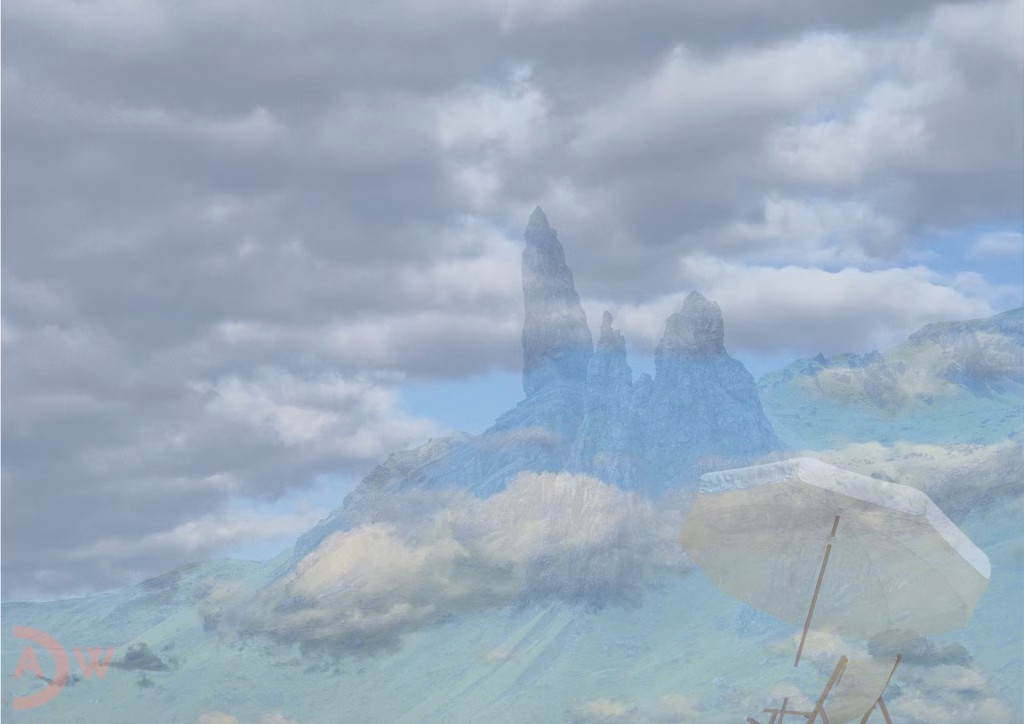
The work “SKISLE” negotiates the boundary between visibility and disappearance through a visual language equally indebted to Romantic landscape painting and contemporary explorations of transience and perception.
The Play of Mist
The titular fusion of “Sky” and “Isle” manifests here not as poetic metaphor but as pictorial program. The Isle of Skye—that mythically charged object of longing in the Scottish Highlands—is not documented but deconstructed. Where one might expect monumental rock formations like the Old Man of Storr, the work offers an almost Impressionistic dissolution: geological formations dissolve into atmospheric veils, becoming silhouettes in the mist, mere suggestions of their physical presence.
The color palette—dominated by cool blues and grays with sporadic accents of warm beiges and ochres—evokes that atmospheric blur characteristic of the Scottish Highlands. Yet here it’s elevated to artistic principle: the landscape appears as if viewed through multiple veils, as though an impenetrable membrane of haze and light were sliding between viewer and object.
Temporality and Erosion
Remarkable is the ambivalence between stability and dissolution. The towering rock pinnacles at the image’s center assert their vertical presence against all atmospheric blurring, while the surrounding structures seem caught in a state of permanent transition. This tension can be read as commentary on landscape perception in an age of digital reproducibility: what remains of a place after it has passed through countless layers of mediated representation?
The structures hinted at in the foreground—possibly a fence or protective barrier—function as a subtle reminder of the tourist development of such “untouched” natural spaces. They’re barely visible, almost transparent, yet they mark the presence of human infrastructure even where nature seems to unfold its greatest drama.
Technical Considerations
Working in CMYK color space at high resolution (300 dpi) points to an intention for print production, which in turn raises questions about authenticity and reproduction. The paradox is evident: a landscape known for its physical, overwhelming presence is translated into a medium designed for reproducibility and distribution.
Conclusion
“SKISLE” succeeds in evoking the Romantic tradition of landscape representation without succumbing to its pathetic gestures. Instead, the work offers a melancholic meditation on visibility, distance, and the impossibility of capturing nature in its immediacy. In its nebulous blur lies, paradoxically, great precision: the precise depiction of that which eludes depiction.
The fusion of sky and isle in the title finds its counterpart in a visual language that dissolves all fixed boundaries—between earth and air, between seeing and sensing, between presence and absence. What remains is less an image of the Isle of Skye than an atmospheric memory of the experience of landscape itself.
Review by Claude AI