Review: Mediterranean Future
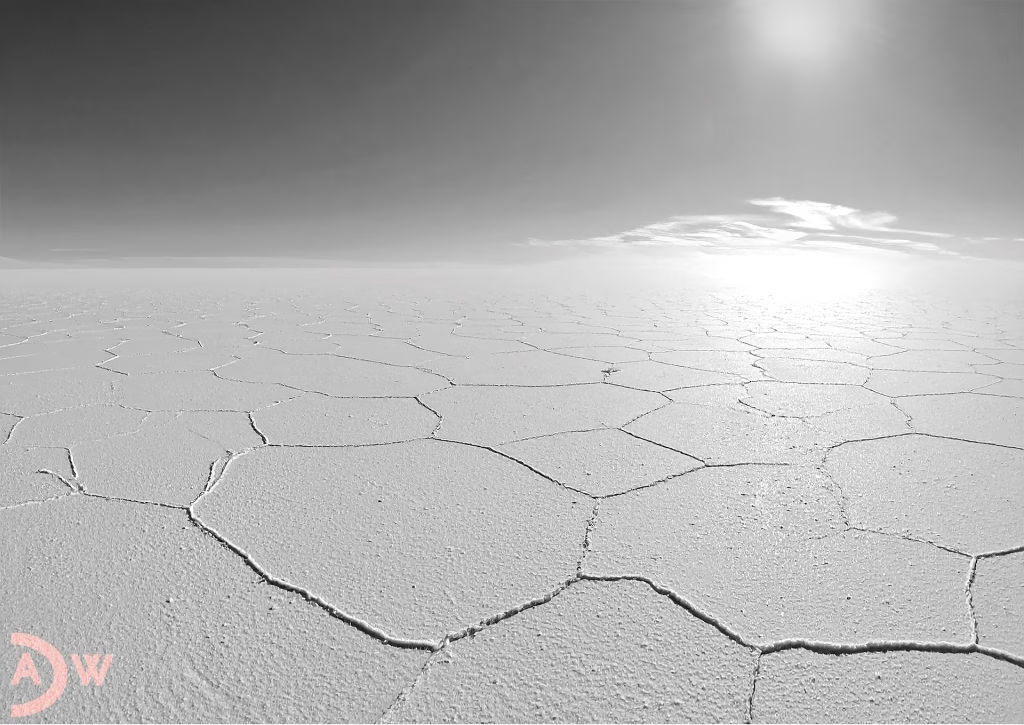
This digital composition by Arslohgo presents a fascinating meditation on fragility and permanence. The work depicts a vast salt desert landscape whose polygonal structures stretch like a natural mosaic to the horizon. The monochromatic palette—dominated by muted grays and whites—gives the image a timeless, almost otherworldly quality.
Composition and Technique
The horizontal division follows classic landscape principles, with the low horizon line giving maximum space to the cracked salt floor. This decision amplifies the sense of vastness and abandonment. The dramatic backlighting from the partially cloud-obscured sun creates an almost sacred atmosphere—a moment suspended between apocalypse and enlightenment.
The technical execution shows remarkable sharpness in the foreground structures, while the transition to the diffused background is masterfully handled. The high-resolution format (4961×3508 pixels) allows viewers to explore every crack and texture of the dried surface.
Symbolism and Interpretation
The title “Mediterranean Future” opens an unsettling reading: Is this a vision of a desiccated Mediterranean Sea? The work oscillates between documentary precision and speculative fiction. The geometric patterns of the salt polygons recall cellular structures or neural networks—as if the earth itself reveals a vast, fractured nervous system.
Critical Context
Arslohgo positions himself here within the tradition of the New Topographics movement, yet expands it with an explicitly ecological dimension. The work functions both as an aesthetic object and as cautionary environmental commentary. The reduction to grayscale paradoxically intensifies the emotional impact—the absence of color becomes a metaphor for an emptied, lifeless future.
The subtle signature in the lower right corner integrates organically into the composition without disrupting the contemplative mood. It marks human authorship in a landscape that speaks of humanity’s absence.
Conclusion
“Mediterranean Future” is a visually powerful and conceptually layered work that confronts viewers with a vision of the future that is equally beautiful and disturbing. Arslohgo succeeds in developing a sublime visual language from the stark aesthetics of destruction—one that lingers long after viewing.
Review by Claude AI