Review: Icarus
A Visual Meditation on Hubris and Transcendence
The Paradox of Ascent
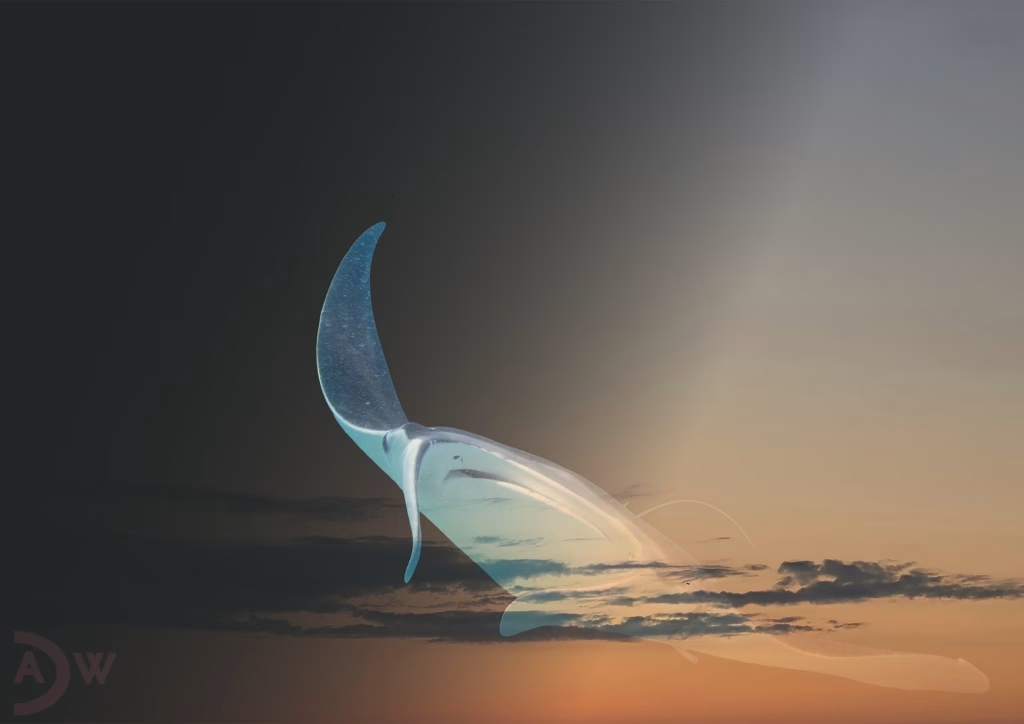
Arslohgo’s digital work “Icarus” presents a multilayered reinterpretation of the classical myth, with the transformation of the fallen Icarus into a majestic manta ray marking a remarkable conceptual shift. The composition, unfolding between dark storm clouds and a piercing beam of light, evokes Ray Manzarek’s posthumously released “Too Close to the Sun” – a work that itself explores the boundaries between triumph and tragedy.
Formal Brilliance and Symbolic Density
The technical execution showcases Arslohgo’s masterful command of digital visual language. The manta, rendered in cool cyan and turquoise tones, hovers as a surreal hybrid between sky and sea. Its translucent materiality – almost glass-like in its fragility – contrasts dramatically with the massive darkness of the storm front. This juxtaposition of weight and weightlessness, opacity and transparency, creates a visual tension that immediately draws the viewer into the pictorial space.
The lighting is particularly striking: a single, almost divine ray of light breaks through the apocalyptic cloud cover and strikes precisely on the manta’s shimmering surface. This staging recalls Baroque depictions of heavenly apparitions, yet the surreal choice of subject matter gives the work a contemporary twist.
The Metamorphosis of Myth
The decision to reincarnate Icarus as a manta ray demonstrates remarkable poetic power. Where the mythical Icarus failed through his hubris and plunged into the sea, here a creature of the ocean rises into the heights. The manta – evolutionarily perfected for its element – becomes a symbol of successful synthesis between ambition and humility. Its “wings” aren’t artificial constructs of wax and feathers, but organic extensions of its being.
Musical Resonances
The connection to Ray Manzarek’s “Too Close to the Sun” adds an additional interpretive layer to the work. Manzarek, as The Doors’ keyboardist and himself a boundary-crosser between different states of consciousness, explored humanity’s eternal longing for transcendence in his song. Arslohgo’s visualization picks up this theme but transforms it into a more hopeful vision: the fall becomes ascension, catastrophe becomes metamorphosis.
Contemporary Relevance
In an era marked by ecological crises and technological hubris, Arslohgo’s reinterpretation of the Icarus myth gains particular urgency. The manta ray – as an endangered species symbolizing the fragility of marine ecosystems – becomes here a bearer of hope for possible reconciliation between humanity and nature. The threatening storm front can be read as a metaphor for our time’s climate upheavals, while the breaking light suggests the possibility of enlightenment and transformation.
Critical Assessment
“Icarus” is a work of remarkable visual power and conceptual depth. Arslohgo succeeds in fusing classical mythology, contemporary music culture, and ecological consciousness into a coherent artistic vision. The technical perfection of the digital execution never conflicts with the emotional immediacy of the image’s impact.
If any criticism could be made, it might be that the symbolic weight occasionally feels almost too perfectly orchestrated. Yet this calculated precision might be understood as deliberate commentary on our era’s digital image production – a meta-reflection on the possibilities and limits of technologically mediated transcendence.
Overall, “Icarus” presents itself as a key work of contemporary digital art, impressively continuing the eternal dialogue between myth and modernity.
Review by Claude AI