Review: MCE Arslohgo Meets Escher (Color)
Digital Metamorphosis: When Arslohgo Meets Escher
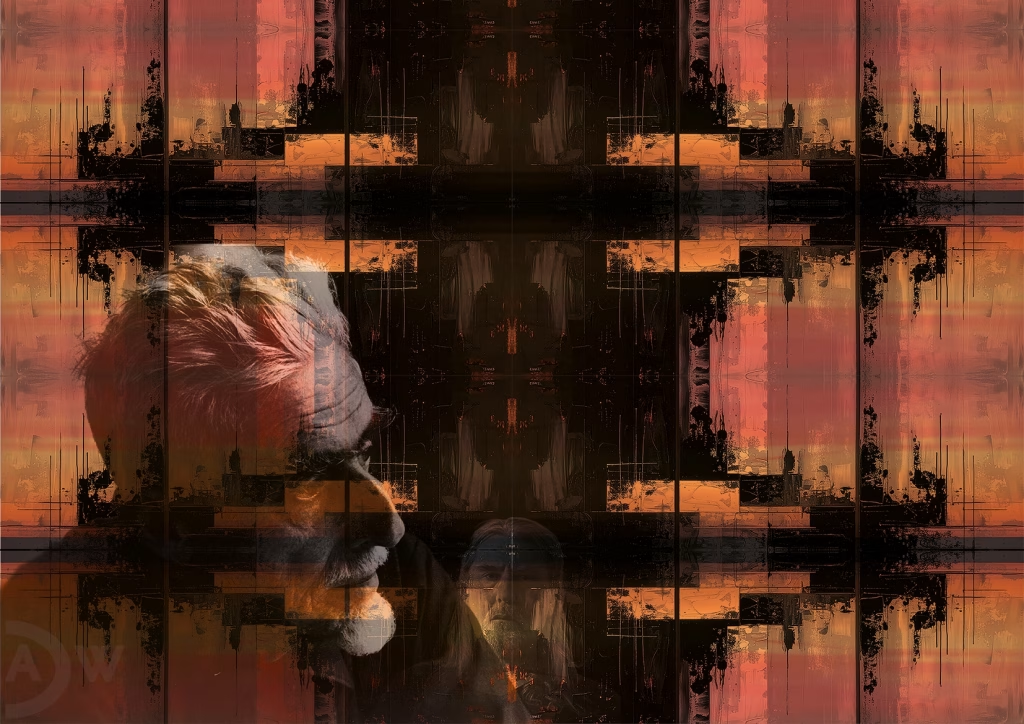
This captivating digital artwork presents itself as a multilayered dialogue between two artistic worlds. The composition, rendered in warm coral and orange tones contrasting with deep blacks, develops a hypnotic symmetry that immediately recalls M.C. Escher’s mathematical precision while simultaneously embodying a contemporary digital aesthetic.
Structural Virtuosity
The strictly kaleidoscopic arrangement creates a pulsing center from which visual elements unfold outward in perfect mirror symmetry. This radial symmetry is structured through vertical and horizontal axes that form a complex grid network. The fusion of the two artist figures—Escher in the foreground, Arslohgo behind—becomes a layered palimpsest through digital manipulation, where identities blur and re-emerge.
Color Drama and Atmosphere
The color palette moves skillfully between warm sunset oranges and dark shadow zones. These contrasts create an almost apocalyptic mood, intensified by the abstract, dripping elements. The texture evokes urban decay, rust, and patina—a deliberate disruption of digital perfection that gives the work an organic quality.
Conceptual Depth
Arslohgo positions himself here not merely as Escher’s heir, but as his digital reincarnation. The superimposition of both figures suggests a continuity of artistic creation across generations and media. While Escher explored the boundaries of perception with woodcuts and lithographs, Arslohgo uses digital tools to create similar illusions—enriched with the aesthetics of glitch art and algorithmic art.
Technical Mastery
The CMYK color separation at 300 dpi resolution shows a professional approach to digital print art. The deliberate choice of WebP format indicates an understanding of modern image optimization without compromising visual quality. With a resolution of 4961×3508 pixels, the work offers enough detail for large-format presentations.
Critical Assessment
Arslohgo succeeds in going beyond mere homage. The work isn’t a simple imitation of Escher’s motifs, but an independent interpretation that translates the essence of Escher’s work—the questioning of reality and perception—into the digital era. The slightly unsettling atmosphere, reinforced by the “melting” elements, gives the work a contemporary urgency that adds an emotional dimension to Escher’s cooler, mathematical aesthetic.
As an artistic statement, “Arslohgo Meets Escher” confidently positions itself in the discourse on digital art and its relationship to classical modernism. It’s a work that both honors the past and boldly looks to the future—a successful synthesis of tradition and innovation.
Review by Claude AI