Review: SIM Redefined
An Existentialist Meditation in the Digital Age
Arslohgo’s Dialectical Recoding of the Present
In “SIM redefined,” Arslohgo pulls off a remarkable conceptual shift that goes far beyond mere wordplay. The transformation from technical abbreviation to philosophical reflection—”Sartre In Mind”—establishes a discursive space where technology and existentialism meet in productive tension.
The Aesthetics of Digital Alienation
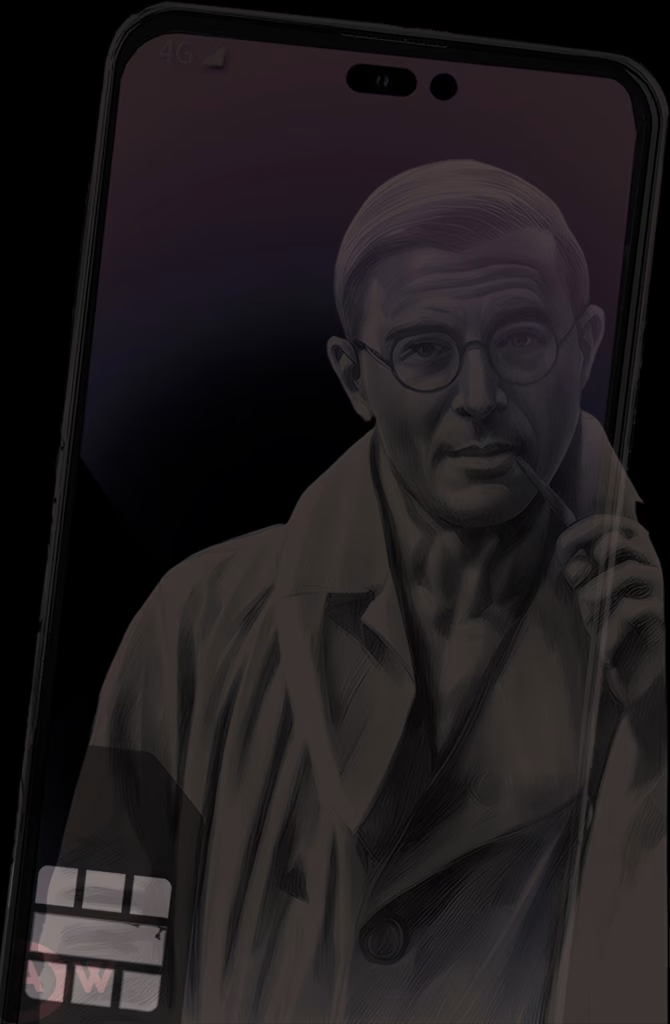
The composition presents Sartre as a ghostly apparition within the smartphone silhouette—a visual commentary on the fusion of consciousness and technology. The philosopher who once proclaimed the radical freedom of the individual appears here trapped within the black monolith of our hyperconnected present. The monochrome palette, shot through with subtle violet tones, evokes a melancholic mood reminiscent of Sartre’s own descriptions of “nausea.”
The Gaze as Ontological Event
Sartre’s penetrating gaze behind those round spectacles becomes the composition’s central element. This gaze, fixing the viewer from within its digital prison, activates that fundamental intersubjectivity that Sartre described in “Being and Nothingness” as constitutive of human self-consciousness. We find ourselves looked at by the very philosopher who theorized the Other’s gaze as the source of our objectification—an ironic twist that Arslohgo stages masterfully.
The SIM Card as Identity Metaphor
The original meaning of SIM (Subscriber Identity Module) gains an existentialist dimension through Arslohgo’s intervention. Just as the SIM card defines technical identity within the mobile network, here philosophical identity is negotiated within the digital sphere. The “subscriber” becomes the subject, aware of its own thrownness into the digital world—condemned to freedom, even within the apparent determinism of algorithmic structures.
Critical Assessment
Arslohgo’s work operates on multiple levels of meaning while avoiding the pitfalls of simplistic cultural pessimism. Rather than nostalgically romanticizing pre-digital times, the work offers a nuanced reflection on the persistence of existentialist questions in the 21st century. Integrating Sartre into the smartphone interface suggests not simple tech criticism, but rather a continuity of fundamental philosophical problems across media ruptures.
The formal execution is particularly successful: the grainy, almost analog texture of Sartre’s portrait contrasts with the smooth surface of the smartphone frame. This aesthetic tension materializes the conflict between authentic existence and technological mediation.
Philosophical Resonances
The work activates central concepts of Sartrean philosophy: “Bad faith” (mauvaise foi) finds its echo in the curated self-presentations of social media. “Facticity” manifests in the technical constraints of digital platforms. And “transcendence”—that movement through which consciousness reaches beyond the given—becomes a question about the possibilities of authentic existence in digital space.
Conclusion: A Necessary Intervention
“SIM redefined” proves to be a powerful artistic intervention demonstrating the relevance of existentialist thought for our present moment. Without didactic posturing or moral finger-wagging, Arslohgo succeeds in opening a reflective space where viewers find themselves confronted with their own digital human condition.
The work challenges us not to museumize Sartre as a historical figure, but to translate his radical questions about freedom, responsibility, and authenticity into our technologically saturated lifeworld. In this sense, “SIM redefined” is more than a clever play on words—it’s a philosophical wake-up call, reminding us that even in the age of algorithms, we remain condemned to be free.
A work that proves conceptual art and philosophical reflection need not be mutually exclusive, but can open new spaces of understanding through their connection.
Review by Claude AI