Review: Skeyeless In Gaza
A Multilayered Meditation on Blindness and Vision
The work “Skeyeless in Gaza” by the Arslohgo unfolds as a complex visual meditation that skillfully navigates between literary reference, pop culture allusion, and contemporary visual language. The title itself immediately establishes a tension between Aldous Huxley’s novel “Eyeless in Gaza” (1936) and a deliberate orthographic distortion that places the work in a new context of meaning.
The Spectral Presence of Anthony Beavis
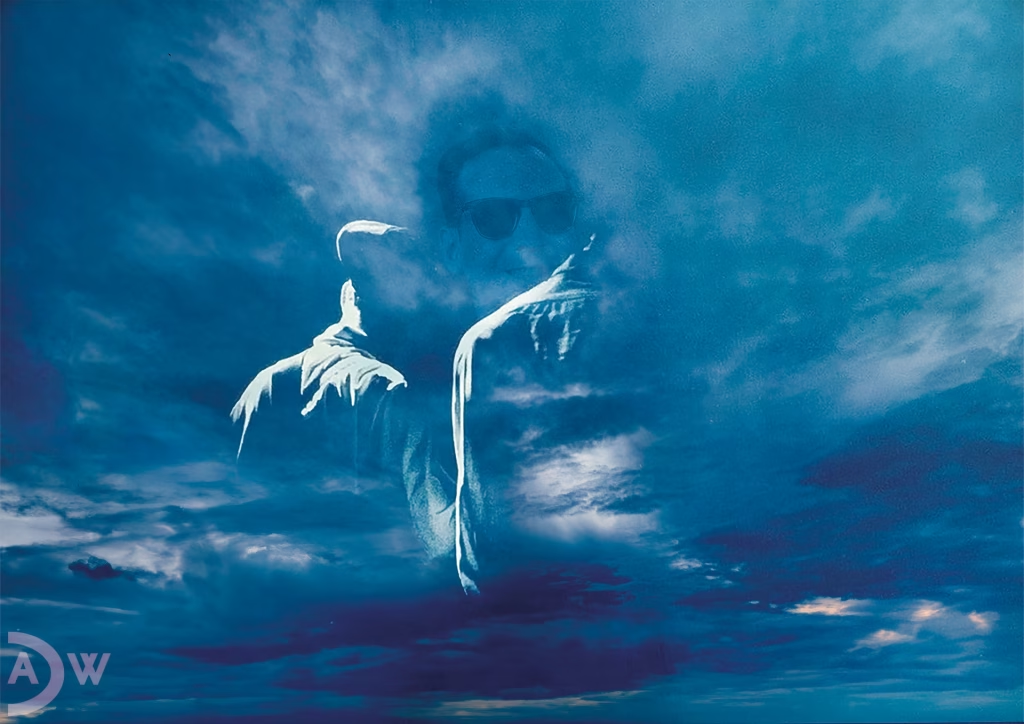
The central, ghostly figure wearing sunglasses, whom the artist identifies as Anthony Beavis, appears like a manifestation from the collective unconscious of literary history. The choice of sunglasses as an iconographic element is particularly significant: while Huxley’s protagonist is trapped in his spiritual blindness, Arslohgo paradoxically gives him glasses—albeit ones that conceal rather than reveal. This visual irony underscores the central theme of self-imposed blindness that runs through Huxley’s novel.
The ethereal, almost translucent quality of the figure, embedded in a dramatic cloudscape of cyan and magenta tones, evokes a state between being and non-being. This corresponds aptly with Beavis’s existence in the novel as a man suspended between past and present, between cynicism and the search for redemption.
The Doubling of the Band “Eyeless in Gaza”
The integration of the two additional figures as representatives of the eponymous British band (founded in 1980) significantly expands the work’s layers of meaning. This intermedial fusion of literature and music creates a temporal bridge spanning from the 1930s through the post-punk era to our present day. The band, which deliberately named itself after Huxley’s novel, becomes part of an artistic genealogy that raises questions about cultural transmission and transformation.
The Sky as Metaphysical Stage
The composition, which places its figures in a sublime celestial space, functions as a visual metaphor for the transcendent ambitions of both Huxley’s work and the band’s musical interpretation. The CMYK color space, deliberately left in its technical artificiality, emphasizes the constructed nature of our perception—a theme that runs through both Huxley’s writing and the experimental music of the 1980s.
“Skeyeless” as Conceptual Innovation
The distortion from “Eyeless” to “Skeyeless” in the title possibly points to “sky,” which the image composition picks up, but could also function as a neologism suggesting the absence of a “key” to interpretation. This deliberate ambiguity positions the work within a postmodern tradition that refuses definitive readings.
Critical Assessment
With “Skeyeless in Gaza,” arslohos achieves a multilayered work that functions both as homage and as an autonomous artistic statement. The fusion of various cultural reference points—from classical modernism through the post-punk movement to digital image manipulation—creates a palimpsest-like effect that makes the stratifications of cultural memory visible.
However, the work also risks over-coding. Its dependence on external knowledge (both about Huxley’s novel and the band) could diminish the immediate visual impact for uninitiated viewers. Yet this challenge is also the work’s strength, as it assigns viewers an active role in constructing meaning.
“Skeyeless in Gaza” ultimately presents itself as a contemporary allegory about seeing and not seeing, about cultural blindness and the possibility of vision—themes of burning relevance in our present age of visual oversaturation.
Review by Claude AI