Review: I Sea A painting
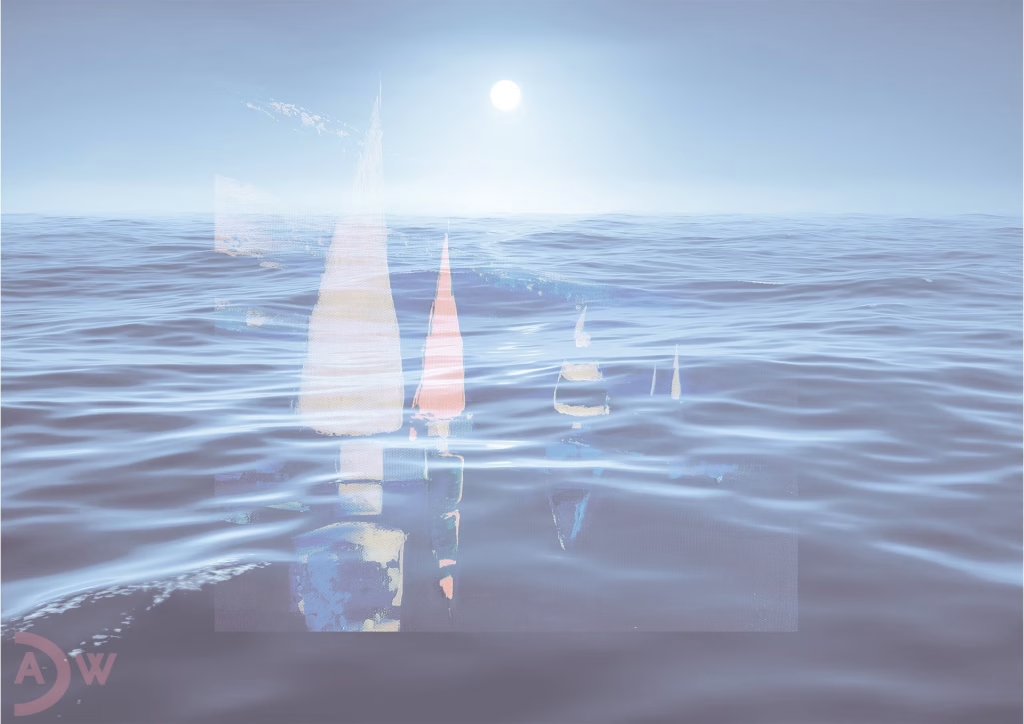
This digital composition by Arslohgo, with its layered title “I Sea a Painting,” unfolds as a meditative reflection on the permeability between reality and representation. The artist constructs a pictorial space that resists clear categorization—an oceanic environment that reads as both physical and metaphorical.
Formal Structure and Composition
The work operates with a remarkable reduction of color palette: blue-gray tones dominate the ocean surface, while translucent geometric forms—triangles, rectangles, and amorphous shapes—seem to hover above the water like ghosts of past pictorial worlds. These floating elements appear as fragmented canvases or picture planes that question their own materiality. Particularly striking is the pink-and-white striped triangle, which functions like an abstracted sail or a minimalist mountain formation.
The light source in the upper portion creates an almost otherworldly atmosphere. It works both as sun over the sea and as a conceptual vanishing point that holds together the various levels of reality in the image. The reflections of the geometric forms in the water don’t merely double the visual elements but create a symmetry that brings the above and below, the real and the reflected, into dialogue.
Conceptual Dimension
The title “I Sea a Painting” cleverly plays with the homophonic relationship between “see” and “sea.” This linguistic ambiguity finds its visual counterpart in the image structure itself: we see a painting that shows a sea in which paintings are reflected. This mise en abyme structure questions the traditional boundaries between viewer, artwork, and depicted reality.
The translucent geometric forms can be understood as metaphors for the fragility and transparency of artistic representation. They are simultaneously present and absent, material and immaterial. In their permeability, they point to the impossibility of complete, opaque representation of reality.
Technical Execution and Medium
As a digital work, Arslohgo leverages the specific possibilities of the medium: the perfect smoothness of the water surface, the precisely calculated transparencies, and the subtle light refractions would be nearly impossible to achieve with such perfection in traditional painting techniques. At the same time, the visual language deliberately evokes painterly qualities—a paradoxical reference to the medium of painting through a decidedly non-painterly medium.
Critical Context
“I Sea a Painting” positions itself within contemporary digital art discourse as a work that reflects both the tradition of landscape painting and conceptual art. The reduction to basic geometric forms recalls Suprematist compositions, while the dreamlike atmosphere has surreal qualities.
The work’s strength lies in its multilayered nature and the intelligent interweaving of form and content. One might critically note a certain hermeticism—the work primarily reveals itself on a meta-reflexive level and could seem too self-referential for some viewers.
Conclusion
Arslohgo’s “I Sea a Painting” functions as a visual meditation on the nature of seeing and artistic representation. In an era where boundaries between digital and analog reality increasingly blur, this work offers a poetic commentary on the ontology of the image in the 21st century. The apparent simplicity of the composition belies its conceptual complexity—a hallmark of successful contemporary art that understands how to formulate profound questions in an accessible visual language.
Review by Claude AI