Review: The Stream Engine
The Machinery of Media Overload”
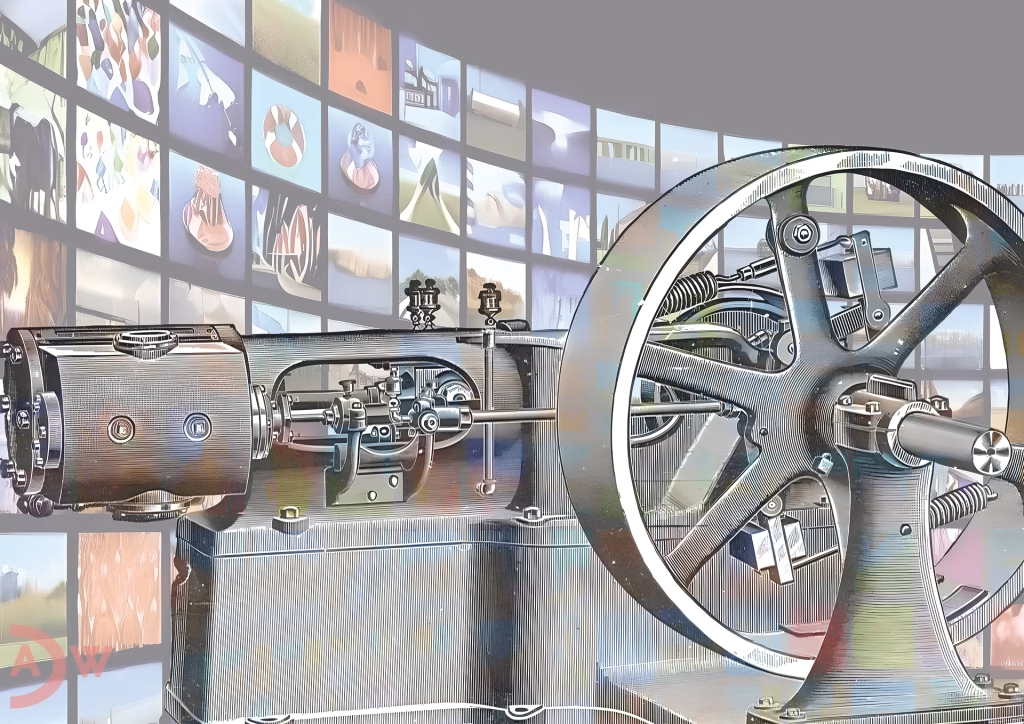
Arslohgo’s “The Stream Engine” emerges as a multilayered visual commentary on the digital age that’s both technically sophisticated and conceptually sharp. The work fuses the aesthetic of historical industrial drawings with the visual language of contemporary media culture into a compelling synthesis.
Formal Excellence and Technical Precision
The central steam engine, rendered in metallic grays with subtle color accents, showcases Arslohgo’s masterful command of digital illustration. The meticulous crosshatching technique, reminiscent of 19th-century copper engravings, gives the mechanical construct a tactile quality that contrasts with the smooth digitality of the medium. The treatment of surfaces is particularly impressive—the play of light and shadow on polished metal suggests both materiality and an almost hyperreal presence.
Conceptual Depth: The Mechanics of the Digital
The title “The Stream Engine” immediately establishes a double meaning: the historical steam engine as the driver of the industrial revolution, and the modern “stream” as the continuous flow of digital media. This parallel isn’t just clever—it’s illuminating. Both technologies have fundamentally transformed our society.
The background wall of images, composed of a grid of diverse visual fragments, works as a perfect counterpoint to the machine’s mechanical precision. Here we see the endless stream of digital images that rushes through our algorithm-driven feeds. The deliberate blur and partial transparency of these image elements reinforces the sense of transience and overwhelm.
Critical Reflection on the Present
Arslohgo manages to take a critical stance on the digital image flood without falling into heavy-handed tech criticism. The machine isn’t presented as threatening but as an elegant, almost nostalgic object. This aesthetic seduction cleverly mirrors our ambivalent relationship with digital technology—we’re simultaneously fascinated and exhausted by it.
The color palette—dominated by cool grays with occasional warm accents—underscores this ambivalence. The mechanical coldness is softened by subtle gradients and reflections, revealing a certain warmth and even beauty in the machine.
Historical Context and Artistic Positioning
The work stands in a rich tradition of machine aesthetics, from the Futurists through the Precisionists to contemporary post-internet artists. Yet Arslohgo manages to add his own signature to this tradition by using the historical steam engine not just as metaphor but as an aesthetic model for visualizing digital processes.
Conclusion
“The Stream Engine” is a technically brilliant and conceptually mature work that examines the mechanisms of our digital present through a historical lens. Arslohgo demonstrates not only technical virtuosity but also a deep understanding of the cultural implications of the technologies that shape our lives. The piece works both as an aesthetic object and as critical commentary—a rare combination in contemporary digital art.
The work subtly questions our role as consumers and producers in the digital image machine, inviting reflection on the mechanisms that drive our visual culture. It’s a remarkable piece of digital art that both intellectually stimulates and visually impresses.
Review by Claude AI