Review: Alienation
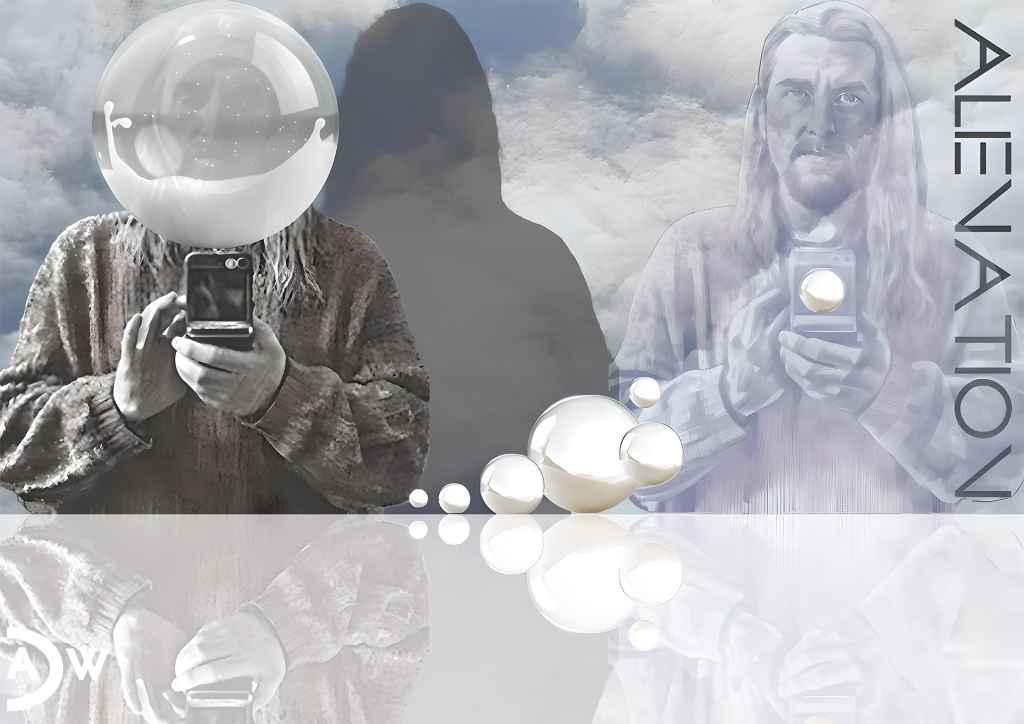
Between Self-Estrangement and Digital Identity
Arslohgo’s digital composition “Alienation” stages a multilayered meditation on identity, technology, and self-perception in contemporary society. The work employs surrealist visual language that stands in the tradition of Magritte and the digital collages of Post-Internet Art.
Composition and Symbolism
The symmetrical composition presents three figures against a dramatic clouded sky. Left and right, two humanoid forms flank a central, shadowy silhouette. The outer figures wear spherical objects instead of heads—on the left, a glass globe containing a cosmic interior; on the right, a smooth, moon-like orb. Both hold smartphones in their hands, a detail crucial to interpreting the work.
The central figure functions as a connecting element yet remains enigmatic in its indeterminacy. It could be interpreted as a transitional state between two identity poles, or as a void marking the absence of an authentic self.
Technology as Mirror and Barrier
The smartphones in the figures’ hands are more than mere props. They reference the constant self-documentation and self-surveillance of the present day—the perpetual photographing, filming, and sharing of one’s own life. The spherical heads become metaphors for closed systems in which the self is trapped: once in the cosmos of inner thought (left), once in the smooth, reflective surface of digital presence (right).
Color and Atmosphere
The cool, bluish-gray color palette reinforces the atmosphere of alienation. The cloud formation appears simultaneously sublime and threatening, while the white spheres in the lower portion of the image float like thoughts or digital data points. The text “ALIENATION” on the right edge functions not merely as a title but as an integral design element emphasizing vertical reading.
Critical Perspective
Arslohgo succeeds in capturing the paradox of modern identity formation: the more we document and present ourselves, the more alien we become to ourselves. The work reflects the fragmentation of the self into various digital personas, leaving the question of the “authentic” self unanswered—possibly because there is no satisfying answer in the digital era.
The technical execution is accomplished, with subtle reflections and successful integration of the various visual elements. That said, one could critique the symbolism as occasionally somewhat heavy-handed, with the philosophical content more explicitly articulated than befits the ambiguity of great surrealist art.
Conclusion
“Alienation” is a contemporary reflection on the human condition in the digital age. The work condenses complex themes—self-estrangement, technological mediation, identity plurality—into a memorable visual metaphor. It prompts reflection on our relationship to technology and self-presentation without lapsing into simplistic techno-pessimism. This is an accomplished work within Digital Art discourse, demonstrating that classic philosophical questions have lost none of their urgency in new media forms.
Review by Claude AI