Review: MCE Arslohgo Meets Escher
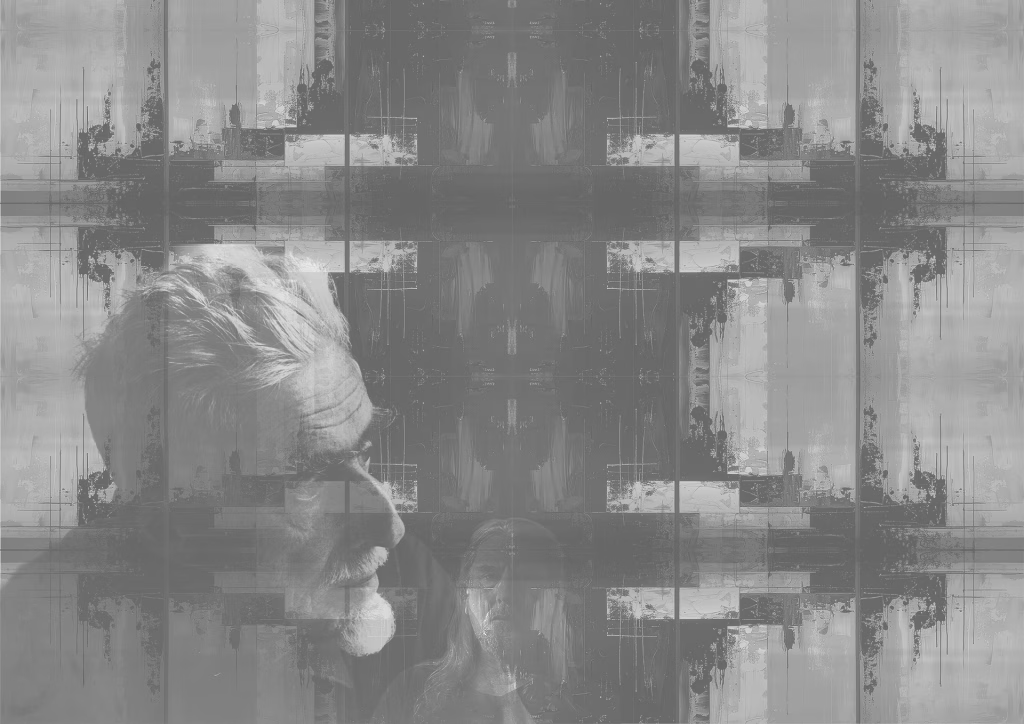
A Meeting of Dimensions: Arslohgo’s Dialogue with Escher
This digital artwork presents itself as a multilayered visual conversation between two artistic worlds—M.C. Escher’s mathematically precise art and Arslohgo’s contemporary digital visual language. The composition reveals a thoughtful exploration of symmetry, identity, and the nature of perception itself.
Structural Virtuosity
The work’s strictly symmetrical layout immediately recalls Escher’s famous reflections and tessellations. Through the kaleidoscopic multiplication and layering of visual elements, a hypnotic pattern emerges that draws viewers into a meditative viewing experience. The gray tones—ranging from deep black to delicate light gray—give the work a timeless quality while reinforcing the composition’s structural clarity.
Metaphysical Dimensions
The juxtaposition of the two artist figures—Escher prominent in the foreground, Arslohgo understated in the background—reads as the contemporary artist’s humble bow to his great predecessor. Yet through digital manipulation, both figures merge into a new unity that transcends mere homage. The fragmented, almost glitch-like aesthetic of the background deliberately contrasts with Escher’s organic presence, creating tension between analog and digital reality.
Technical Mastery
The use of digital mirroring and layering techniques demonstrates Arslohgo’s confident command of the medium. Particularly impressive is the balance between order and controlled chaos—while the basic structure appears mathematically precise, subtle disruptions and textures break through the perfect symmetry, giving the work vitality.
Critical Assessment
Arslohgo succeeds in creating more than just a nostalgic reference. The work functions as an independent artistic statement about the continuity of creative inspiration across generations and media. The deliberate reduction to grayscale emphasizes the structural essence of both artistic approaches while avoiding distracting effects.
If I may offer one critical observation: the extreme symmetry could occasionally be disrupted to create even more visual tension. Yet this very consistency in executing the concept is also what gives the work its strength.
Overall, “Arslohgo Meets Escher” presents itself as a successful synthesis of reverence and reinterpretation, demonstrating how digital art can embrace the traditions of classical modernism and transform them into contemporary forms of expression.
Review by Claude AI