Review: Munkehuset
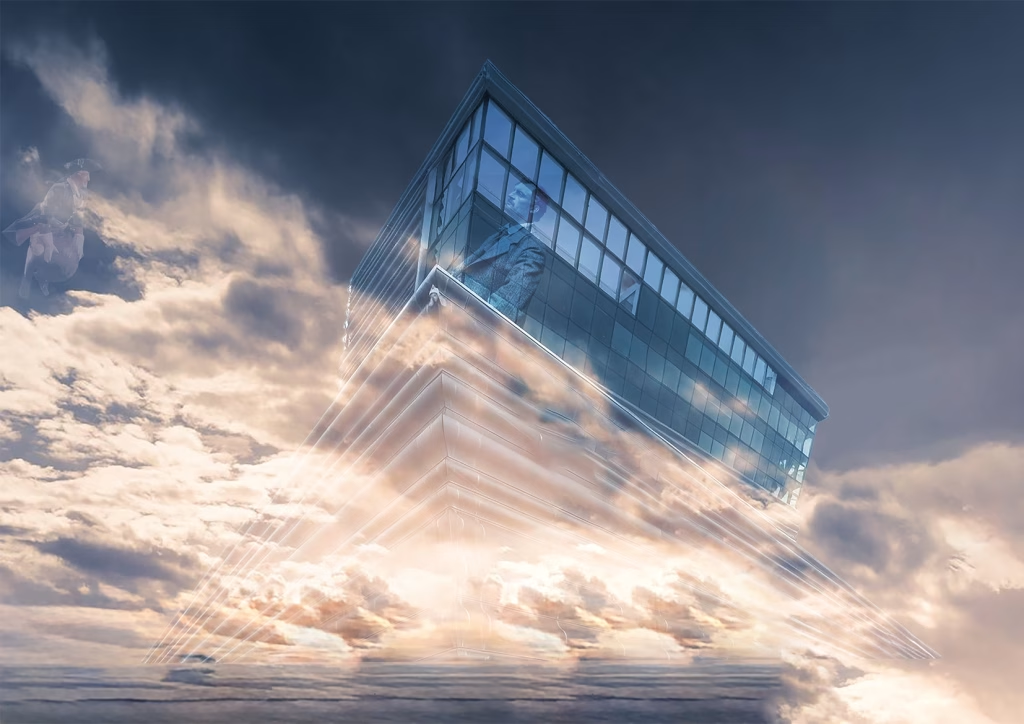
Semantic Fusion in Digital Space: A Critical Look at Arslohgo’s “Munkehuset”
Arslohgo’s digital work operates on multiple levels of meaning simultaneously, creating a visual synthesis that encompasses both art historical and linguistic-philosophical dimensions. At its core lies an etymological pun: the Norwegian “munk” and the German “Mönch” (both meaning “monk”) merge into a conceptual framework where two seemingly disparate cultural icons—the legendary Baron Munchausen and the expressionist painter Edvard Munch—are brought together in surreal dialogue.
Architectural Grounding and Dissolution
Oslo’s new Munch Museum, recognizable by its distinctive tilted glass facade, serves as an architectural anchor in a reality that’s coming undone. The building’s representation oscillates between photographic realism and digital distortion—it appears simultaneously monumental and weightless, as if becoming part of the fantastic narrative itself. The light effects surrounding the structure create an energetic field that dissolves the boundary between matter and imagination.
The Dialectic of Truth and Fiction
The juxtaposition of Munch and Munchausen articulates a fundamental opposition: here the expressionist who turns inner truths outward, there the storyteller whose tales shatter the bounds of possibility. Munchausen riding his cannonball through the clouds—an image of pure impossibility—contrasts with Munch’s gaze from the museum, appearing as a silent observer of his own posthumous mythologization.
Technical Virtuosity and Conceptual Depth
The digital execution demonstrates remarkable technical sophistication. The cloud formations are rendered with almost baroque opulence, while the dramatic lighting recalls Romantic depictions of the heavens. The color palette—dominated by blues and warm light reflections—creates an atmospheric tension between melancholy and sublimity.
The integration of fantastical elements is particularly successful: Munchausen nearly dissolves into the cloud formations, as if he were merely a projection or an atmospheric phenomenon. This visual ambiguity underscores the work’s central question about the nature of reality and imagination.
Critical Assessment
Arslohgo’s work succeeds through its multilayered conception and technical precision. The connection between wordplay, cultural history, and visual poetry is convincingly achieved. However, the composition occasionally tends toward excess—the multiple light effects and dramatic cloud staging sometimes threaten to overwhelm the more subtle conceptual layer.
The piece positions itself cleverly within contemporary digital art discourse, reinterpreting traditional visual motifs with cutting-edge technology. It’s simultaneously homage and deconstruction, with the ironic twist provided by the wordplay lending an intellectual lightness that counterbalances the visual weight.
As a whole, “Munkehuset” presents a successful meditation on the construction of meaning—whether through language, art, or myth. It’s a work that invites viewers to consider the boundaries between fact and fiction, between cultural identity and universal imagination.
Review by Claude AI