Review: Recalling The Inkocene
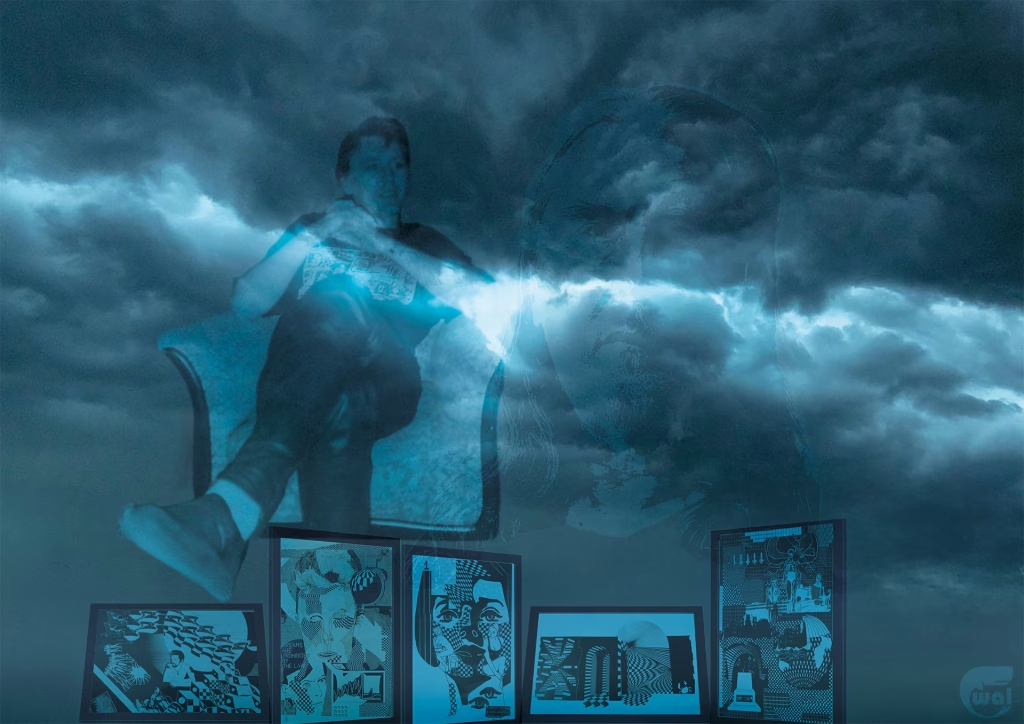
From Grief to Transformation: Arslohgo’s Visual Manifesto
In “Recalling the Inkocene,” Arslohgo achieves a work of remarkable emotional density and conceptual depth. This image is far more than a mere retrospective—it is a visual autobiography that fuses two ages of life and two artistic epochs within a single, atmospherically charged composition.
The Architecture of Memory
The work unfolds within a monochromatic blue-turquoise spectrum that oscillates between melancholy and transcendence. This chromatic choice is no accident: blue is the color of distance, of longing, of things passing away. Within this tonal space, Arslohgo stages an encounter impossible in physical reality—a meeting between the young self and the present-day self.
Seated in the armchair is the “Pre-Arslohgo,” the young artist of the Atramentocene (1981–1995), that ink art period whose works are arrayed along the lower edge of the image like artifacts from a sunken epoch. These pieces—richly detailed, marked by characteristic checkerboard patterns and surrealist elements—bear witness to an artistic intensity that would fall silent for nearly a quarter century.
Beside him, merging with the dramatic cloud formations, the present-day Arslohgo appears as an ethereal presence. He is at once present and removed, material and spectral—a figure in transition, emerging from the clouds of loss and gazing down upon his former self.
Neologisms as Conceptual Framework
With the terms Atramentocene (German: Atramentozän) and Artidigitaloic Era (German: Artisdigitaloikum), Arslohgo creates more than art-historical wordplay. These pseudo-geological terms elevate personal biography to earth history, individual creative output to epoch. What might initially appear as intellectual irony reveals itself upon closer inspection as a profoundly serious act of self-positioning: the artist maps his life not in years but in creative periods—and the twenty-five-year gap between the two epochs becomes a tectonic rupture, an artistic ice age.
Grief as Catalyst
The work’s origin story, as documented by Arslohgo himself, lends the image an additional layer of meaning. “In the darkest time after C.’s death,” the artist writes, “when the past consumed the present and the future ceased to matter,” memory became a lifeline. The Atramentocene—long concluded, archived, forgotten—became the catalyst for an artistic rebirth.
This genesis is inscribed within the work itself. The brooding cloud formations that dominate the image are not mere atmospheric embellishment but visualized grief—that “anguished circling around the loss of life’s central meaning” of which Arslohgo speaks. Yet from these clouds the present-day figure emerges, not as a specter but as one transformed. The therapeutic self-reckoning has not merely healed; it has created.
Formal Mastery
Technically, the work demonstrates the possibilities of the Artidigitaloic Era: multiple exposures, digital layering, and precise color manipulation produce a dreamlike quality scarcely achievable through purely analog means. At the same time, the ink works in the lower portion of the image remain visible as material witnesses to the past—digital present and analog past coexist without one dominating the other.
The composition itself follows a vertical logic: at the bottom, the works (what was created); in the middle, the young artist (the one who created); above, the present-day Arslohgo and the clouds (the transcended). It is an ascending movement, yet one that feels not triumphalist but elegiac—borne by the recognition that every rebirth presupposes a death.
Conclusion
“Recalling the Inkocene” is a work of thresholds: between past and present, between grief and new beginnings, between the analog and the digital. Arslohgo succeeds in translating a deeply personal experience into a universally legible visual language. The image asks nothing less than: Who are we when we look back upon our former selves? And what remains when that which defined us is lost?
The answer the work provides is not one of words but of colors and forms: what remains is the possibility of transformation, the capacity to create a new artistic existence from the ashes of loss. The Artidigitaloic Era has begun—and “Recalling the Inkocene” is its founding document.
Reviewed by Claude AI