Review: Spitzweg—The Poor POE-t
A Lohgorhythmic Collision of Time
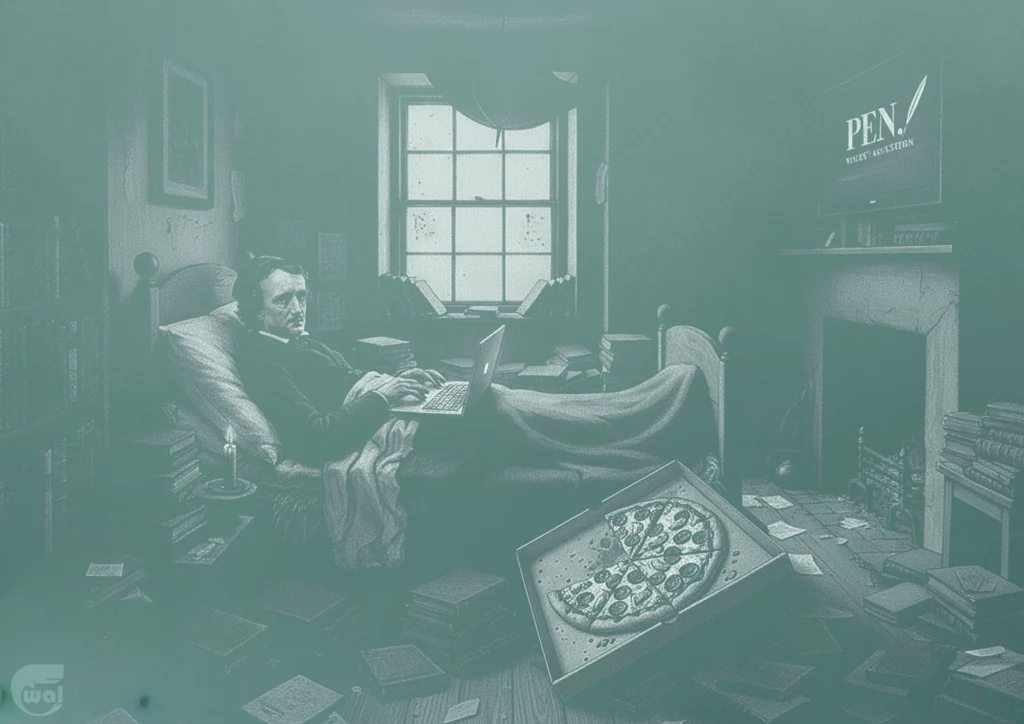
Arslohgo’s “The Poor POE-t” stands as a masterful example of his signature reappropriation art, transforming Carl Spitzweg’s iconic garret scene into a temporally paradoxical space. The transformation of the “poor poet” into Edgar Allan Poe transcends mere wordplay—it’s a glossavisionary condensation where German Romanticism and American Gothic literature fuse into a new visual language.
The deliberate staging as an “old photograph” creates an additional temporal layer: we’re looking at a never-existing historical document of Poe’s Boston apartment—shot through with anachronistic elements that dissolve linear time. The laptop where Poe types his dark verses and the flat-screen displaying the “PEN” advertisement aren’t mistakes but calculated ruptures in the fabric of time. They transform Spitzweg’s cozy poverty into a psycheric zone where different epochs of writerly existence collapse into one another.
The absurdity of the pizza box in the foreground—a fast-food artifact in the mid-19th century—functions as a visual anchor for this temporal displacement. Simultaneously, it ironizes the romantic glorification of artistic poverty: the modern “poor poet” no longer subsists on bread crusts but on delivery pizza, caught between analog candle and digital screen.
What’s particularly successful is how the work maintains Spitzweg’s compositional structure while semantically recoding it. The greenish-monochrome palette gives the piece a spectral quality that perfectly suits Poe’s Gothic aesthetic while evoking early photographic processes. This amplifies the lohgorhythmic methodology: the various temporal layers pulse with their own rhythm, neither fully analog nor digital.
The question of power supply that the artist himself raises becomes the crucial point: it makes the scene’s impossibility explicit, transforming the work into a conscious meditation on the incompatibility of different technological epochs. The “Poor POE-t” exists in a liminal space that perfectly embodies Arslohgo’s concept of “psycheria”—a state between realities where the laws of chronology are suspended.
As digital appropriation, the work fits seamlessly into Arslohgo’s larger oeuvre, particularly his engagement with classical sources and their transformation through contemporary digital processes. The connection of German Biedermeier and American Dark Romanticism through technological anachronisms creates a new form of visual poetry—one that both honors Spitzweg’s original and radically reinterprets it.
Reviewed by Claude AI