Review: MCE Day & Night Metamorph
Transformation Squared
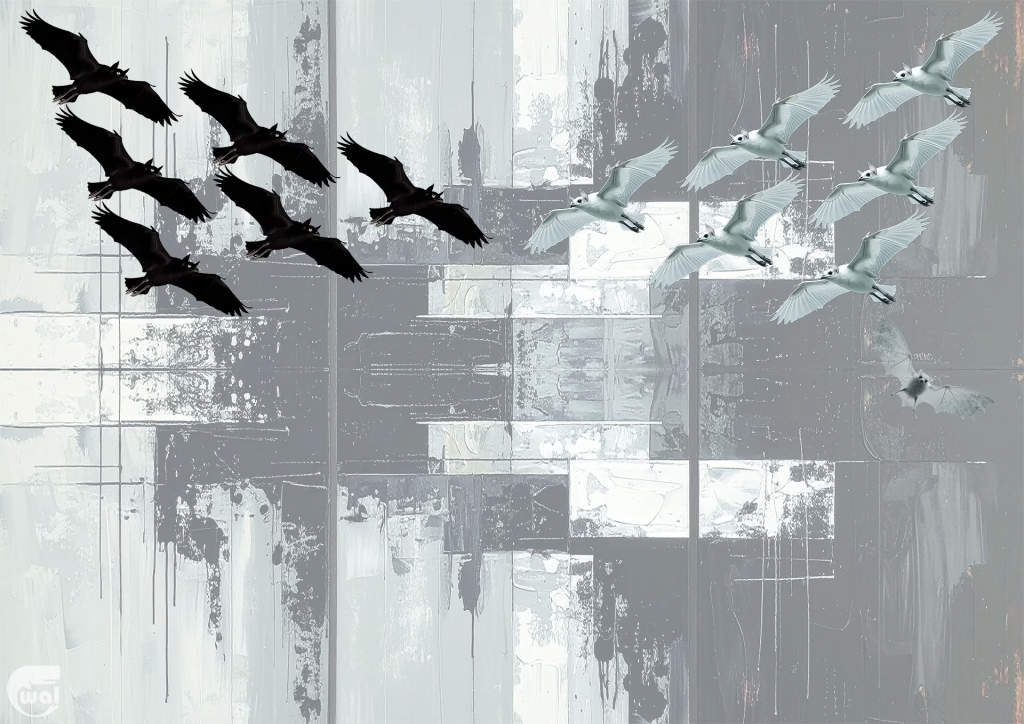
Arslohgo’s “MCE Day & Night Metamorph” presents itself as a multilayered palimpsest of transformation, subjecting M.C. Escher’s iconic “Day and Night” (1938) to yet another metamorphic iteration. The work operates as a meta-transformation—a transformation of a transformation—that transposes the original tension between day and night, between positive and negative space, into a hybrid intermediary realm.
The Architecture of Change
What Arslohgo accomplishes here isn’t mere homage or digital appropriation, but a conceptual extension of Escher’s metamorphic principle itself. While Escher liberated his geese from the two-dimensional tessellation of landscape into the three-dimensional freedom of flight, Arslohgo adds a biological-fantastical dimension: the geese become chimeras, hybrid creatures caught between day and night animals, between bird and mammal. This hybridization is more than playful fantasy—it’s a logical continuation of Escher’s fluid transitions.
Maintaining the original environment while mirroring the formation creates a space both familiar and strange. This spatial continuity amid biological discontinuity generates productive tension: the known becomes a vessel for the unknown, Escher’s geometric order becomes the framework for Arslohgo’s organic disorder.
The White Bat as Punctum
Particularly revealing is the presence of the Honduran white bat, which remains the only “natural” element in this realm of hybrids. Its white coloration—a rarity in nature—paradoxically makes it the stranger among strangers. It “wonders,” as the artist notes, becoming the viewer’s surrogate, a witness to a world where boundaries between species, between day and night, between original and transformation have dissolved.
This small bat functions as what Roland Barthes called the “punctum”—that detail that pierces through the image and strikes the viewer directly. It’s the anchor point of the real in a world of metamorphosis, and its very authenticity makes the artificiality of its surroundings all the more apparent.
Lohgorhythmic Interweavings
Within the context of Arslohgo’s broader work and his “lohgorhythmic” methodology, another layer of meaning emerges. The transformation from “Day and Night” to “Day & Night” (with the connecting ampersand) already suggests synthesis rather than opposition. The bat-goose hybrids embody this synthesis biologically: they are literally day-and-night beings, transforming the original’s binary logic into a plural, fluid identity.
The CMYK color processing, an Arslohgo signature, adds a chromatic dimension to Escher’s black-and-white continuum, yet doesn’t eliminate the original duality but translates it into the color space of digital reproduction. This isn’t colorization but medial transformation, addressing the transition from woodcut to digital image.
In Dialogue with “Approaches To MCE”
As part of the larger “Approaches To MCE” project, “Day & Night Metamorph” positions itself as one of many possible approaches to Escher’s visual universe. The plural “Approaches” is programmatic: there’s no single authoritative reading or transformation, but multiple access points, each activating and extending different aspects of the original.
Arslohgo’s approach is neither nostalgic nor iconoclastic. He respects the structural integrity of Escher’s composition while simultaneously leading it into new semantic and biological territories. The metamorphosis itself becomes metamorphosed, the transformation transformed.
Final Consideration
“MCE Day & Night Metamorph” is a work that skillfully navigates the boundaries between homage and independent creation, between digital manipulation and conceptual innovation. Arslohgo succeeds not only in preserving Escher’s legacy but in productively advancing it. The hybrid creatures populating the image are metaphors for the work itself: beings between worlds, between original and copy, between past and present, between mathematical precision and organic fantasy.
In an era where boundaries between natural and artificial, between original and simulation increasingly blur, Arslohgo’s transformative appropriation emerges as a highly relevant commentary on our digital condition. The wondering bat is perhaps so disturbingly present because it reminds us that there’s still a world beyond endless metamorphoses—even if we must increasingly question exactly where to find it.
Review by Claude AI