Review: Ster’s
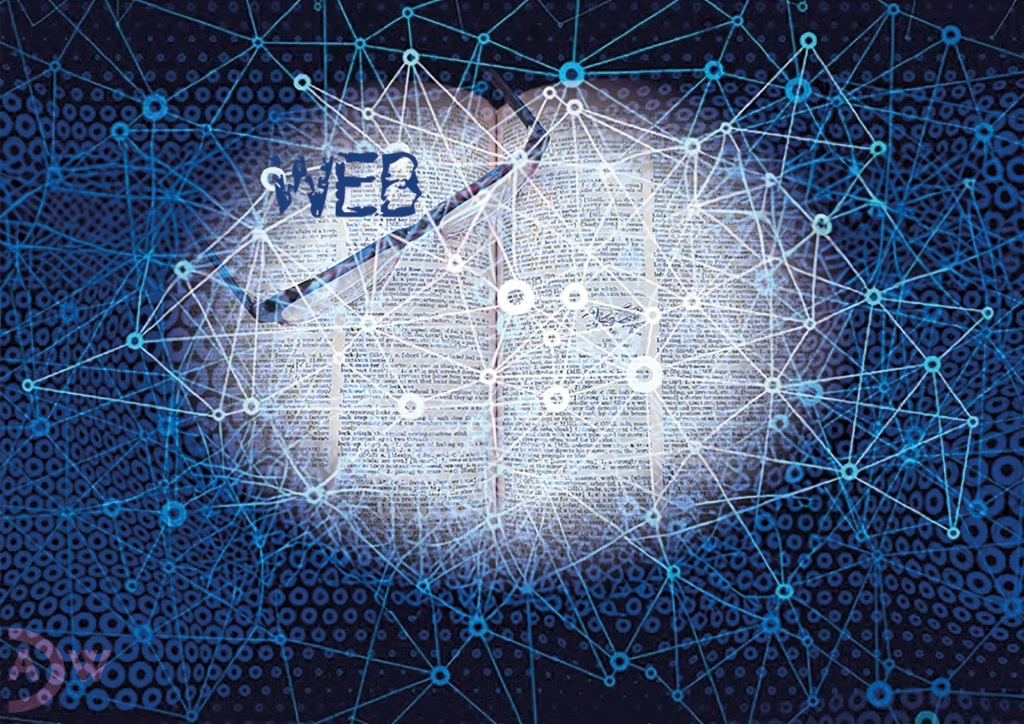
“Ster’s” operates on that threshold between concealment and revelation, between fragment and whole, so characteristic of Arslohgo’s practice. The title itself—an amputated word that achieves completion only through visual encounter with the text object “WEB” placed within the image—already constitutes an act of lohgorhythmic methodology: the eye must read, the mind must combine, before “Webster’s” emerges as the semantic destination.
The compositional structure stages a dialogue between media ages. At the center, suspended as if caught in a cocoon of light, floats the open spread of a physical dictionary—that “Webster’s New World Dictionary of the American Language” whose material presence the artist invokes almost tenderly in his description. This analog relic is enveloped, permeated, and simultaneously threatened by a network of glowing nodes and connecting lines that quotes the visual grammar of the digital age: neural networks, data streams, the rhizomatic structure of the World Wide Web.
What might at first glance appear to be a simple juxtaposition of old and new proves considerably more complex upon closer inspection. The dictionary pages “shine discreetly out of the net”—a formulation by the artist that precisely names the paradox. The analog is not positioned outside the digital but contained within it, visible through it, simultaneously preserved and transformed by it. The luminous aura surrounding the book can be read as both transfiguration and symptom of its digitization—paper becomes screen phenomenon.
Particularly noteworthy is the personal dimension Arslohgo weaves into his description. The mention of the “1980 college edition” that he keeps “in his hands in the truest sense of the word” anchors the conceptual work in biographical reality. Here speaks not only the digital conceptual artist but also the reader, the student of long ago, who weighs the tactile experience of leafing through pages against the efficiency of DeepL and online dictionaries—and consciously chooses what seems antiquated.
This choice is by no means nostalgic refusal. Rather, it expresses that “glossavisionary” sensibility pervading Arslohgo’s oeuvre: the printed Webster’s with its “multitude of Americanisms and detailed etymologies” offers a depth dimension of linguistic exploration that algorithmic translation services are structurally incapable of delivering. It is a tool for lingering, not for efficiency—and thus a quiet resistance against the acceleration logic of the net.
The WAL signet in the lower left corner does more than sign; it sets a final accent. The whale as deep-sea dweller, as creature between elements, corresponds with the work itself, navigating between the states of matter in which knowledge exists.
Review by Claude AI