Review: Kashmere
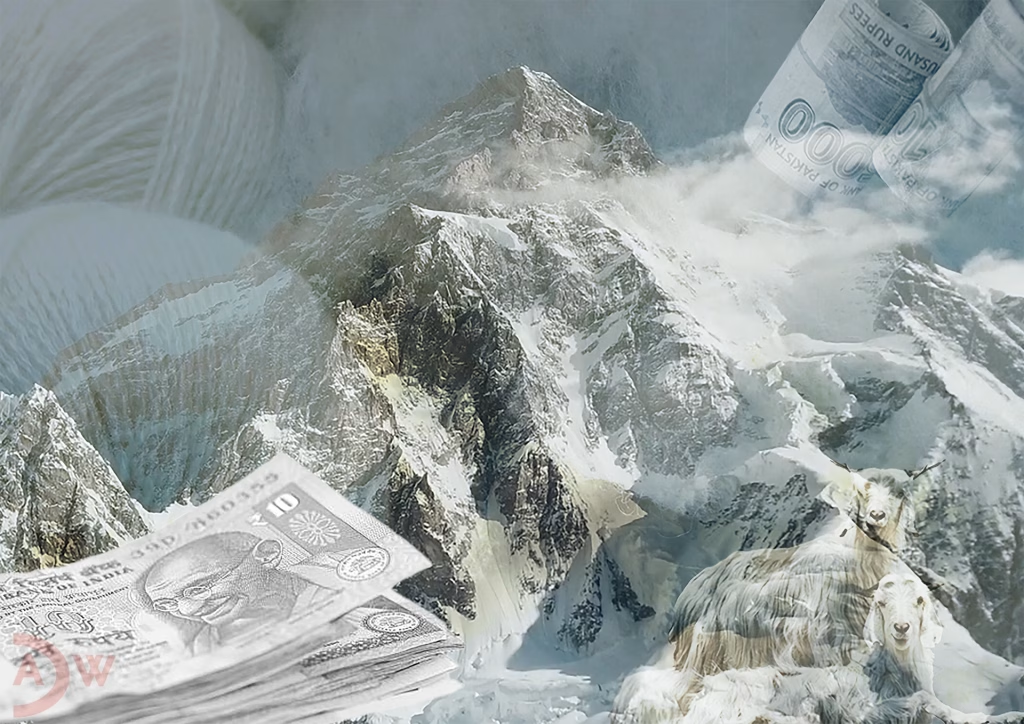
Capitalist Altitude in Alpine Monetary Landscape
Arslohgo’s “Kashmere” stages a startling collision between the sublime monumentality of the Himalayas and the mundane materiality of money. The title itself operates as a linguistic montage, merging Kashmir—that contested region between India and Pakistan—with cashmere while allowing the English “cash” to shimmer through. This neologism is programmatic for the entire work: it’s about the refinement of conflict into luxury, the transformation of geopolitical tensions into consumer goods.
The composition employs a sophisticated layering technique where banknotes glide like tectonic plates across the mountain landscape. The rupee bills—recognizable by their distinctive typography and ornamentation—morph into semi-transparent glaciers of capital that overlay what appears to be K2 or one of its neighboring peaks. This interpenetration of nature and currency creates a visual metaphor for the commodification of landscape itself.
Particularly striking is the integration of the Kashmir goat as an iconic element. The animal appears here not as a bucolic motif but as a production unit within a globalized value chain. The goat, whose undercoat ranks among the world’s most expensive textile fibers, becomes a symbol for the extraction of luxury from barren highlands. Arslohgo makes visible how the extreme climatic conditions that produce the animals’ fine undercoat are fed into the circulation of international luxury markets.
The color palette—dominated by grays and blues with occasional gold accents—evokes both the coldness of the high mountain region and the sterility of banknote printing processes. The CMYK halftone pattern, visible upon closer inspection, underscores the mechanical reproduction process of both money and the digital image itself.
“Kashmere” can be read as a critical commentary on the romanticization of both mountain wilderness and luxury consumption. The superimposition of currency and wilderness deconstructs the idea of untouched nature, revealing it as a thoroughly economized zone. At the same time, the work points to the complex entanglements between local subsistence economies (goat herding), international trade routes, and the fetishization of natural fibers in Western luxury markets.
The work’s ambiguity lies in its aesthetic seductiveness: despite or precisely because of its anti-capitalist reading, “Kashmere” possesses a seductive surface quality reminiscent of luxury advertising. This tension between critique and complicity makes the piece an exemplary instance of contemporary art that reflects on its own entanglement in the very mechanisms it purports to critique.
Review by Claude AI