Review: PD/Psycho Drapes
The Threshold Between Observer and Observed
In “PD/Psycho Drapes,” Arslohgo stages a multilayered psychoanalytic tableau that systematically deconstructs the boundaries between self and other, between analysand and analyst. The title itself establishes a complex system of references: “PD” as per diem points to the temporary, transitory nature of psychic journeys, while the allusion to David Byrne’s “Psycho Killer” inscribes an undercurrent of violence into the process of self-discovery.
Architecture of Repression
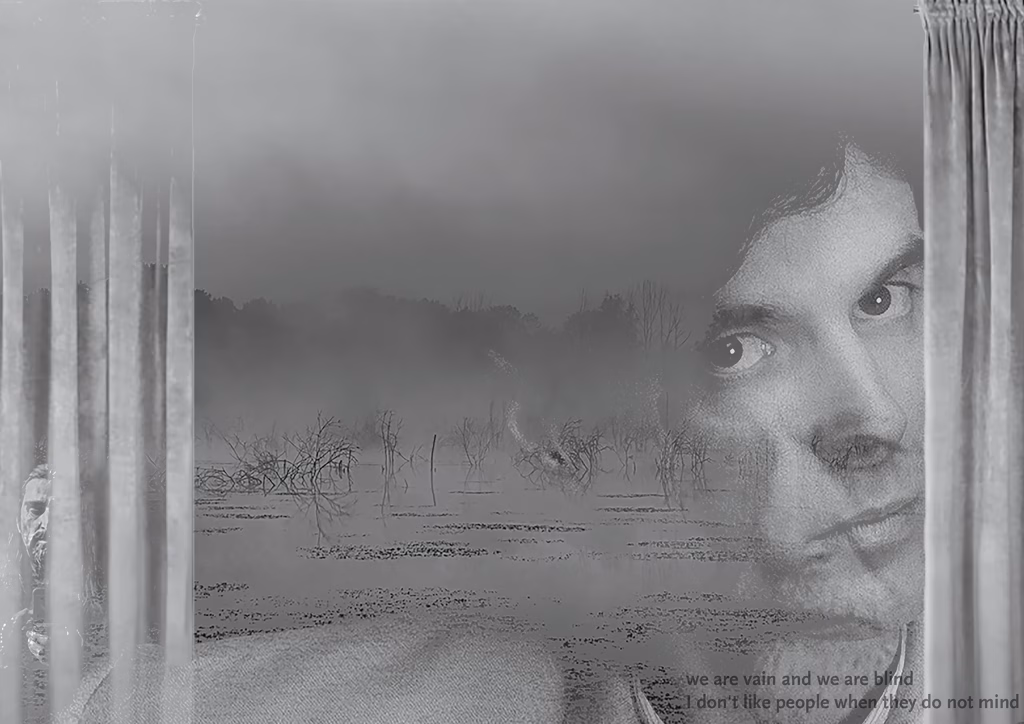
The work’s formal composition operates through a sophisticated splitting of the pictorial space. On the left, Arslohgo manifests himself, fragmented and simultaneously veiled and revealed by vertical curtain structures. These drapes function not as mere barriers but as liminal space—a threshold zone reminiscent of Lacan’s concept of the veil, behind which the objet petit a conceals itself. The curtains become a metaphor for the psychoanalytic situation itself: they conceal and reveal simultaneously, creating distance while enabling intimacy.
The Freudian Palimpsest
Arslohgo achieves particular virtuosity in merging Freud and David Byrne in the right area of the image. From Byrne’s facial features emerges the visage of psychoanalysis’s founder—a morphological superimposition that goes far beyond mere visual trickery. Here, the Talking Heads line “Psycho Killer, qu’est-ce que c’est” becomes a fundamental question about the nature of the psychic apparatus itself. The fusion suggests that every attempt at self-analysis is inevitably filtered through the cultural and theoretical sediments that shape our understanding of the unconscious.
Landscape of the Unconscious
The middle ground opens onto a barren, wintry landscape—a psychic topos evoking the desolation of the inner world. The skeletal trees function as visual metaphors for the branching structures of neural and psychic networks. This intermediate zone between the two protagonists becomes the actual site of the analytic encounter, a no-man’s-land of the unconscious where transference and countertransference perform their complex choreography.
Textual Intervention
The fragments inscribed at the bottom edge—”we are vain and we are blind / I don’t like people when they do not mind”—break through the visual plane and introduce an additional dimension of meaning. These lines, presumably from Byrne’s work, articulate the fundamental ambivalence of human relationships and the narcissistic wound inherent in any analytical self-inquiry. Vanity and blindness are declared fundamental constants of the human condition.
Digital Reflexivity
Arslohgo succeeds in making digital image manipulation itself a subject. The visible artifacts of manipulation, the grainy texture, and the spectral quality of the superimpositions point to the constructed nature of all identity. The work thus reflects its own conditions of production, making technological mediation an integral part of its aesthetic and conceptual statement.
Conclusion
“PD/Psycho Drapes” emerges as a complex meditation on the impossibility of authentic self-knowledge in a world saturated with cultural codes and psychoanalytic discourses. Arslohgo orchestrates a visual essay that interweaves the violence of introspection (“Psycho Killer”) with the everyday banality of psychic work (“per diem”). The work refuses any singular reading, insisting instead on the fundamental ambiguity that characterizes every attempt to map one’s own unconscious. Paradoxically, this refusal is where its greatest analytical precision lies.
Review by Claude AI