Review: Mo(o)nsun
Between Intimacy and Apocalypse
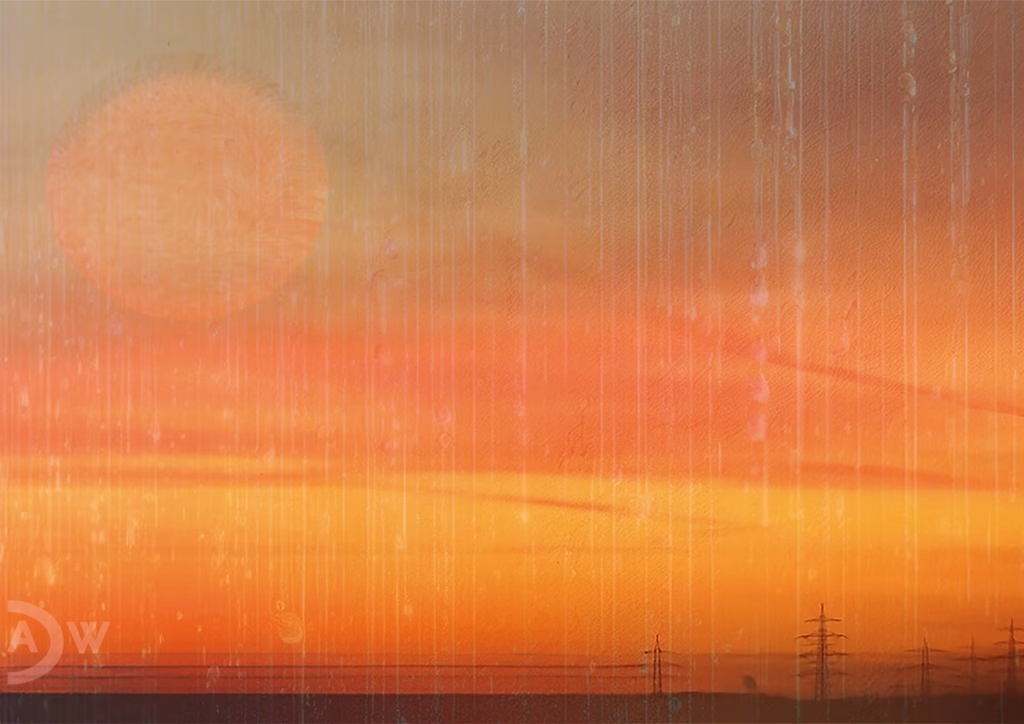
Arslohgo’s “Mo(o)nsun” confronts us with a perceptual paradox: the monumental force of a monsoon, captured through the intimate frame of a kitchen window. This deliberate tension between the cosmic and the domestic runs through the entire work like a red—or rather, orange—thread.
The Dissolution of Celestial Bodies
The title itself sets the agenda: the typographic fusion of “Moon” and “Sun” into “Mo(o)nsun” finds its visual counterpart in the chromatic dissolution of both celestial bodies. Neither moon nor sun appears as a distinct form; instead, they merge into a glowing continuum that permeates the entire pictorial space. This dissolution of astronomical order in favor of meteorological totality points to a fundamental shift: our world is no longer structured by the reliable cycles of day and night, but by the unpredictable forces of climate change.
The Window as Filter
The white vertical disruptions—raindrops on the kitchen window—function as a double marker: they locate the viewer in the protected interior while simultaneously making the boundary between inside and outside permeable. These drops aren’t romantic signs of nature but digital glitches that transform the natural spectacle into a data phenomenon. The verticality of the droplet traces evokes both falling rain and crashing data streams—an ambivalence characteristic of Arslohgo’s work.
Chromatic Catastrophe
The color palette—a continuous spectrum from orange to ochre—creates an unsettling warmth. This isn’t a romantic sunset but a feverish vision where the atmosphere itself seems to burn. The CMYK color separation, hinted at in the technical specifications, becomes a metaphor for breaking down natural phenomena into their technical components. Nature appears as printed matter, as reproducible catastrophe.
The Horizon Line as Final Refuge
At the bottom edge, a landscape emerges—power lines traverse the horizon like skeletal remains of a technical civilization. This minimal grounding of the otherwise boundless color event acts as a final point of orientation in a world where elementary distinctions—day/night, rain/sun, sky/earth—are collapsing.
Conclusion: Domesticated Apocalypse
“Mo(o)nsun” achieves a disturbing synthesis: the apocalypse, viewed through a kitchen window, becomes an everyday phenomenon. Arslohgo doesn’t stage the spectacular end but rather its creeping normalization. The raindrops on the window become pixels of a new reality where the boundary between natural disaster and screen surface blurs.
The work operates precisely at the intersection of our current crisis: we observe climate catastrophe through the filters of our screens, from the supposed safety of our interiors, while outside the categories blur and the world sinks into an orange continuum. Here, art doesn’t offer comfort but serves as an uncomfortable reminder that even the kitchen window no longer represents a real boundary.
Review by Claude AI